
Orangutan seized in Thane reported repatriated to Indonesia under CITES
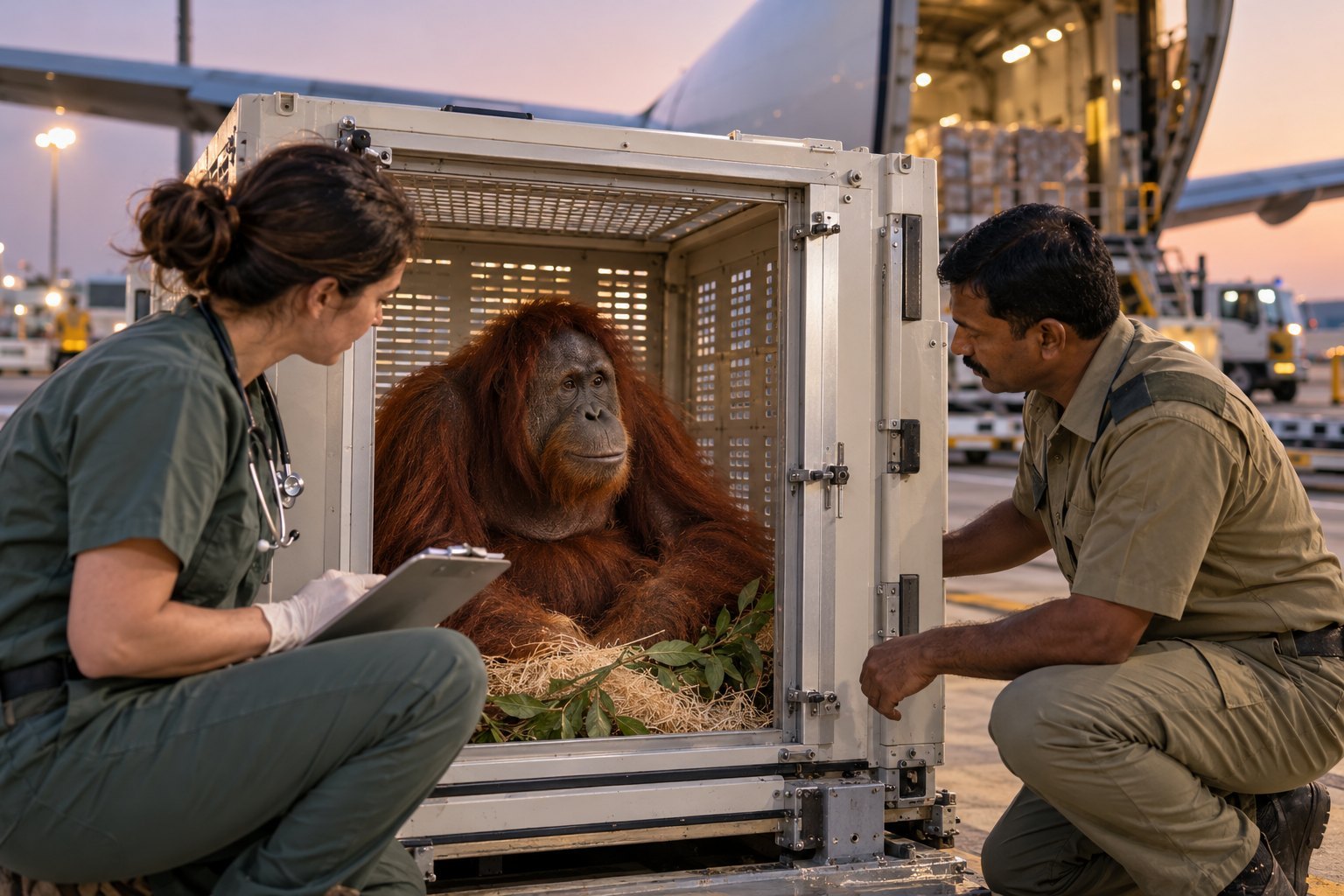
A male orangutan seized from a Dombivli flat in Thane district in November 2024 reached Jakarta, Indonesia, on 19 October 2026, reports say, likely the first return of a wild animal rescued in India to its home country. Wildlife Crime Control Bureau officials supervised the flight from Ahmedabad. Orangutans are listed in CITES Appendix I.
Syllabus: Prelims · Environment & Ecology; GS3 · Environment & Conservation; GS2 · Groupings & Agreements
Why this matters for UPSC
GS3 conservation and border security: Prelims can ask about CITES Appendix I, Schedule IV and the Management Authority under the Wild Life (Protection) Act, 1972, and the Wildlife Crime Control Bureau; Mains, about wildlife trafficking across the India-Myanmar border.
Why it matters
A family tempted to buy a baby ape or a python as a pet is paying for a chain that conservationists say often begins with poachers killing the mother to take the young, and Customs officials say many baby primates flown into India die on the way. A rescued animal is not simply left in the nearest zoo: it is treated, held and, where possible, sent home, which took two governments almost two years here. Returning it helps the source country protect a shrinking wild population and trace the network that moved it. The larger issue is organised wildlife trafficking that uses India as both a market and a transit route, and whether enforcement can follow the network instead of only rescuing animals.
Prelims pointers
- CITES: signed at Washington D.C. on 3 March 1973 and amended at Bonn on 22 June 1979, as section 49D of the Wild Life (Protection) Act, 1972 records.
- Section 49J: importing an Appendix I specimen needs an Indian import permit plus the exporter's export permit or re-export certificate, and cannot be for primarily commercial purposes.
- Section 49M: anyone holding a living Schedule IV animal must report it, and its transfers, births and deaths, to the Management Authority, which issues registration certificates.
- Section 38Y: the Director of Wildlife Preservation is the WCCB's ex officio Director; an Inspector-General of Police is Additional Director, with police, forest and customs Joint Directors.
- Section 38Z: the WCCB collects intelligence on organised wildlife crime, keeps a centralised wildlife crime data bank and helps implement India's international wildlife conventions.
- Section 51 since 2022: an offence on an Appendix I specimen carries three to seven years' imprisonment and a fine of at least Rs 25,000, as for Schedule I animals.
- MoEFCC advisory, released 11 June 2020: holders of exotic live species could declare them to the State Chief Wildlife Warden on the Parivesh portal; import licences come from the DGFT.
- Orangutans: great apes native only to Indonesia and Malaysia; the Sumatran and Tapanuli species live only on Sumatra, the Bornean in Indonesian and Malaysian Borneo.
Practise a UPSC-style question
With reference to the Convention on International Trade in Endangered Species of Wild Fauna and Flora (CITES), consider the following statements:
1. The Convention was signed at Bonn in 1979.
2. Importing an Appendix I specimen into India needs an Indian import permit and an export permit or re-export certificate from the exporting country.
Which of the statements given above is/are correct?
- (a) 1 only
- (b) 2 only
- (c) Both 1 and 2
- (d) Neither 1 nor 2
Show the answer
Answer: (b) 2 only
Answer: (b) 2 only. CITES was signed at Washington D.C. in 1973; Bonn in 1979 is where it was amended.
Statement 1: incorrect. Section 49D of the Wild Life (Protection) Act, 1972 records that CITES was signed at Washington D.C. on 3 March 1973 and amended at Bonn on 22 June 1979.
Statement 2: correct. Section 49J requires both an import permit and the exporting country's export permit or re-export certificate for an Appendix I specimen.
Eliminate: Statement 1 gives the place and year of the amendment, not of the signing, so it is wrong. Out: (a), (c).
Eliminate: Statement 2 states the two-permit rule of section 49J, so it is right. Out: (d).
Trap: Swapped attribution. The place and year of the 1979 amendment at Bonn are pinned on the 1973 signing at Washington D.C.
Remember: CITES: signed Washington 1973, amended Bonn 1979; Appendix I import needs two permits.
More from the 20 October 2026 edition
- China proposes export curbs on 40 AI, solar and biomedicine technologies World & IR
- Parallel distribution licence: HERC grants one for Gurugram and Nuh Economy
- DGFT notifies tariff-rate quotas for New Zealand apples, kiwifruit, honey Economy
- Remand is judicial work, not a formality: Allahabad High Court Polity
- Karnataka High Court upholds AMASR Act's prohibited and regulated zones Polity
- High Court allows Punjab's plea against MEA's political clearance refusal Polity
- IT Rules due diligence: MeitY advisory tells Meta to review recommendation systems Polity
- China puts tunnel boring machines under dual-use export control World & IR
- Who may practise law: Karnataka HC refuses to quash AIBE case Polity
- CCPA uses Consumer Protection Act to curb online explosives sales Polity
- Section 17A, Prevention of Corruption Act: bribe demand needs no approval Polity
- FSSAI directs cold-chain compliance for perishables under 2011 Licensing Regulations National