
FSSAI directs cold-chain compliance for perishables under 2011 Licensing Regulations
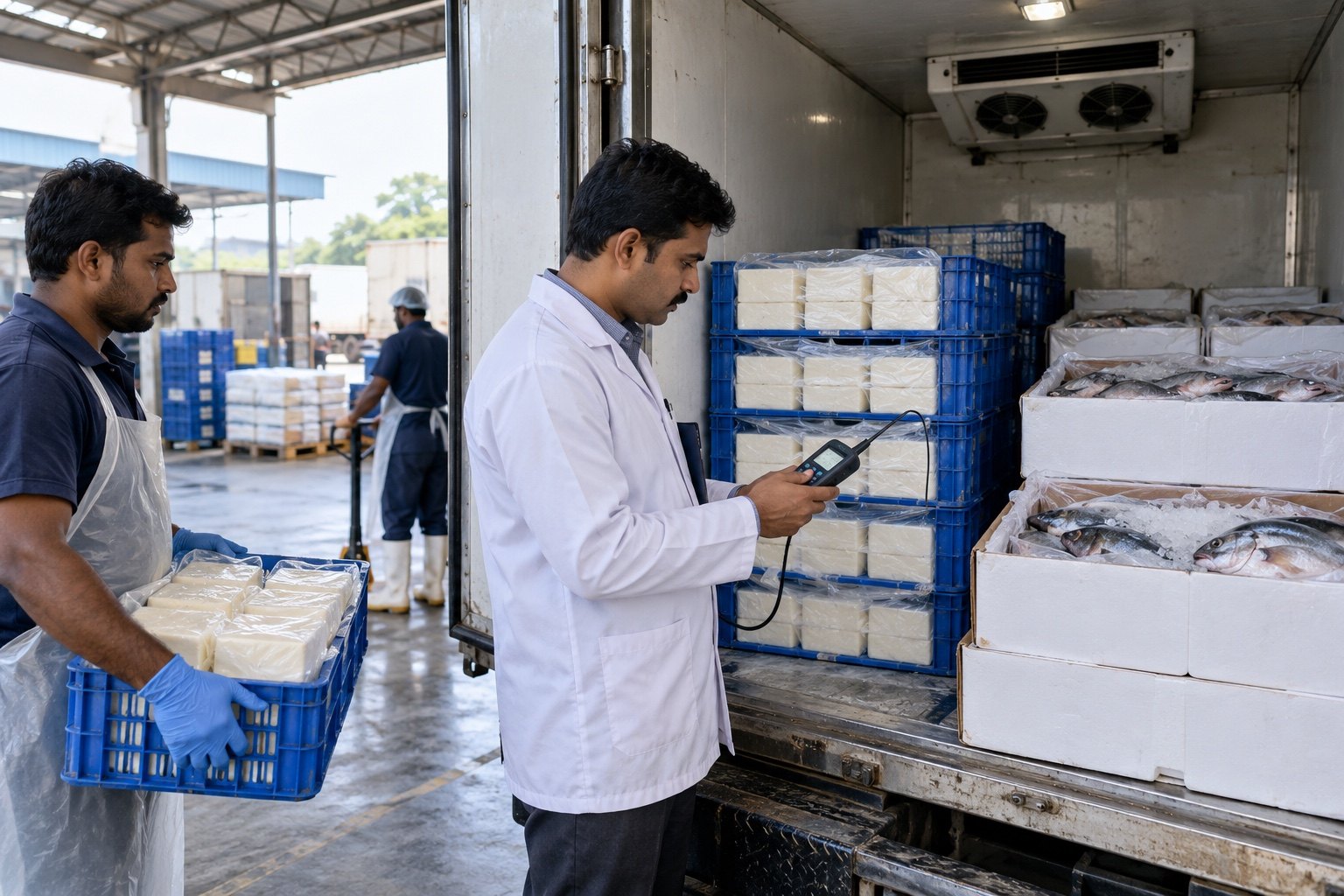
The Food Safety and Standards Authority of India (FSSAI) has directed food business operators to keep khoa, paneer, meat and fish at the prescribed temperature from sourcing to the end consumer. The advisory restates existing licence conditions and creates no new rule. It tells State food safety officers and Indian Railways to check consignments in transit.
Syllabus: Prelims · Polity & Governance; GS3 · Food Processing; GS2 · Statutory & Regulatory Bodies
Why this matters for UPSC
GS2 statutory bodies and GS3 food processing and supply chains: Prelims can ask what the Food Safety and Standards Act, 2006 replaced and who enforces it; Mains, about cold chain gaps and food-safety enforcement.
Why it matters
A family buying paneer from a local dairy or fish from a market cannot see how it travelled. If khoa rides in an open truck under a gunny bag, bacteria can multiply and the food can make people ill while still looking fresh. The advisory puts the duty on every link in the chain, from the maker to the shop, and asks inspectors to check vehicles on the road, not only shops. Small dairy and meat traders may need insulated or refrigerated transport to comply. The larger issue is India's weak cold chain for perishables: a rule on paper protects consumers only when regular inspections back it.
Prelims pointers
- Section 97 and Second Schedule, FSS Act, 2006: repealed the Prevention of Food Adulteration Act, 1954 and food orders such as the Milk and Milk Products Order, 1992.
- Section 5, FSS Act: FSSAI has a Chairperson and twenty-two members, one-third of them women; its head office is at Delhi under section 4.
- Section 30, FSS Act: the State Government appoints the Commissioner of Food Safety, who may prohibit a food's sale for up to one year in public interest.
- Section 32, FSS Act: a Designated Officer issues an improvement notice of at least fourteen days; continued failure leads to suspension, then cancellation of the licence.
- Section 38, FSS Act: a Food Safety Officer may take samples and send them to a Food Analyst.
- 2011 Regulations: a petty food business, with annual turnover not exceeding Rs 12 lakh, registers and follows Part I of Schedule 4.
- Schedule 1, 2011 Regulations: the Central Licensing Authority licenses importers, 100% export-oriented units, multi-State operators and catering at Railways, airports and Defence units.
Practise a UPSC-style question
With reference to the Food Safety and Standards Authority of India (FSSAI), consider the following statements:
1. It is established under section 4 of the Food Safety and Standards Act, 2006, with its head office at Delhi.
2. Its administrative ministry is the Union Ministry of Food Processing Industries.
3. It consists of a Chairperson and twenty-two members, of whom one-third must be women.
How many of the above statements are correct?
- (a) Only one
- (b) Only two
- (c) All three
- (d) None
Show the answer
Answer: (b) Only two
Answer: (b) Only two. Statements 1 and 3 are correct; FSSAI sits under the Health Ministry, not Food Processing.
Statement 1: correct. Section 4 of the Food Safety and Standards Act, 2006 directs the Centre to establish FSSAI as a body corporate with its head office at Delhi.
Statement 2: incorrect. The Ministry of Health and Family Welfare is FSSAI's administrative ministry; Food Processing is only one of seven ministries with an ex officio member on it.
Statement 3: correct. Section 5 provides a Chairperson and twenty-two members, one-third of whom shall be women.
Eliminate: Statement 2 is wrong, so not all three can be correct. Out: (c).
Eliminate: Statements 1 and 3 both hold, so at least two are correct. Out: (a), (d).
Trap: Swapped attribution. Food processing sounds like the natural home of a food regulator, but the FSS Act was allocated to the Health Ministry.
Remember: FSSAI = FSS Act 2006, section 4, head office Delhi, Ministry of Health and Family Welfare.
More from the 20 October 2026 edition
- China proposes export curbs on 40 AI, solar and biomedicine technologies World & IR
- Parallel distribution licence: HERC grants one for Gurugram and Nuh Economy
- DGFT notifies tariff-rate quotas for New Zealand apples, kiwifruit, honey Economy
- Remand is judicial work, not a formality: Allahabad High Court Polity
- Karnataka High Court upholds AMASR Act's prohibited and regulated zones Polity
- High Court allows Punjab's plea against MEA's political clearance refusal Polity
- IT Rules due diligence: MeitY advisory tells Meta to review recommendation systems Polity
- China puts tunnel boring machines under dual-use export control World & IR
- Who may practise law: Karnataka HC refuses to quash AIBE case Polity
- CCPA uses Consumer Protection Act to curb online explosives sales Polity
- Section 17A, Prevention of Corruption Act: bribe demand needs no approval Polity
- Orangutan seized in Thane reported repatriated to Indonesia under CITES Environment