
DGFT notifies tariff-rate quotas for New Zealand apples, kiwifruit, honey
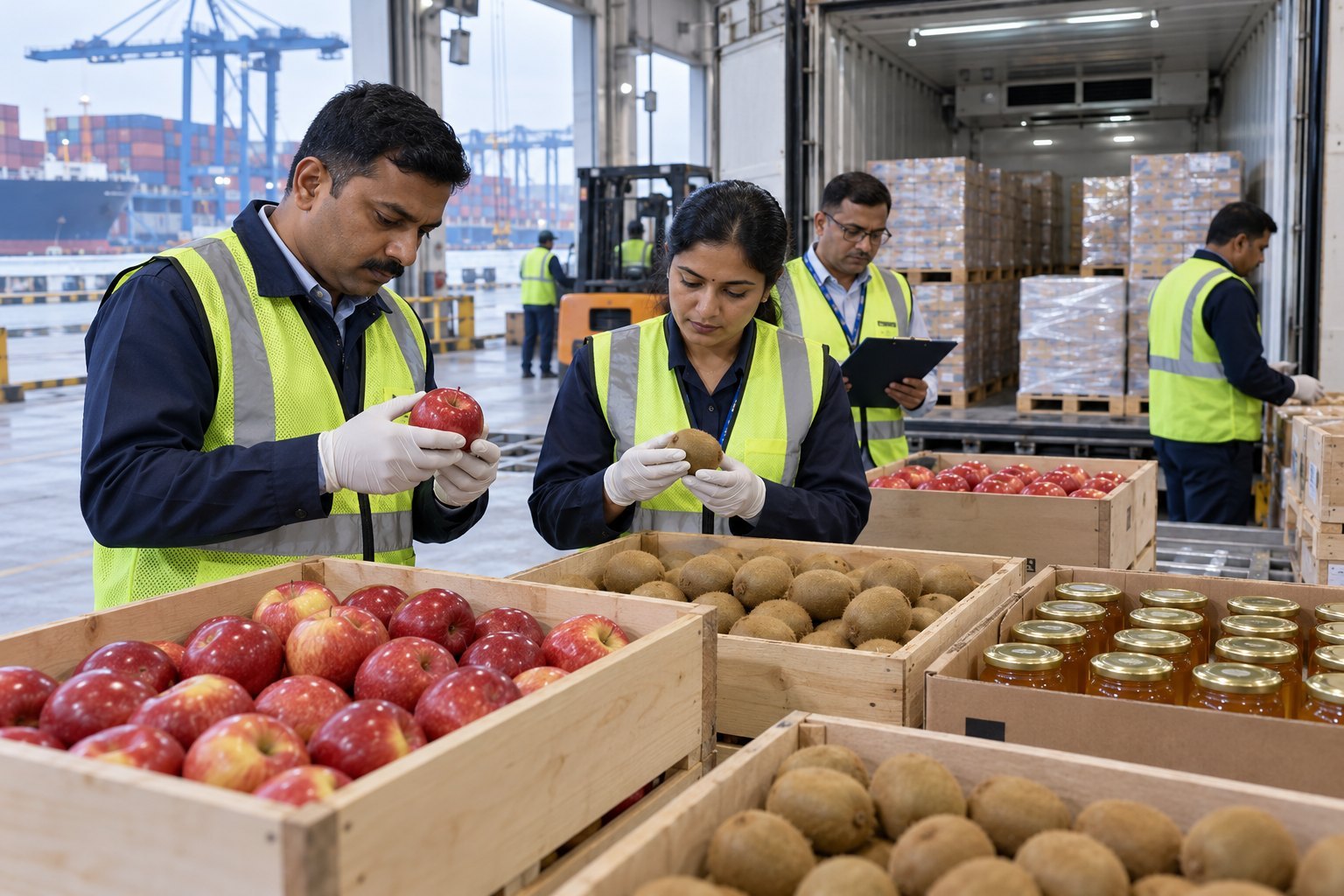
The Directorate General of Foreign Trade (DGFT) on 17 October 2026 notified how tariff-rate quotas for New Zealand apples, kiwifruit, albumins and Manuka honey will work under the India–New Zealand Free Trade Agreement from 20 October. Apples within quota pay 25% duty against 50% outside it; quota kiwifruit enters duty-free. Both fruit quotas open in 2027.
Syllabus: GS3 · Indian Economy & Growth; Prelims · Current Affairs & IR; GS3 · Agriculture & Irrigation
Why this matters for UPSC
GS3 Indian economy and agricultural marketing, with GS2 bilateral agreements: Prelims can ask what a tariff-rate quota is and how the WTO Agreement on Agriculture uses it; Mains, how a Free Trade Agreement shields farmers while opening markets.
Why it matters
An apple grower in Himachal Pradesh or Uttarakhand worries that cheaper foreign fruit will pull down the price of a season's harvest. The quota answers that worry in three ways. It caps how much New Zealand fruit can come in cheaply, it sets a price floor so low-priced fruit cannot use the cut, and it allows the shipments only in months that the rules fix. Buyers in Indian cities get more choice of fruit, honey and protein products at lower cost. For India's trade policy, it shows a way to open farm markets in steps without leaving growers exposed, a balance that every new trade deal has to strike.
Prelims pointers
- The Uruguay Round's tariffication package replaced agriculture-specific non-tariff measures with tariffs giving an equivalent level of protection.
- Under the Agreement on Agriculture, minimum access opportunities had to be opened on a most-favoured-nation basis, at least 3% of 1986-88 consumption in 1995.
- The special safeguard under Article 5 of the Agreement on Agriculture allows an additional tariff, but only on products marked 'SSG' in a member's schedule.
- Developed WTO members agreed to cut farm tariffs by 36% on average over six years from 1995; developing members by 24% over ten years.
- The Directorate General of Foreign Trade works under the Department of Commerce, Ministry of Commerce and Industry, and also issues the Importer-Exporter Code.
- India's tariff-rate quotas also run under the India–UK CETA, the India–Oman CEPA, the India–UAE CEPA (gold) and the India–Mauritius CECPA.
Practise a UPSC-style question
With reference to the tariff-rate quotas India has notified for imports from New Zealand, consider the following statements:
1. Kiwifruit imported within the quota pays no customs duty when its CIF value is at least US$1.80 per kg.
2. Manuka honey under the quota must carry certification from New Zealand's Ministry for Primary Industries.
3. New Zealand allocates the quota by issuing export certificates that name the designated Indian importer.
How many of the above statements are correct?
- (a) Only one
- (b) Only two
- (c) All three
- (d) None
Show the answer
Answer: (c) All three
Answer: (c) All three. Each statement matches DGFT Public Notice No. 33/2026-27 of 17 October 2026.
Statement 1: correct. Kiwifruit within quota enters at 0% duty if its CIF value is US$1.80 a kg or more.
Statement 2: correct. The honey quota covers only Manuka honey certified by New Zealand's Ministry for Primary Industries, at a CIF value of US$20 to below US$30 a kg.
Statement 3: correct. New Zealand issues export certificates naming the item, quantity and Indian importer; the importer then applies to DGFT.
Eliminate: statement 1 matches the notice, so None goes. Out: (d).
Eliminate: statements 2 and 3 hold too, so Only one and Only two go. Out: (a), (b).
Trap: Swapped attribution. A student who assumes India's DGFT shares out the quota may mark statement 3 wrong, but New Zealand allocates it and DGFT authorises imports.
Remember: New Zealand allocates by export certificate; DGFT issues the TRQ authorisation.
More from the 20 October 2026 edition
- China proposes export curbs on 40 AI, solar and biomedicine technologies World & IR
- Parallel distribution licence: HERC grants one for Gurugram and Nuh Economy
- Remand is judicial work, not a formality: Allahabad High Court Polity
- Karnataka High Court upholds AMASR Act's prohibited and regulated zones Polity
- High Court allows Punjab's plea against MEA's political clearance refusal Polity
- IT Rules due diligence: MeitY advisory tells Meta to review recommendation systems Polity
- China puts tunnel boring machines under dual-use export control World & IR
- Who may practise law: Karnataka HC refuses to quash AIBE case Polity
- CCPA uses Consumer Protection Act to curb online explosives sales Polity
- Section 17A, Prevention of Corruption Act: bribe demand needs no approval Polity
- Orangutan seized in Thane reported repatriated to Indonesia under CITES Environment
- FSSAI directs cold-chain compliance for perishables under 2011 Licensing Regulations National