
Supreme Court to test State DGP appointment rules against Prakash Singh ruling
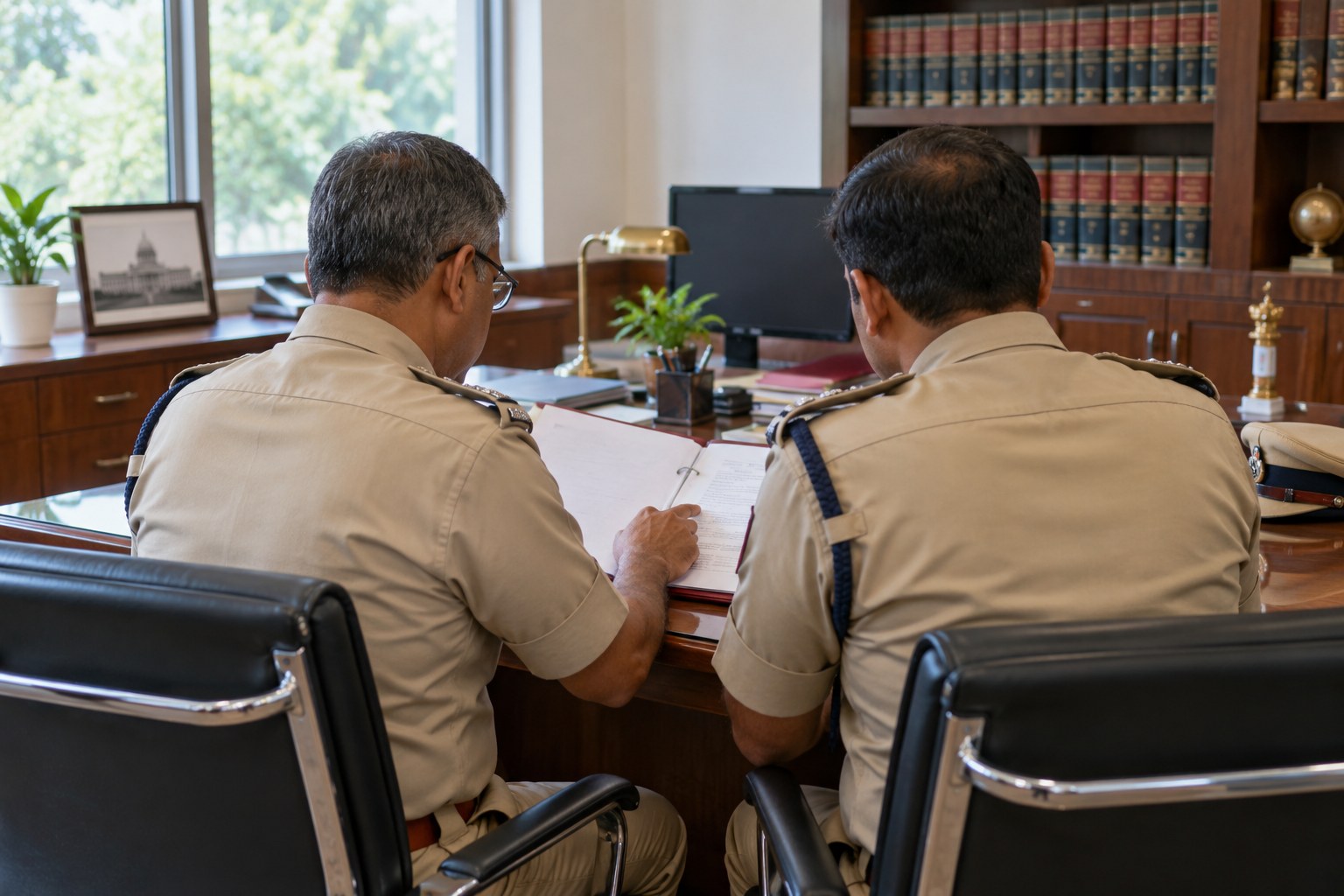
The Supreme Court on October 8 asked amicus curiae Raju Ramachandran to examine whether States' rules for appointing police chiefs breach its 2006 Prakash Singh judgment. On the Centre's complaint that Jharkhand DGP Tadasha Mishra's appointment failed that test, the court issued her notice. Jharkhand argued West Bengal and Bihar also flouted the ruling. The next hearing is November 3.
Syllabus: GS2 · Federalism & Local Government; Prelims · Polity & Governance; GS2 · Executive & Judiciary
Why it matters
The head of a State's police force should be chosen fairly and allowed to serve a steady term, not picked or moved at political convenience. Twenty years after the Supreme Court said so, it is now checking whether States' own rules quietly undo those safeguards. The answer shapes how independent, and how accountable, policing is for ordinary people who rely on the police to register complaints and investigate crimes without fear or favour. The case also has a Centre-State edge: the Centre has questioned one State's choice, and that State says others are doing the same.
Prelims pointers
- Prakash Singh judgment (2006): Supreme Court directions on police reform, including transparent DGP selection and a minimum two-year tenure.
- Under Prakash Singh, a State selects its DGP from the three senior-most officers empanelled by the Union Public Service Commission (UPSC).
- 2019 clarification: a residual tenure of six months before normal retirement is required for DGP consideration.
- Police (Entry 2) and public order (Entry 1) are in List II, the State List, of the Seventh Schedule.
- Other Prakash Singh directions: State Security Commission, Police Establishment Board, Police Complaints Authorities, and separating investigation from law and order.
- Article 141: law declared by the Supreme Court binds all courts in India; Article 144: all civil and judicial authorities must act in its aid.
- Amicus curiae: a lawyer appointed to assist the court impartially; here senior advocate Raju Ramachandran.
- Delegated legislation: rules framed by the executive under powers given to it by a statute.
Practise a UPSC-style question
With reference to the Supreme Court's directions on choosing a State's Director General of Police (DGP), consider the following statements:
1. A State selects its DGP from the three senior-most officers empanelled by the Union Public Service Commission.
2. The 2006 Prakash Singh judgment fixed a minimum tenure of three years for a DGP once selected.
3. A 2019 order said only officers with at least six months of service left before retirement should be considered.
Which of the statements given above is/are correct?
- (a) 1 and 2 only
- (b) 2 and 3 only
- (c) 1 and 3 only
- (d) 1, 2 and 3
Show the answer
Answer: (c) 1 and 3 only
1 is correct: under the Prakash Singh scheme the State picks its DGP from the three senior-most officers empanelled by the UPSC. 2 is incorrect: the 2006 judgment fixed a minimum tenure of two years, not three. 3 is correct: the court's 2019 order limited consideration to officers with a residual service of at least six months before normal retirement.
More from the 8 October 2026 edition
- CBAM: US invites comments as EU weighs widening carbon border levy Economy
- Glacial lake outburst flood exposure: Himalayan flood-zone building up 46% Environment
- Nobel Prize in Literature 2026: Swedish Academy honours Canada's Anne Carson World & IR
- World Development Report 2026 on AI gets its India launch Sci-Tech
- Nameri Tiger Reserve in Assam gets CA|TS Approved status Environment
- GST Council recommends scrapping arrest powers, ₹5 crore prosecution threshold Economy
- India joins 14 economies in joint statement on industrial overcapacity Economy
- WMO forecasts December El Niño peak, drier conditions over India Environment
- Chhattisgarh High Court seeks State reply on anti-conversion law challenge Polity
- Centre to release AI regulation consultation paper within a month Sci-Tech
- Supreme Court orders expert panel on statutory curbs for pharma marketing National
- Saudi investment treaty to allow arbitration after two years, officials say Economy