
CBAM: US invites comments as EU weighs widening carbon border levy
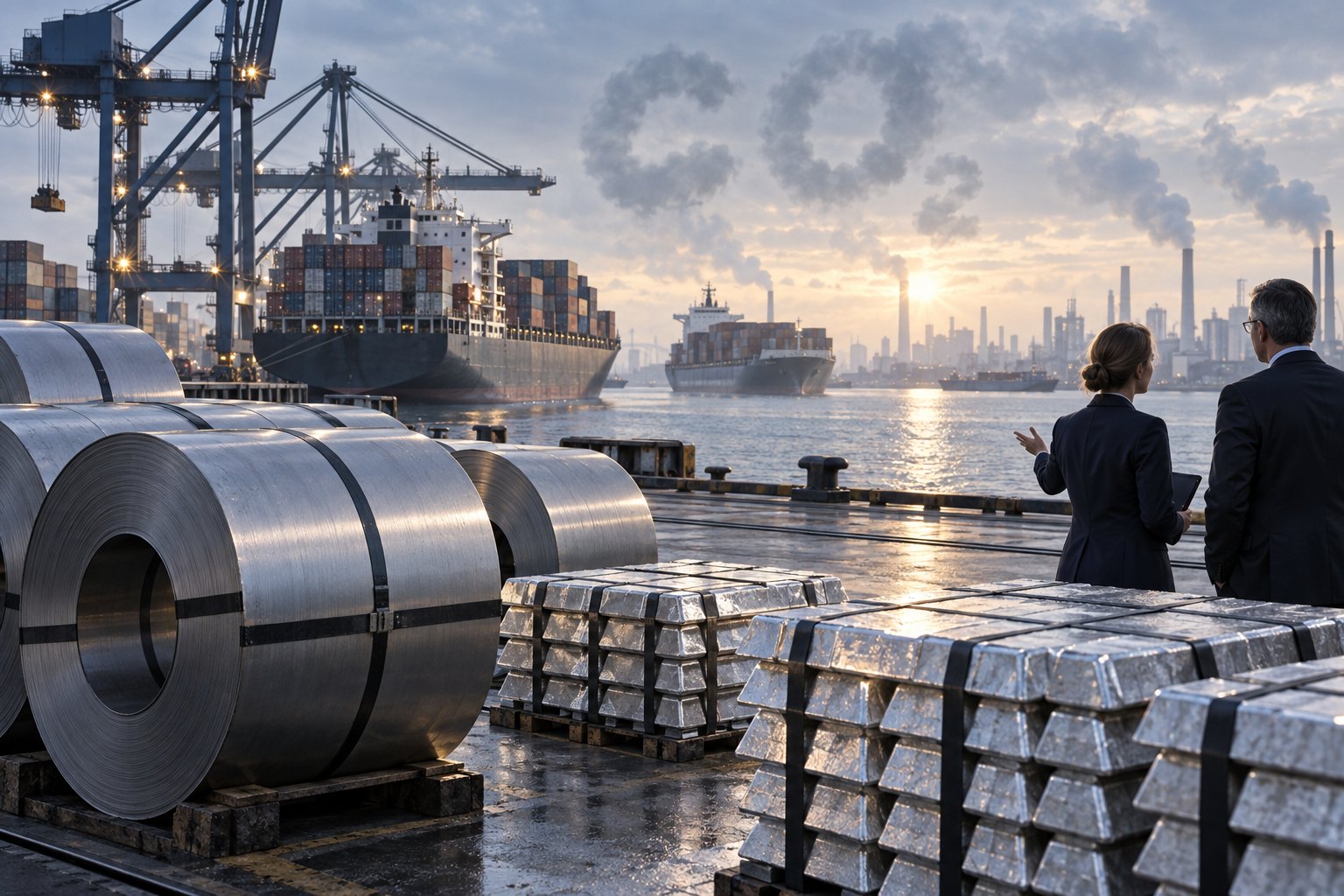
The Office of the United States Trade Representative on 8 October 2026 invited comments, due by 9 November, on how the EU's Carbon Border Adjustment Mechanism (CBAM) affects US trade. CBAM's definitive phase began on 1 January 2026 for steel, aluminium, cement, fertilisers, electricity and hydrogen. The EU is weighing extending it to downstream steel and aluminium goods.
Syllabus: GS3 · Indian Economy & Growth; Prelims · Environment & Ecology; GS2 · Foreign Policies & the Diaspora
Why it matters
Take an Indian mill selling steel coil to a buyer in Germany. Every tonne now carries a carbon bill that the German importer must cover with CBAM certificates, so the mill must either prove its emissions with data checked by an EU-accredited verifier or accept EU default values with a mark-up. Mills using blast furnaces, as most Indian ones do, face the biggest bill; the think tank GTRI estimates CBAM will work like a 20-35% tax on some Indian metal exports. If downstream goods are added, makers of steel and aluminium products join the list. India's government expects any flexibility the US wins to reach Indian exporters through the trade agreement; the EU says India gets no better treatment than others.
Prelims pointers
- CBAM: an EU charge on the embedded emissions of imports, meant to match the carbon price EU producers pay under the EU ETS; obligations fall on EU importers.
- EU Emissions Trading System (2005): a cap-and-trade carbon market; CBAM certificate prices track its allowance auction prices.
- Carbon leakage: carbon-intensive production moving to countries with weaker climate rules, or cleaner EU goods being replaced by more carbon-intensive imports.
- GATT 1994: Article I most-favoured-nation treatment; Article III national treatment; Article XX general exceptions, including (b) health and (g) exhaustible natural resources.
- UNFCCC (1992), Article 3.5: climate measures, including unilateral ones, should not be arbitrary or unjustifiable discrimination or a disguised restriction on international trade.
- Steel routes by emissions: blast furnace-basic oxygen furnace highest, gas-based direct reduced iron lower, scrap-based electric arc furnace lowest.
- USTR: part of the Executive Office of the US President; it negotiates trade agreements and enforces US trade rights.
Practise a UPSC-style question
With reference to the European Union's Carbon Border Adjustment Mechanism (CBAM), consider the following statements:
1. It applies to imports of hydrogen and electricity as well as iron and steel and aluminium.
2. During its transitional phase of 2023 to 2025, importers had to buy and surrender CBAM certificates.
3. The price of CBAM certificates is based on auction prices of EU Emissions Trading System allowances.
Which of the statements given above is/are correct?
- (a) 1 and 2 only
- (b) 2 and 3 only
- (c) 1 and 3 only
- (d) 1, 2 and 3
Show the answer
Answer: (c) 1 and 3 only
1 is correct: CBAM's six sectors are cement, iron and steel, aluminium, fertilisers, electricity and hydrogen. 2 is incorrect: the 2023-2025 transitional phase required only reports of embedded emissions; buying and surrendering certificates belongs to the definitive regime that began on 1 January 2026. 3 is correct: the Commission sets the certificate price from EU ETS allowance auction prices, averaged quarterly in 2026 and weekly from 2027.
More from the 8 October 2026 edition
- Glacial lake outburst flood exposure: Himalayan flood-zone building up 46% Environment
- Nobel Prize in Literature 2026: Swedish Academy honours Canada's Anne Carson World & IR
- World Development Report 2026 on AI gets its India launch Sci-Tech
- Nameri Tiger Reserve in Assam gets CA|TS Approved status Environment
- GST Council recommends scrapping arrest powers, ₹5 crore prosecution threshold Economy
- India joins 14 economies in joint statement on industrial overcapacity Economy
- WMO forecasts December El Niño peak, drier conditions over India Environment
- Chhattisgarh High Court seeks State reply on anti-conversion law challenge Polity
- Centre to release AI regulation consultation paper within a month Sci-Tech
- Supreme Court orders expert panel on statutory curbs for pharma marketing National
- Saudi investment treaty to allow arbitration after two years, officials say Economy
- NMC bars fake reviews, referral fees and AI testimonials for doctors National