
NASA, US Energy Department sign space nuclear pact; Moon reactor by 2030
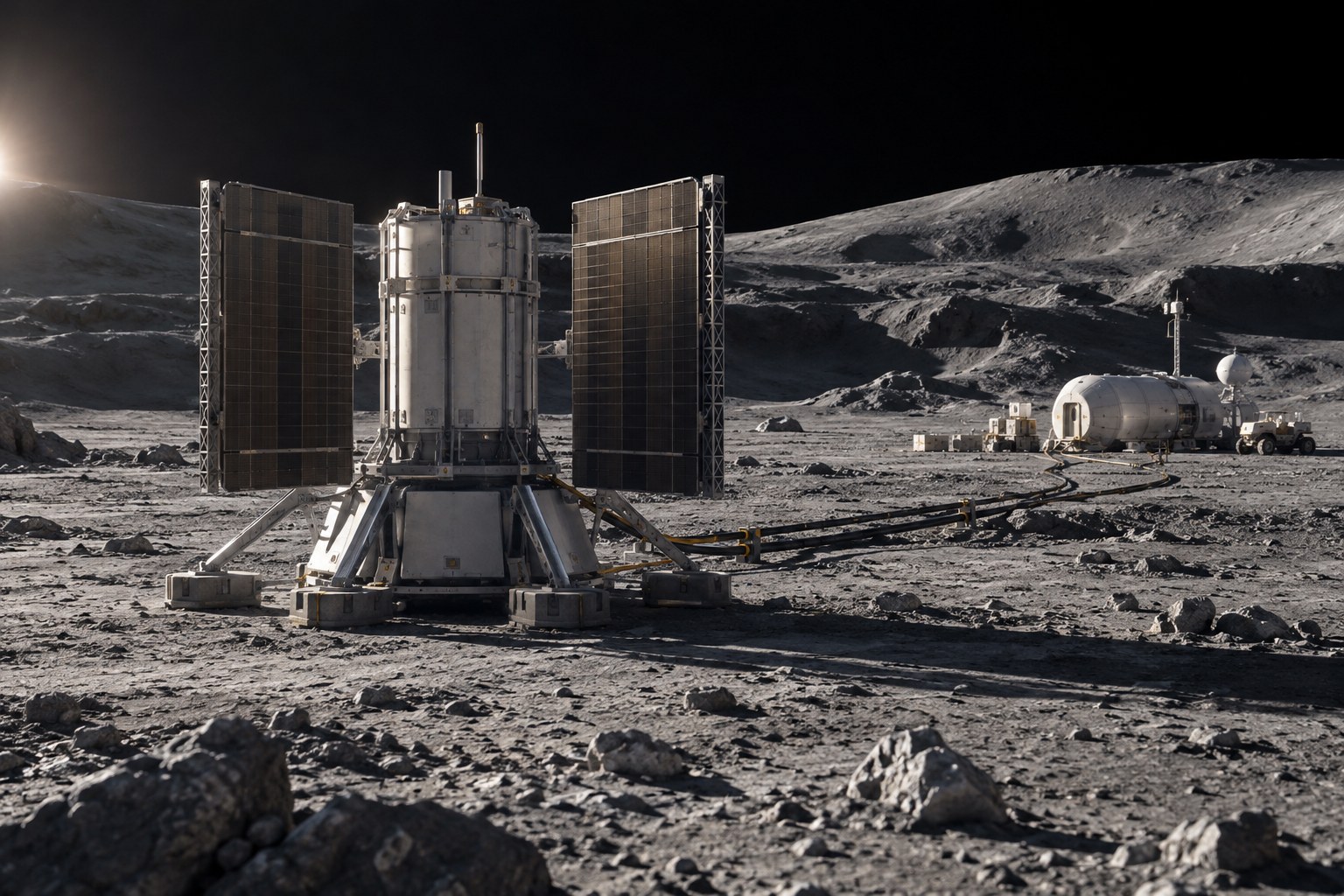
NASA and the US Department of Energy signed a memorandum of understanding on space nuclear power and propulsion on October 8, 2026. It covers Lunar Reactor-1, a fission reactor for NASA's Moon Base near the lunar South Pole, and Space Reactor-1 Freedom, a Mars-bound spacecraft planned for 2028. A December 2025 executive order wants the lunar reactor launch-ready by 2030.
Syllabus: Prelims · Current Affairs & IR; GS3 · IT, Space, Biotech & IPR; GS2 · Groupings & Agreements
Why it matters
Astronauts who stay on the Moon for months cannot depend on sunlight. A lunar night lasts about two Earth weeks, and the icy craters near the South Pole never see the Sun, so a base there needs power that keeps habitats, communications, instruments and rovers running in the dark. NASA and DOE expect a fission system to supply it for years without refuelling. India has a stake: it signed the Artemis Accords in 2023, Chandrayaan-3 made the first landing near the lunar south pole, and an Indian landing on the Moon is planned by 2040. The larger issue is rules. The UN's 1992 principles on nuclear power sources in space are a General Assembly resolution, and their own text says they will need revision as new nuclear uses emerge.
Prelims pointers
- Outer Space Treaty, 1967, Article IV: no nuclear weapons or other weapons of mass destruction in orbit or on celestial bodies; the Moon is reserved exclusively for peaceful purposes.
- Outer Space Treaty, 1967, Article II: outer space, including the Moon, is not subject to national appropriation by claim of sovereignty, by use or occupation, or by any other means.
- Principles Relevant to the Use of Nuclear Power Sources in Outer Space: UN General Assembly resolution 47/68 of December 14, 1992; they allow reactors on interplanetary missions.
- Under the 1992 Principles, a reactor shall not be made critical before reaching its operating orbit or interplanetary trajectory, and a safety assessment is made public before each launch.
- Artemis Accords: adopted on October 13, 2020 as a political commitment, not a treaty; they provide for temporary safety zones; India signed on June 21, 2023 as the 27th country.
- Fission surface power: uranium atoms are split in a reactor to make heat, which is converted to electricity; it works regardless of sunlight or temperature.
- Radioisotope power systems use heat from the natural radioactive decay of plutonium-238; NASA's Dragonfly mission to Saturn's moon Titan, due to launch in 2028, will carry one.
- The Moon is tilted only 1.5 degrees on its axis (Earth: 23.5 degrees), so some polar crater floors stay permanently dark; NASA's instrument on Chandrayaan-1 confirmed water ice there.
Practise a UPSC-style question
With reference to the Outer Space Treaty, 1967, consider the following statements:
1. It bars national appropriation of the Moon by claim of sovereignty, by use or occupation, or by any other means.
2. It forbids states to install nuclear weapons or other weapons of mass destruction on the Moon and other celestial bodies.
3. It prohibits states from using nuclear reactors to generate electricity on the Moon.
Which of the statements given above is/are correct?
- (a) 1 and 2 only
- (b) 2 and 3 only
- (c) 1 and 3 only
- (d) 1, 2 and 3
Show the answer
Answer: (a) 1 and 2 only
1 is correct: Article II says outer space, including the Moon, is not subject to national appropriation by claim of sovereignty, by means of use or occupation, or by any other means. 2 is correct: Article IV bars placing nuclear weapons or other weapons of mass destruction in orbit and installing them on celestial bodies. 3 is incorrect: the treaty bans nuclear weapons, not nuclear power; Article IV itself says equipment needed for the peaceful exploration of the Moon is not prohibited, and the UN's 1992 Principles guide the safe use of nuclear power sources.
More from the 8 October 2026 edition
- CBAM: US invites comments as EU weighs widening carbon border levy Economy
- Glacial lake outburst flood exposure: Himalayan flood-zone building up 46% Environment
- Nobel Prize in Literature 2026: Swedish Academy honours Canada's Anne Carson World & IR
- World Development Report 2026 on AI gets its India launch Sci-Tech
- Nameri Tiger Reserve in Assam gets CA|TS Approved status Environment
- GST Council recommends scrapping arrest powers, ₹5 crore prosecution threshold Economy
- India joins 14 economies in joint statement on industrial overcapacity Economy
- WMO forecasts December El Niño peak, drier conditions over India Environment
- Chhattisgarh High Court seeks State reply on anti-conversion law challenge Polity
- Centre to release AI regulation consultation paper within a month Sci-Tech
- Supreme Court orders expert panel on statutory curbs for pharma marketing National
- Saudi investment treaty to allow arbitration after two years, officials say Economy