
Living Planet Index: monitored wildlife populations shrank 73% on average, 1970–2022
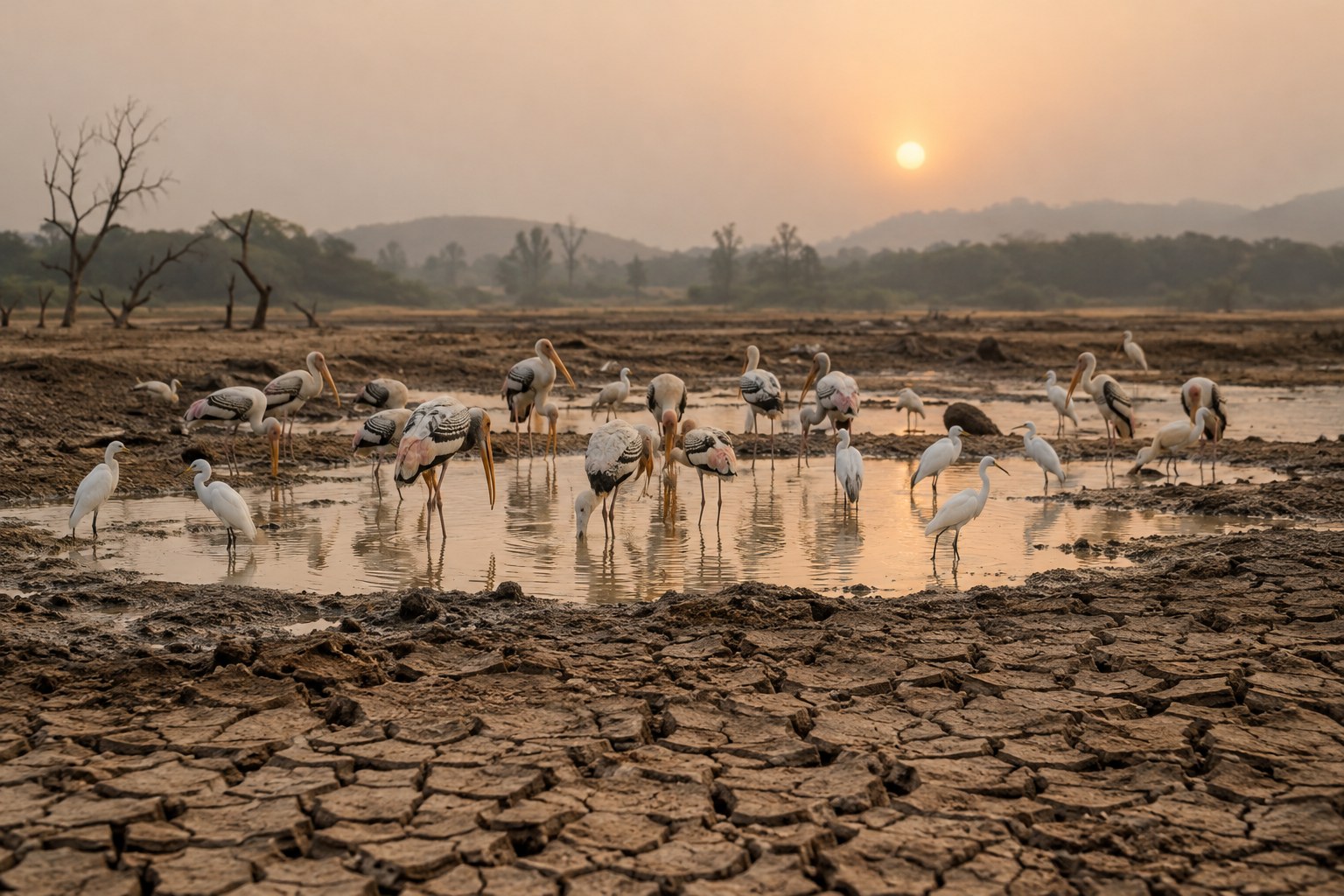
Monitored populations of vertebrate wildlife shrank by an average of 73% between 1970 and 2022, WWF's biennial Living Planet Report 2026 finds. Freshwater populations fell hardest, by 85%, ahead of terrestrial (69%) and marine (59%). The report names food production and consumption as the biggest driver of biodiversity loss, yet half the tracked populations are stable or rising.
Syllabus: Prelims · Environment & Ecology; GS1 · Geophysical Phenomena; GS3 · Environment & Conservation
Why it matters
Wildlife numbers are a broad signal of how healthy nature is, and this report says the populations scientists follow have fallen by nearly three-quarters on average in about fifty years. Freshwater species are faring worst, showing heavy pressure on rivers, lakes and similar habitats. The report puts the biggest share of the blame on how the world grows and eats food, so the answer lies partly in farms, diets and supply chains, not only in protected areas. Still, half the tracked populations are steady or rising, and comebacks such as that of tigers in India and worldwide show that patient, sustained conservation can turn declines around.
Prelims pointers
- Living Planet Report: a biennial WWF publication; its Living Planet Index is produced by the Zoological Society of London (ZSL).
- The LPI tracks relative abundance: the 73% is an average change in population size, not animals or populations lost.
- The LPI covers vertebrates (animals with a backbone) only; invertebrates and plants are outside it.
- Order of decline: freshwater (85%) > terrestrial (69%) > marine (59%).
- Drivers listed: habitat loss and degradation, overexploitation, climate change, invasive species, pollution and disease.
- Recoveries cited: green turtles, bluefin tuna, tigers and southern African elephants.
- WWF (World Wide Fund for Nature) is an international conservation NGO founded in 1961 and headquartered in Gland, Switzerland.
Practise a UPSC-style question
Consider the following statements about the Living Planet Index (LPI):
1. It is compiled for WWF's Living Planet Report by the International Union for Conservation of Nature.
2. It tracks changes in the relative abundance of wildlife populations rather than their absolute numbers.
3. It covers vertebrate species such as mammals, birds, fish and amphibians, but not plants or invertebrates.
Which of the statements given above is/are correct?
- (a) 1 and 2 only
- (b) 2 and 3 only
- (c) 1 and 3 only
- (d) 1, 2 and 3
Show the answer
Answer: (b) 2 and 3 only
1 is incorrect: the LPI is produced by the Zoological Society of London (ZSL). 2 is correct: it measures the average change in population size over time, not headcounts. 3 is correct: the index covers vertebrates, animals with a backbone; in this edition, 35,803 population trends of 5,790 species.
More from the 8 October 2026 edition
- CBAM: US invites comments as EU weighs widening carbon border levy Economy
- Glacial lake outburst flood exposure: Himalayan flood-zone building up 46% Environment
- Nobel Prize in Literature 2026: Swedish Academy honours Canada's Anne Carson World & IR
- World Development Report 2026 on AI gets its India launch Sci-Tech
- Nameri Tiger Reserve in Assam gets CA|TS Approved status Environment
- GST Council recommends scrapping arrest powers, ₹5 crore prosecution threshold Economy
- India joins 14 economies in joint statement on industrial overcapacity Economy
- WMO forecasts December El Niño peak, drier conditions over India Environment
- Chhattisgarh High Court seeks State reply on anti-conversion law challenge Polity
- Centre to release AI regulation consultation paper within a month Sci-Tech
- Supreme Court orders expert panel on statutory curbs for pharma marketing National
- Saudi investment treaty to allow arbitration after two years, officials say Economy