
Kagan and Soai win 2026 Chemistry Nobel for mirror-molecule work
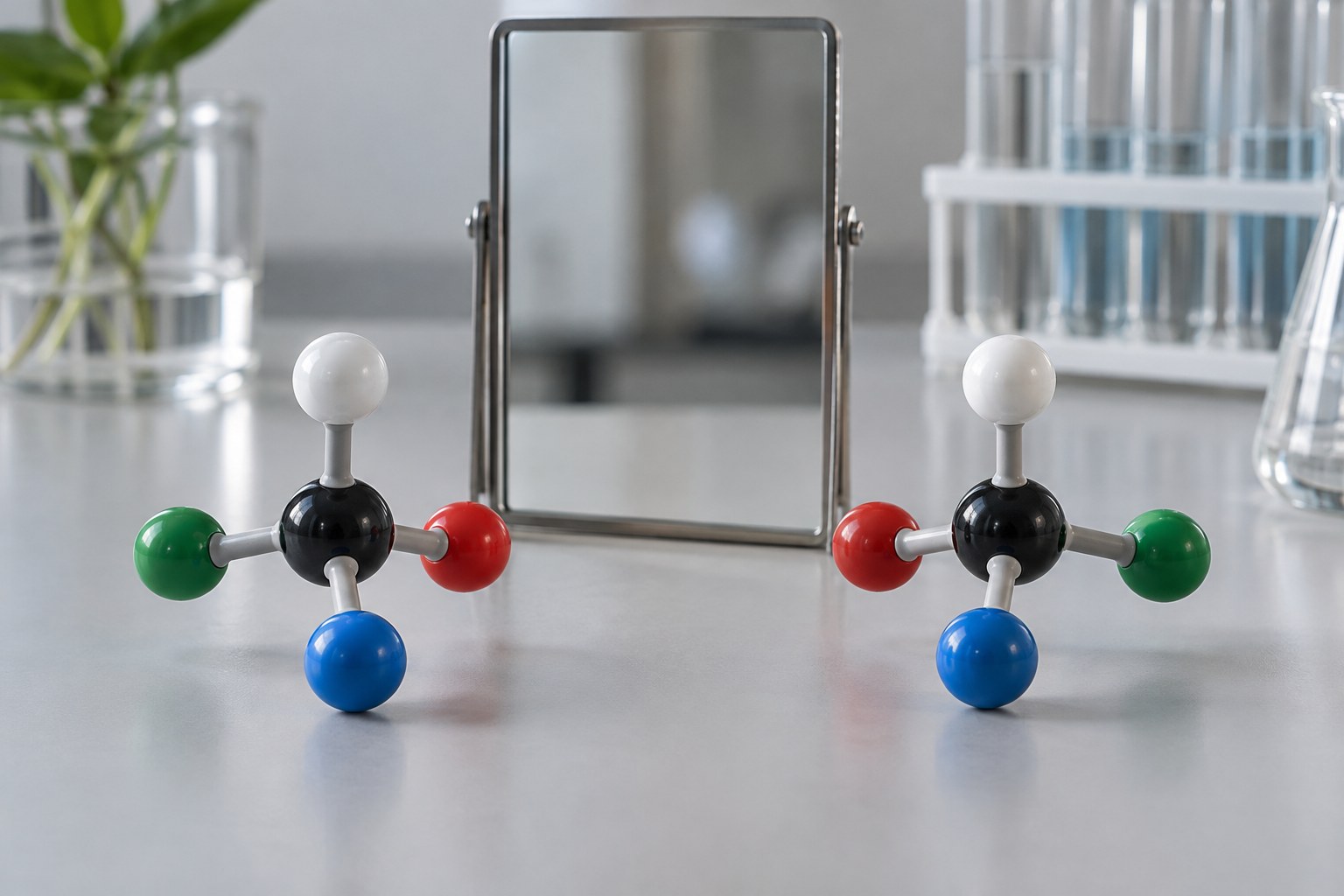
French chemist Henri Kagan and Japanese chemist Kenso Soai have won the 2026 Nobel Prize in Chemistry for discovering non-linear effects and autocatalysis in asymmetric organic synthesis. The two will share the prize equally. Their research shows how chemical reactions can magnify a tiny imbalance between mirror-image molecules into an overwhelming one.
Syllabus: Prelims · Current Affairs & IR; Prelims · Science & Technology; GS3 · Science & Technology
Why it matters
A patient taking a medicine often swallows a chiral drug. One mirror-image form does the healing; its twin can cause unwanted, sometimes harmful side effects, because the body's enzymes and receptors are themselves chiral. The Academy recalls the thalidomide scandal of the early 1960s, when a sedative left thousands of children with birth defects and the harm was traced to the mirror image of the active substance. Smell differs too: one form of carvone smells of mint, the other of caraway. Kagan's insight helps chemists design reactions giving the purest form of a drug, flavour, scent or farm chemical. Soai's reaction shows that a tiny chance imbalance can snowball into near-total one-handedness without any living cell, though the Academy calls it a proof of concept, not life's own route.
Prelims pointers
- Chiral molecule: exists as two non-superimposable mirror-image forms (enantiomers) with the same atoms and bonding order but a different 3D arrangement.
- Enantiomers have identical melting and boiling points but rotate plane-polarised light by equal amounts in opposite directions; a racemic mixture, with equal amounts of both, shows no net rotation.
- Proteins use L-amino acids and DNA and RNA use D-sugars; D and L name the spatial arrangement, not the direction of optical rotation (D-fructose rotates light to the left).
- Asymmetric reaction: one that yields more of one enantiomer than the other; enantiomeric excess measures by how much one form outnumbers its mirror image.
- Autocatalysis: a reaction whose product acts as the catalyst for that same reaction, so an initial imbalance can snowball.
- A catalyst speeds up a reaction without itself being consumed in it.
- Match the names: Pasteur (tartaric acid), Marckwald (first asymmetric reaction), Frank (1953 model), Kagan (non-linear effects), Soai (asymmetric autocatalysis).
- The Royal Swedish Academy of Sciences awards the Chemistry Nobel; earlier prizes for asymmetric catalysis went to Knowles, Noyori and Sharpless (2001) and to List and MacMillan (2021).
Practise a UPSC-style question
With reference to chiral molecules, consider the following statements:
1. The two enantiomers of a chiral molecule have the same atoms joined in the same order but a different 3D arrangement.
2. A racemic mixture contains equal amounts of two enantiomers and shows no net rotation of plane-polarised light.
3. The two enantiomers of a chiral compound have different boiling points and different melting points.
Which of the statements given above is/are correct?
- (a) 1 and 2 only
- (b) 2 and 3 only
- (c) 1 and 3 only
- (d) 1, 2 and 3
Show the answer
Answer: (a) 1 and 2 only
1 is correct: enantiomers are non-superimposable mirror images with identical atoms and bonding order, differing only in 3D layout. 2 is correct: the two forms rotate plane-polarised light by equal amounts in opposite directions, so an equal mix shows no net rotation. 3 is incorrect: enantiomers have identical boiling and melting points; they differ in how they rotate polarised light and interact with other chiral molecules.
More from the 8 October 2026 edition
- CBAM: US invites comments as EU weighs widening carbon border levy Economy
- Glacial lake outburst flood exposure: Himalayan flood-zone building up 46% Environment
- Nobel Prize in Literature 2026: Swedish Academy honours Canada's Anne Carson World & IR
- World Development Report 2026 on AI gets its India launch Sci-Tech
- Nameri Tiger Reserve in Assam gets CA|TS Approved status Environment
- GST Council recommends scrapping arrest powers, ₹5 crore prosecution threshold Economy
- India joins 14 economies in joint statement on industrial overcapacity Economy
- WMO forecasts December El Niño peak, drier conditions over India Environment
- Chhattisgarh High Court seeks State reply on anti-conversion law challenge Polity
- Centre to release AI regulation consultation paper within a month Sci-Tech
- Supreme Court orders expert panel on statutory curbs for pharma marketing National
- Saudi investment treaty to allow arbitration after two years, officials say Economy