
Centre reconstitutes Press Council, nominating 13 journalists as members
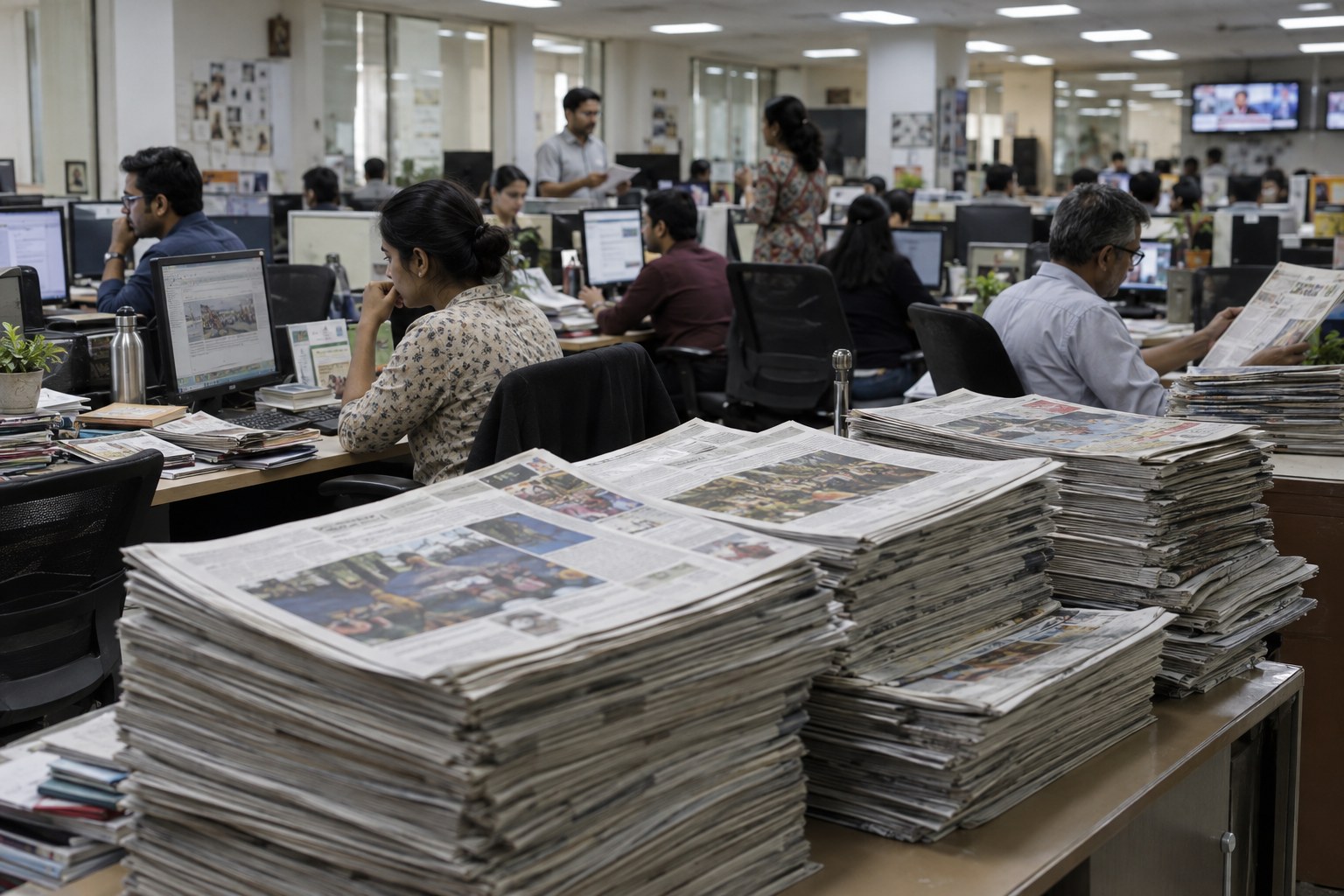
The Information and Broadcasting Ministry on October 7, 2026 notified 13 working journalists, six editors and seven others, as members of the Press Council of India, taking it to 27 of 28 members. A statutory body under the Press Council Act, 1978, it can censure newspapers and news agencies; television and digital media lie outside its jurisdiction.
Syllabus: Prelims · Polity & Governance; GS2 · Statutory & Regulatory Bodies; GS2 · Governance & e-Governance
Why it matters
A reader who finds a newspaper report false or in bad taste can complain to the Press Council. So can a journalist who is assaulted, or a newspaper whose freedom an authority curtails. Members of the Council hear these cases, so the 13 seats for working journalists put practising editors and reporters beside newspaper owners, MPs and experts when complaints are decided. The Council's limits matter as much as its powers. It can censure a newspaper but has no power to fine it, and it closes complaints about television, social media or OTT content as outside its jurisdiction. Television and digital news follow separate codes under other laws.
Prelims pointers
- Press Council of India: a statutory body under the Press Council Act, 1978, with quasi-judicial powers; it is not a constitutional body.
- History: set up in 1966 under a 1965 Act; dissolved from 1 January 1976 during the Emergency; re-established in 1979. National Press Day is 16 November.
- Chairman: nominated by a committee of the Rajya Sabha Chairman, the Lok Sabha Speaker and a member elected by the Council; by convention a retired Supreme Court judge.
- MPs: three nominated by the Lok Sabha Speaker, two by the Rajya Sabha Chairman. Experts: one each from the University Grants Commission, Bar Council of India and Sahitya Akademi.
- Power to censure: after an inquiry the Council may warn, admonish or censure; its decision is final and cannot be questioned in any court of law.
- It has a civil court's powers to summon persons and documents, but cannot compel a journalist to disclose a source or inquire into a matter pending in court.
- Jurisdiction: print only. Television follows the Programme Code under the Cable Television Networks (Regulation) Act, 1995; digital news the Code of Ethics in rules under the Information Technology Act, 2000.
- Press freedom is not a separate fundamental right; it is part of the freedom of speech and expression under Article 19(1)(a), subject to reasonable restrictions under Article 19(2).
Practise a UPSC-style question
Consider the following statements about the Press Council of India:
1. The Press Council of India is a constitutional body set up under Article 19 of the Constitution.
2. It was set up to preserve the freedom of the press and to improve the standards of newspapers and news agencies.
3. After an inquiry, it may warn, admonish or censure a newspaper, a news agency, an editor or a journalist.
Which of the statements given above is/are correct?
- (a) 1 and 2 only
- (b) 2 and 3 only
- (c) 1 and 3 only
- (d) 1, 2 and 3
Show the answer
Answer: (b) 2 and 3 only
1 is incorrect: the Press Council is a statutory autonomous body under the Press Council Act, 1978, not a constitutional body. 2 is correct: preserving press freedom and maintaining and improving the standards of newspapers and news agencies are its objects under the Act. 3 is correct: Section 14 lets it warn, admonish or censure after an inquiry; the Act provides for no fine.
More from the 8 October 2026 edition
- CBAM: US invites comments as EU weighs widening carbon border levy Economy
- Glacial lake outburst flood exposure: Himalayan flood-zone building up 46% Environment
- Nobel Prize in Literature 2026: Swedish Academy honours Canada's Anne Carson World & IR
- World Development Report 2026 on AI gets its India launch Sci-Tech
- Nameri Tiger Reserve in Assam gets CA|TS Approved status Environment
- GST Council recommends scrapping arrest powers, ₹5 crore prosecution threshold Economy
- India joins 14 economies in joint statement on industrial overcapacity Economy
- WMO forecasts December El Niño peak, drier conditions over India Environment
- Chhattisgarh High Court seeks State reply on anti-conversion law challenge Polity
- Centre to release AI regulation consultation paper within a month Sci-Tech
- Supreme Court orders expert panel on statutory curbs for pharma marketing National
- Saudi investment treaty to allow arbitration after two years, officials say Economy