
TDB backs indigenous AI vision chip with ₹130 crore
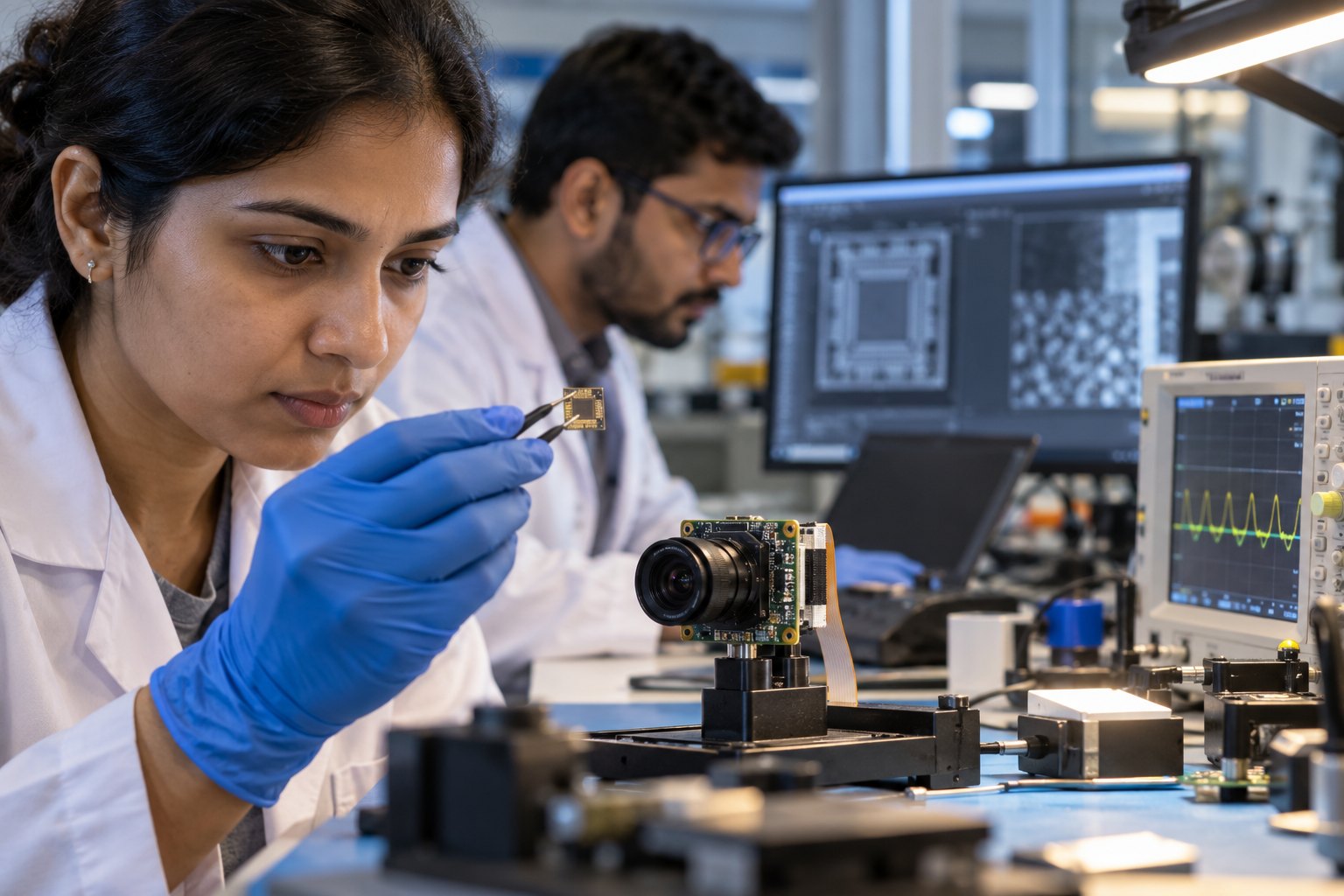
The Technology Development Board (TDB) of the Department of Science and Technology will give Bengaluru's BigEndian Semiconductors ₹130 crore from the Research Development and Innovation (RDI) Fund, the government announced on October 5, 2026. The sum, half of Project VeerAI's ₹260 crore cost, is Optional Convertible Debt to take a camera-focused AI chip from Technology Readiness Level 5 to 9.
Syllabus: GS3 · Investment Models; GS3 · Science & Technology; GS3 · Indian Achievements in S&T
Why it matters
A police control room or a housing society that installs smart CCTV cameras relies on chips from external supply chains. VeerAI aims to cut that dependence with an Indian-designed camera chip that has security and privacy features built in. Moving a chip from advanced development to commercial deployment needs heavy investment; the TDB Secretary said the RDI Fund gives sustained support for exactly that move. If VeerAI reaches TRL 9, Indian design talent will have produced a working product it owns. The larger issue is strategic autonomy in technology, as connected devices of the Internet of Things spread through critical infrastructure.
Prelims pointers
- Technology Development Board: statutory body of the Department of Science and Technology under the Technology Development Board Act, 1995; functioning since 1 September 1996.
- TDB Act, Section 6: equity capital or other financial assistance for commercial application of indigenous technology or adaptation of imported technology; aid to recognised R&D institutions.
- TDB Board: the Secretary, DST is ex-officio Chairperson; the Secretaries for Defence Research and Development and for Industrial Policy and Promotion (now DPIIT) are among its ex-officio members.
- RDI Scheme financing modes: long-term loans at low or nil interest, equity infusion (especially in start-ups) and contributions to a Deep-Tech Fund of Funds; no grants.
- Technology Readiness Levels: a nine-step maturity scale that originated at NASA; TRL 1 turns basic research into an idea, TRL 9 is proven in operation.
- System-on-chip: processor, memory, input/output and accelerators such as AI blocks integrated on a single chip, in place of separate chips on a board.
- Deep Learning works in two steps: training feeds a model examples and corrects its errors; inference applies the trained model to new data.
- India Semiconductor Mission: nodal agency of the Ministry of Electronics and IT for the ₹76,000 crore Semicon India Programme, which includes a Design Linked Incentive scheme for chip design.
Practise a UPSC-style question
With reference to the Technology Development Board (TDB), consider the following statements:
1. It is a statutory body under the Ministry of Electronics and Information Technology.
2. It can provide equity capital to industrial concerns attempting commercial application of indigenous technology.
Which of the statements given above is/are correct?
- (a) 1 only
- (b) 2 only
- (c) Both 1 and 2
- (d) Neither 1 nor 2
Show the answer
Answer: (b) 2 only
1 is incorrect: TDB is a statutory body of the Department of Science and Technology, set up under the Technology Development Board Act, 1995; the Ministry of Electronics and IT houses the India Semiconductor Mission. 2 is correct: Section 6 of the Act lets TDB give equity capital or other financial assistance to firms commercialising indigenous technology or adapting imported technology.
More from the 5 October 2026 edition
- India and Japan launch operational manual for Joint Crediting Mechanism Environment
- National Waterway-2 and Protocol Route: Assam methanol barge sails for Dhaka Economy
- World vegetable-oil prices up 18.3% in a year, raising India’s import costs Economy
- India conveying messages between Russia and Ukraine, says Jaishankar World & IR
- BRICS tax heads create India-led groups on transfer pricing, revenue statistics Economy
- Supreme Court extends three-language relief to CBSE Class 6 students National
- Indian team demonstrates 5.56-km free-space quantum key distribution link Sci-Tech