
India and Japan launch operational manual for Joint Crediting Mechanism
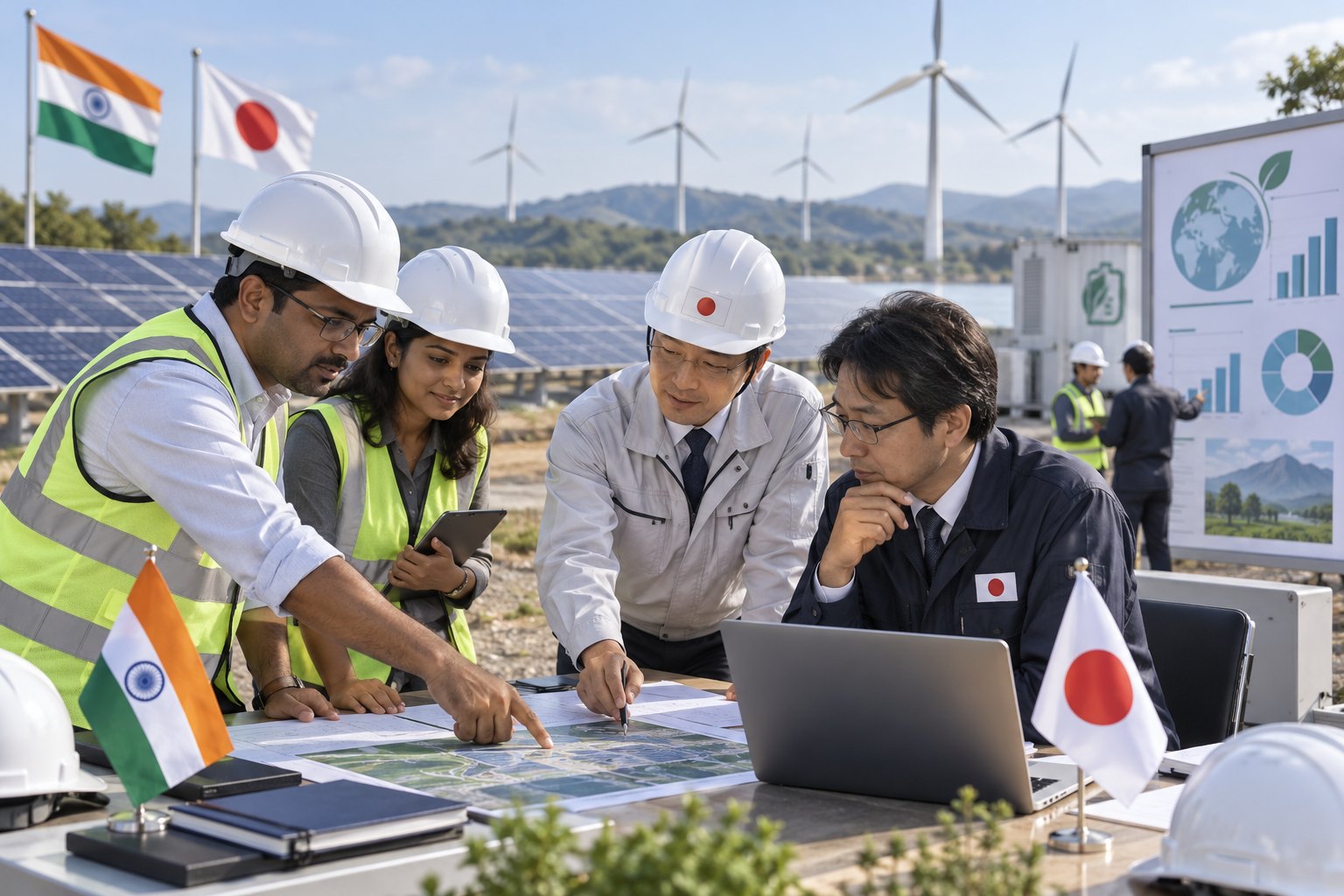
India and Japan launched the operational manual for their Joint Crediting Mechanism (JCM) in New Delhi on 30 September 2026, taking their cooperation under Article 6.2 of the Paris Agreement into implementation. The manual sets out every step of a project, from a Project Idea Note to the issuance and authorisation of JCM credits.
Syllabus: Prelims · Environment & Ecology; GS3 · Environment & Conservation; GS2 · Groupings & Agreements
Why it matters
An Indian factory owner or clean-energy developer who cannot afford an advanced low-carbon technology may now find a Japanese partner and climate finance through the JCM. The manual tells such a developer how a project is proposed, checked and credited. Each credit India authorises for Japan's use needs a corresponding adjustment: India adds it back to its own emissions balance, so it cannot also count that cut towards its own NDC. India must therefore choose which reductions to share. The larger issue is trust: a carbon market works only when every tonne is counted once.
Prelims pointers
- Article 6.2, Paris Agreement: voluntary cooperative approaches using internationally transferred mitigation outcomes (ITMOs) towards NDCs, with robust accounting to avoid double counting.
- Article 6.3: using ITMOs towards NDCs is voluntary and must be authorised by the participating Parties.
- Article 6.4: a mechanism supervised by a body designated by the Parties, the Paris Agreement Crediting Mechanism; Article 6.5 bars double use by host and buyer.
- Articles 6.8 and 6.9: a framework for non-market approaches covering mitigation, adaptation, finance, technology transfer and capacity-building.
- Corresponding adjustment: the transferring country adds transferred outcomes to its reported emissions balance and the acquiring country subtracts them; the national GHG inventory is unchanged.
- Carbon Credit Trading Scheme, 2023: Bureau of Energy Efficiency is Administrator, Grid Controller of India Limited the registry, and the Central Electricity Regulatory Commission regulates trading.
- India's NDAIAPA, notified in May 2022 and amended in August 2025, recommends the activities eligible for international carbon trading under Articles 6.2 and 6.4.
- Paris Agreement: adopted at COP21 in 2015 under the UNFCCC; Article 2 aims to hold warming well below 2°C and pursue 1.5°C.
Practise a UPSC-style question
With reference to Article 6 of the Paris Agreement, consider the following statements:
1. It allows Parties to use internationally transferred mitigation outcomes towards their nationally determined contributions.
2. The use of such transferred outcomes must be authorised by the participating Parties.
3. It recognises non-market approaches to help Parties implement their nationally determined contributions.
Which of the statements given above is/are correct?
- (a) 1 and 2 only
- (b) 2 and 3 only
- (c) 1 and 3 only
- (d) 1, 2 and 3
Show the answer
Answer: (d) 1, 2 and 3
1 is correct: Article 6.2 covers voluntary cooperative approaches that use internationally transferred mitigation outcomes towards NDCs. 2 is correct: Article 6.3 makes such use voluntary and subject to authorisation by the participating Parties. 3 is correct: Articles 6.8 and 6.9 recognise non-market approaches and set up a framework for them.
More from the 5 October 2026 edition
- National Waterway-2 and Protocol Route: Assam methanol barge sails for Dhaka Economy
- TDB backs indigenous AI vision chip with ₹130 crore Sci-Tech
- World vegetable-oil prices up 18.3% in a year, raising India’s import costs Economy
- India conveying messages between Russia and Ukraine, says Jaishankar World & IR
- BRICS tax heads create India-led groups on transfer pricing, revenue statistics Economy
- Supreme Court extends three-language relief to CBSE Class 6 students National
- Indian team demonstrates 5.56-km free-space quantum key distribution link Sci-Tech