
Indian team demonstrates 5.56-km free-space quantum key distribution link
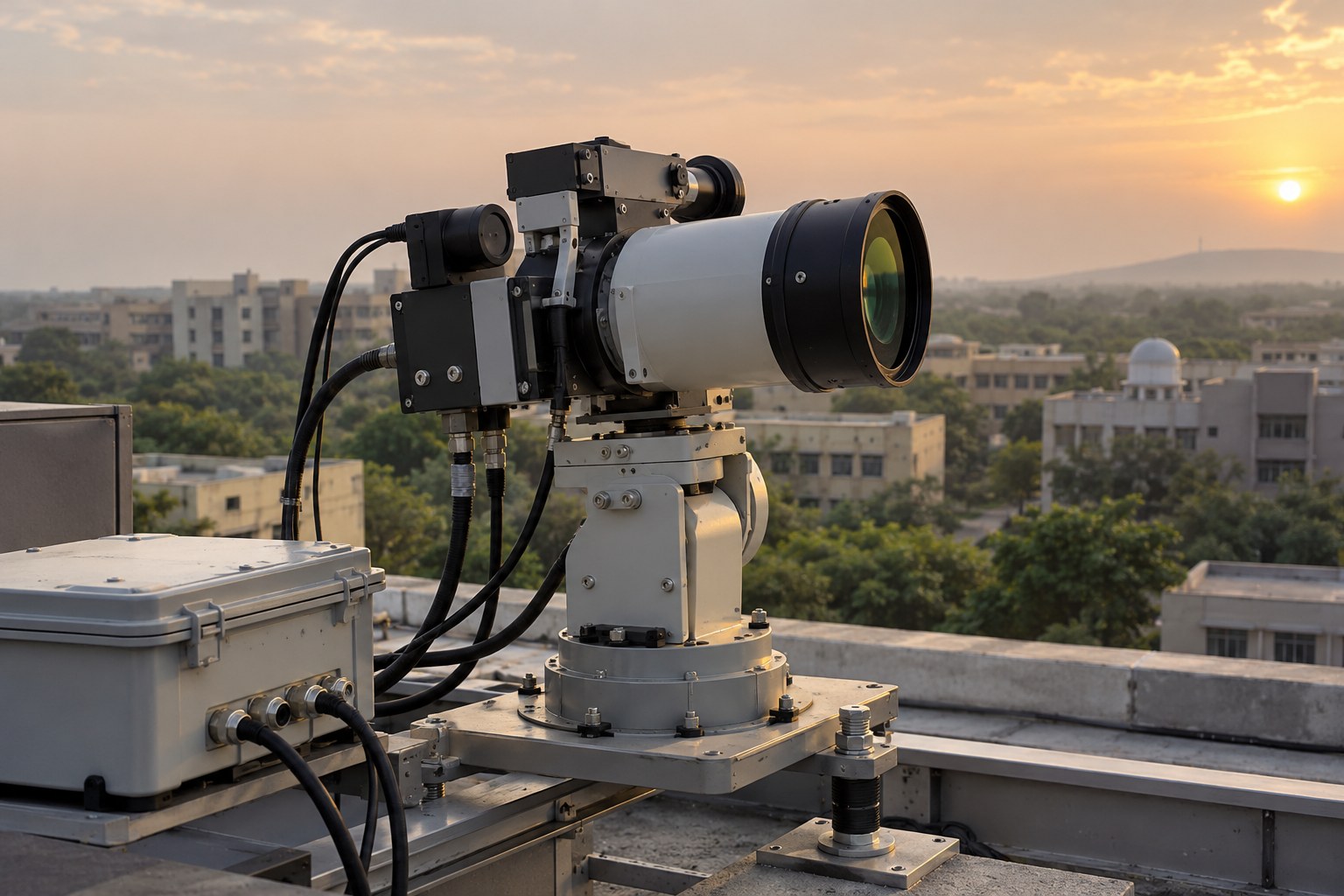
QNu Labs, BISAG-N and IIT Gandhinagar demonstrated a 5.56-km free-space quantum key distribution link on the night of September 27–28. The trial recorded a quantum bit error rate below 5% and secure key generation at 230–260 bits per second. The keys encrypted and decrypted test messages using BISAG-N’s Vedic Kavach platform.
Syllabus: GS3 · Indian Achievements in S&T; GS3 · IT, Space, Biotech & IPR; GS3 · Cyber Security & Money Laundering
Why it matters
This trial links an Indian start-up, a public scientific institution and an IIT in indigenous secure-communication research. Free-space experiments can help prepare longer-distance and satellite links envisaged by the National Quantum Mission. Combining hardware QKD with software post-quantum protection illustrates complementary approaches to quantum-era threats. A field demonstration does not establish invulnerable equipment or operational national networks: robust devices, implementation checks and reliable optical links remain essential.
Prelims pointers
- BISAG-N is an autonomous scientific society under the Ministry of Electronics and IT.
- Quantum bit error rate is the fraction of quantum bits received incorrectly.
- The National Quantum Mission targets 2,000-km satellite-based communication between ground stations and inter-city QKD using existing optical fibre.
- Post-quantum cryptography uses mathematical algorithms designed to resist conventional and quantum-computer attacks.
Practise a UPSC-style question
Consider the following statements about quantum key distribution (QKD):
1. QKD uses the same mathematical approach as post-quantum cryptography, without transmitting quantum states.
2. QKD can distribute shared encryption keys using photon quantum states.
3. Measurement disturbances in quantum transmission can help detect eavesdropping.
Which of the statements given above is/are correct?
- (a) 1 only
- (b) 1 and 2 only
- (c) 2 and 3 only
- (d) 1, 2 and 3
Show the answer
Answer: (c) 2 and 3 only
1 is incorrect: QKD uses physical quantum states, whereas post-quantum cryptography uses mathematical algorithms. 2 is correct: photon quantum states can distribute shared encryption keys. 3 is correct: measurement disturbances can reveal interception; this does not guarantee that every practical implementation is free from exploitable flaws.
More from the 5 October 2026 edition
- India and Japan launch operational manual for Joint Crediting Mechanism Environment
- National Waterway-2 and Protocol Route: Assam methanol barge sails for Dhaka Economy
- TDB backs indigenous AI vision chip with ₹130 crore Sci-Tech
- World vegetable-oil prices up 18.3% in a year, raising India’s import costs Economy
- India conveying messages between Russia and Ukraine, says Jaishankar World & IR
- BRICS tax heads create India-led groups on transfer pricing, revenue statistics Economy
- Supreme Court extends three-language relief to CBSE Class 6 students National