
The Commonwealth and CHOGM: membership, aims and India's role
Why in news: External Affairs Minister S. Jaishankar spoke on digital public infrastructure at CHOGM 2026 in St John's, Antigua and Barbuda, on 3 November 2026.
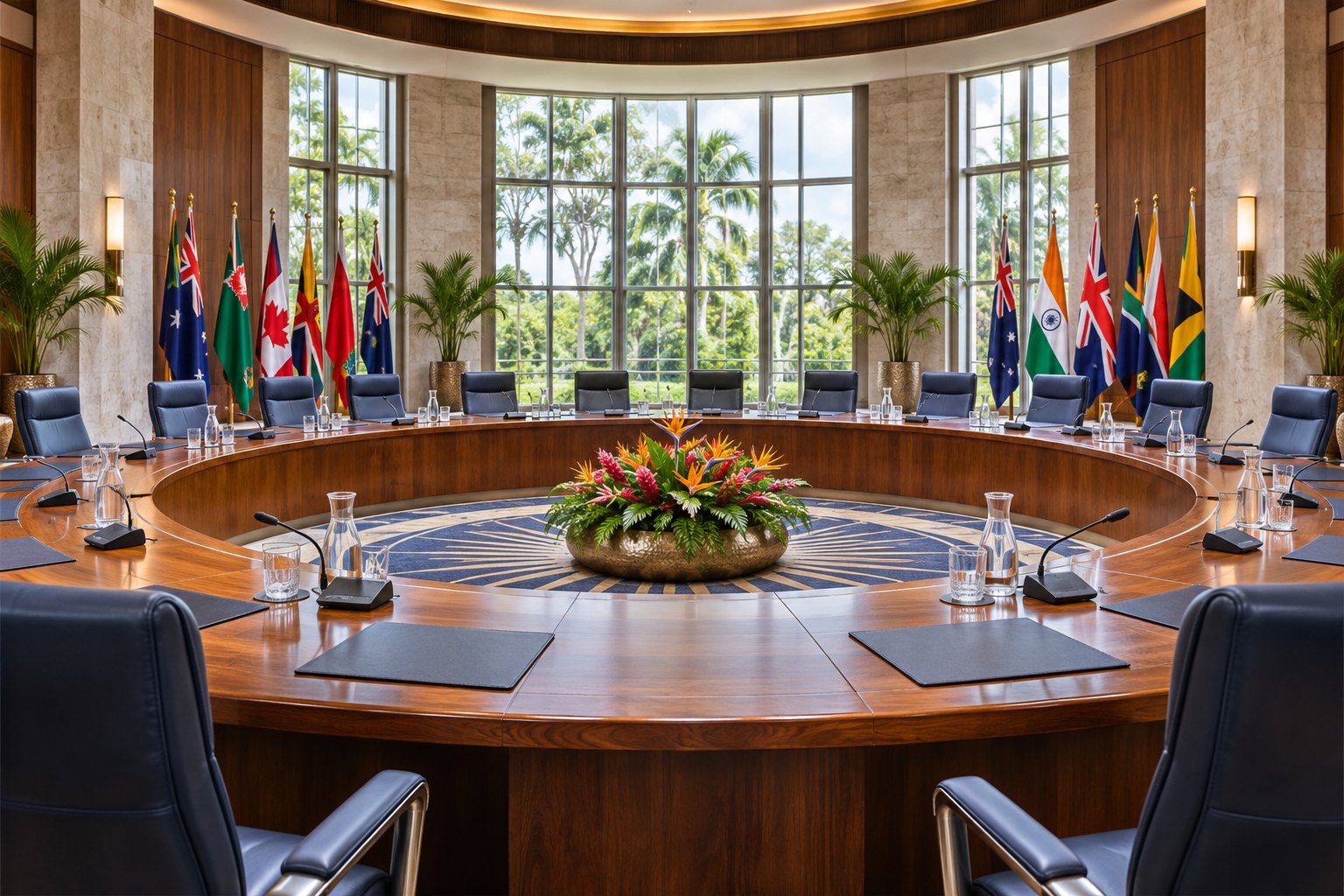
The Commonwealth of Nations is a free grouping of 56 sovereign countries that deal with one another as equals, home to 2.7 billion people. Its leaders meet every two years at the Commonwealth Heads of Government Meeting (CHOGM). External Affairs Minister S. Jaishankar spoke on digital public infrastructure at CHOGM 2026 in St John's, Antigua and Barbuda.
Syllabus: Prelims · Current Affairs & IR; GS2 · Groupings & Agreements; GS2 · International Institutions
Why this matters for UPSC
GS2 international relations: global groupings involving India, their structure and mandate. Prelims can ask about the Secretary-General, CHOGM and the Head; Mains, the Commonwealth's relevance to India.
In short
The Commonwealth of Nations is a free association of 56 sovereign and equal states, held together by shared values set out in the Commonwealth Charter.
The Commonwealth earns India's investment only by delivering for small states and partners; shared history and consensus alone cannot keep it relevant.
Why it matters
A teacher on a small Pacific or Caribbean island may never sit at the United Nations, but through the Commonwealth her government gets technical help, training and a louder voice on debt and climate change. For India, the grouping is a ready forum with dozens of developed and developing partners at one table, outside the rivalries of the big powers. When India offers its digital public infrastructure as a model, a smaller member could adopt similar systems for payments and welfare delivery, and India gains goodwill and markets. Whether such talk becomes real trade and investment decides whether the Commonwealth stays useful or fades into a ceremonial club.
Prelims pointers
- The Commonwealth Secretariat supports governments in pursuing shared aims; the Commonwealth Foundation supports citizens' participation in democracy and development.
- The headquarters of the Commonwealth Secretariat and the Commonwealth Foundation are at Marlborough House on Pall Mall, London.
- The Secretariat's Executive Committee, which works under the Board of Governors, counts the eight biggest contributors to the Secretariat's resources among its members.
- The Board of Governors normally meets yearly; it clears the Secretariat's strategic plans, its work programmes and its budgets.
- The Commonwealth Charter lists the Langkawi Declaration on the Environment and the Latimer House Principles among the earlier statements of values it affirms.
- Among its core principles, the Charter lists consensus and common action, mutual respect, inclusiveness, transparency and accountability.
Practise a UPSC-style question
With reference to the Commonwealth of Nations, consider the following statements:
1. The post of Head of the Commonwealth is hereditary and passes to the British monarch's successor.
2. The Commonwealth Secretary-General may hold office for no more than two four-year terms.
3. The Commonwealth Secretary-General is the chief executive of the Commonwealth Secretariat.
Which of the statements given above is/are correct?
- (a) 1 and 2 only
- (b) 2 and 3 only
- (c) 1 and 3 only
- (d) 1, 2 and 3
Show the answer
Answer: (b) 2 and 3 only
Answer: (b) 2 and 3 only. The Head's post is not hereditary; the Secretary-General's term limit and role are as stated.
Statement 1: incorrect. The Commonwealth Secretariat says the role of Head is not hereditary; Commonwealth leaders will choose future Heads.
Statement 2: correct. Commonwealth leaders put forward the Secretary-General, who may hold office for no more than two four-year terms.
Statement 3: correct. The Secretariat describes the Secretary-General as its Chief Executive Officer and the Commonwealth's public representative.
Eliminate: statement 1 is false because leaders choose the Head, so every option holding 1 goes. Out: (a), (c), (d).
Trap: Sounds right. The British monarch has held the post, so it looks inherited; the Commonwealth says leaders choose future Heads.
Remember: Head of the Commonwealth is symbolic and chosen by leaders; the Secretary-General runs the Secretariat.
More Explainers
- Zero FIR: Section 173 of the BNSS and where it stops Polity
- Enforcement Directorate's PMLA powers depend on a scheduled offence Polity
- Preventive detention: Article 22 and the National Security Act, 1980 Polity
- Prohibition of Child Marriage Act, 2006 and Bal Vivah Mukt Bharat National
- Liberalised Remittance Scheme (LRS) under FEMA, 1999 Economy
- Carbon sinks: why the Amazon now releases more carbon than it absorbs Environment
- Pharmacovigilance and materiovigilance: how India tracks harm from medicines and devices National
- UGC equity regulations, 2026, against discrimination in higher education Polity
- Space debris and India's Debris Free Space Mission goal for 2030 Sci-Tech
- Somnath temple: Prabhas Patan's jyotirlinga, its destruction and 1951 rebuilding National
- Food safety enforcement: FSSAI, State Commissioners and central licensing Polity
- Safe harbour for internet intermediaries under Section 79 of the IT Act Polity