
Rooftop solar and grid stability: frequency, inertia and ride-through
Why in news: Sri Lanka's grid collapsed on 17 October 2026; the system operator's preliminary report indicated a possible role for non-dispatchable sources such as rooftop solar.
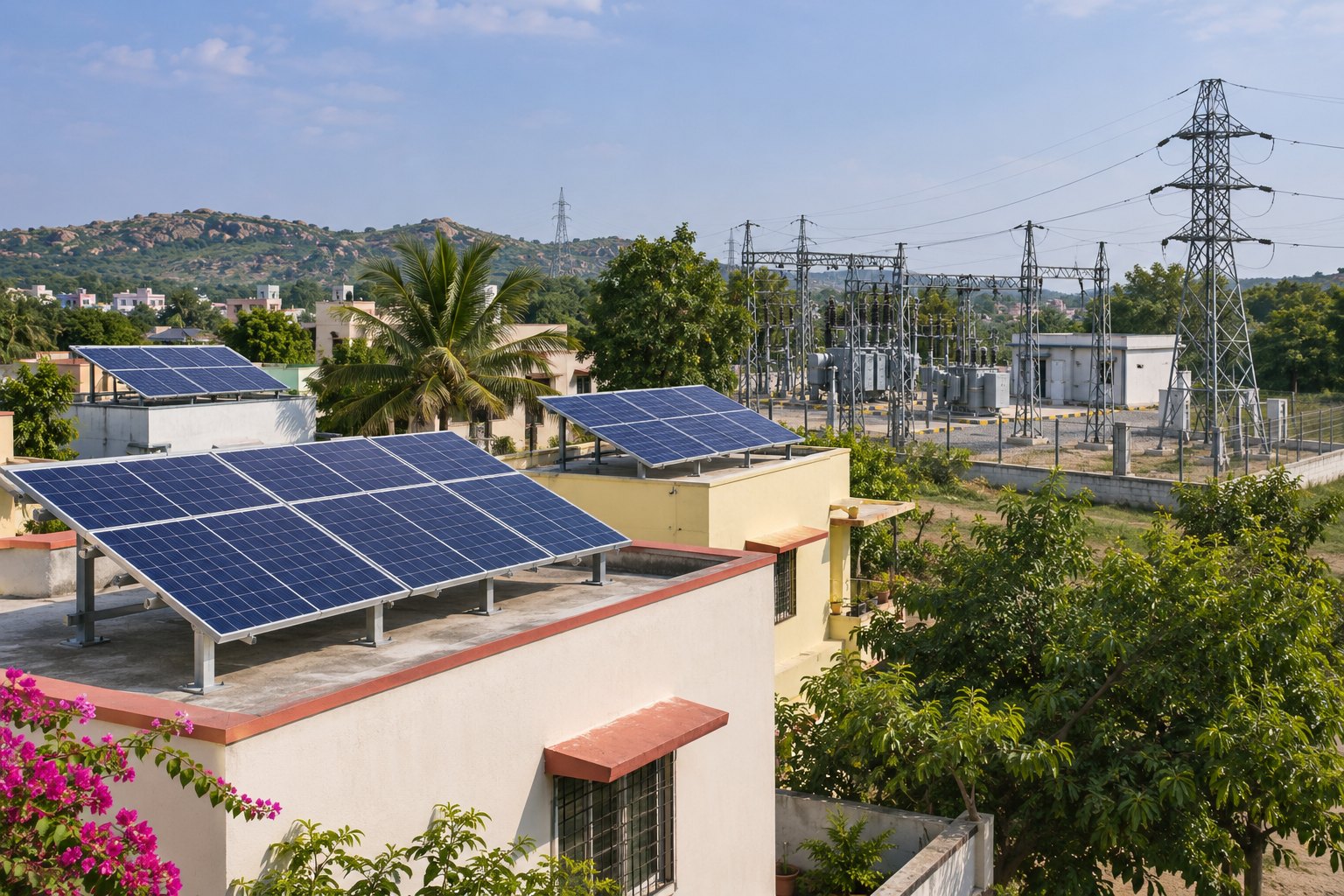
Grid stability is the task of keeping electricity supply equal to demand every second, shown by a steady frequency. Rooftop solar connects through inverters that may trip in unison during a disturbance, widening any shortfall. On 17 October 2026, Sri Lanka's national grid collapsed and its 23 million people lost power for more than five hours.
Syllabus: Prelims · Current Affairs & IR; GS3 · Infrastructure; GS3 · Science & Technology
Why this matters for UPSC
GS3 infrastructure: energy, renewable integration and grid stability. Prelims can ask about REMCs, the Indian Electricity Grid Code or ancillary services; Mains, managing rooftop solar safely.
In short
Grid stability means holding supply and demand in balance every second, which keeps frequency near its nominal value; inverter-based rooftop solar strains that balance as its share grows.
Rooftop solar can stay safe only if small inverters ride through faults like large plants, backed by storage, forecasting and enforced standards.
Why it matters
A family that puts panels on its roof saves on its bill and can sell spare power to its distribution company. Yet if thousands of such systems switch off in the same second during a fault, the power stations still running must cover the gap at once. If they cannot, frequency keeps sliding, automatic protection cuts whole areas off, and homes, hospitals and factories can sit in the dark for hours, as Sri Lanka found. The more homes go solar, the more grid safety rests on how millions of small inverters behave, not only on big plants. Settings, meters and enforcement decide whether the rooftop push makes supply cleaner without making it fragile.
Prelims pointers
- Under Frequency Load Shedding automatically drops chosen loads as frequency falls, reducing demand so that the remaining generation can hold the grid.
- Thirteen Regional Energy Management Centres forecast and track renewable generation in real time, per the Ministry of Power (2025).
- Automatic Generation Control and the SRAS and TRAS ancillary services are the tools India uses for frequency regulation and balancing.
- STATCOMs and synchronous condensers serve voltage stability and dynamic response, not frequency regulation, which falls to Automatic Generation Control and ancillary services.
- The CEA connectivity standards decide what a plant must meet before it connects; the Indian Electricity Grid Code governs how plants behave once on the grid, including frequency control.
- Energy storage systems are part of the power system under the Electricity Act, 2003; the Energy Storage Obligation climbs from 1% in 2023-24 to 4% by 2029-30.
- The Green Energy Corridor scheme of the Ministry of New and Renewable Energy builds transmission to evacuate renewable power in ten States.
Practise a UPSC-style question
With reference to the frequency of an electricity grid, consider the following statements:
1. Grid frequency rises when electricity supply suddenly drops below demand.
2. Under-frequency load shedding automatically disconnects selected loads to reduce demand when frequency falls.
Which of the statements given above is/are correct?
- (a) 1 only
- (b) 2 only
- (c) Both 1 and 2
- (d) Neither 1 nor 2
Show the answer
Answer: (b) 2 only
Answer: (b) 2 only. Statement 1 turns the direction of the frequency change around.
Statement 1: incorrect. Frequency falls, not rises, when supply suddenly drops below demand; it is the measure of the supply-demand balance.
Statement 2: correct. Under-frequency load shedding cuts chosen loads in stages as frequency falls, lowering demand to save the rest of the grid.
Eliminate: statement 1 is surely wrong, since a supply shortfall pulls frequency down. Out: (a), (c).
Eliminate: statement 2 is true, as load shedding exists to reduce demand. Out: (d).
Trap: Reversed direction. The right link between supply and frequency is given with its direction turned, from fall to rise.
Remember: less supply than demand means falling frequency; load shedding cuts demand to stop the fall.
More Explainers
- Zero FIR: Section 173 of the BNSS and where it stops Polity
- Enforcement Directorate's PMLA powers depend on a scheduled offence Polity
- Preventive detention: Article 22 and the National Security Act, 1980 Polity
- Prohibition of Child Marriage Act, 2006 and Bal Vivah Mukt Bharat National
- Liberalised Remittance Scheme (LRS) under FEMA, 1999 Economy
- Carbon sinks: why the Amazon now releases more carbon than it absorbs Environment
- Pharmacovigilance and materiovigilance: how India tracks harm from medicines and devices National
- UGC equity regulations, 2026, against discrimination in higher education Polity
- Space debris and India's Debris Free Space Mission goal for 2030 Sci-Tech
- Somnath temple: Prabhas Patan's jyotirlinga, its destruction and 1951 rebuilding National
- Food safety enforcement: FSSAI, State Commissioners and central licensing Polity
- Safe harbour for internet intermediaries under Section 79 of the IT Act Polity