
Wildlife board's Standing Committee releases marine conservation assessments
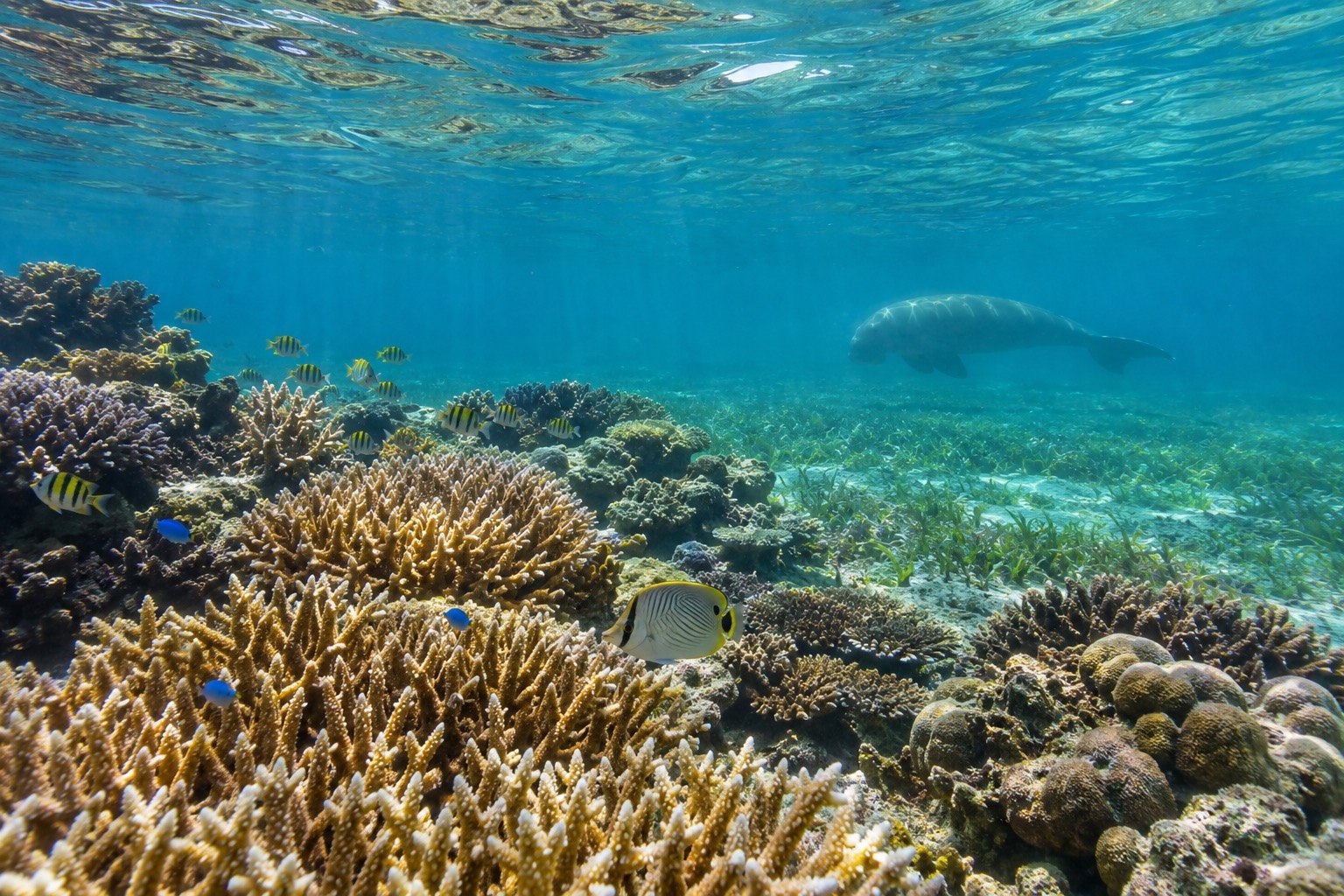
The Standing Committee of the National Board for Wildlife held its 92nd meeting on 23 November 2026. The Union Environment Minister chaired it. Its theme was marine conservation. It released Wildlife Institute of India studies on 108 coastal and marine Protected Areas. Others covered marine turtles, dugongs and the Arabian Sea humpback whale.
Syllabus: Prelims · Environment & Ecology; GS2 · Statutory & Regulatory Bodies; GS3 · Environment & Conservation
Why this matters for UPSC
GS3 environment: marine biodiversity, Protected Areas and the National Board for Wildlife. Prelims can ask the dugong's status and habitat; Mains, how well marine Protected Areas are managed.
Why it matters
A fisher in Palk Bay or the Gulf of Mannar works the same shallow waters where dugongs graze on seagrass. Gillnets and shore seine nets that catch fish also drown dugongs, and trawling tears up the meadows they need. A reliable count tells forest officers where to patrol, where to talk to fishing villages and where to restore seagrass. The same logic runs through the turtle and whale studies: knowing which beaches turtles nest on, or where whales gather, lets the State keep lights, nets and construction away at the right season. Scoring how marine reserves are managed shows which ones exist only on paper.
Prelims pointers
- Dugongs in India live in shallow, sheltered waters with seagrass: the Gulf of Mannar and Palk Bay, the Gulf of Kutch and the Andaman and Nicobar Islands.
- The dugong is now locally extinct in the Lakshadweep islands, though it was once recorded there.
- The dugong is Vulnerable on the IUCN Red List globally, but WII considers it Critically Endangered within India.
- About 450 sq km of Palk Bay forms India's first Dugong Conservation Reserve, in Tamil Nadu.
- The Coastal Regulation Zone Notification, 2019, issued under the Environment (Protection) Act, 1986, protects turtle nesting grounds, seagrasses and corals as Ecologically Sensitive Areas.
- CA|TS was launched in 2013 and agreed by the Tiger Range Countries; in 2021, 14 Indian tiger reserves, including Kaziranga, Manas and Orang in Assam, were accredited.
- India's MEE scores are meant to track each Protected Area over time, not to compare one site with another.
Practise a UPSC-style question
With reference to the Standing Committee of the National Board for Wildlife, consider the following statements:
1. It is constituted under the Environment (Protection) Act, 1986.
2. The Union Minister in charge of Environment is its Chairman.
3. It may use the powers of the National Board for Wildlife, subject to the Board's general superintendence and control.
Which of the statements given above is/are correct?
- (a) 1 and 2 only
- (b) 2 and 3 only
- (c) 1 and 3 only
- (d) 1, 2 and 3
Show the answer
Answer: (b) 2 and 3 only
Answer: (b) 2 and 3 only. The Committee is a creature of the wildlife law, led by the Environment Minister, and acts with the Board's powers.
Statement 1: incorrect. The Standing Committee is constituted by the National Board for Wildlife under the Wild Life (Protection) Act, 1972, not the 1986 environment law.
Statement 2: correct. The 2003 notification names the Minister of Environment and Forests as Chairman; the Union Environment Minister chaired the 92nd meeting in November 2026.
Statement 3: correct. Subject to the Board's general superintendence, direction and control, it may exercise all powers the Board holds under the 1972 Act.
Eliminate: statement 1 is wrong, since the Board itself exists under the 1972 Act. Out: (a), (c), (d).
Trap: Swapped attribution. The question pins the Committee on the Environment (Protection) Act, 1986, which also governs coastal rules, to catch a student who mixes the two laws.
Remember: NBWL and its Standing Committee: Wild Life (Protection) Act, 1972; Environment Minister chairs the Committee.
More from the 26 November 2026 edition
- Six brownfield urea plants taken forward under NIPU-2026 Economy
- Cabinet approves scheme to build India's construction equipment manufacturing base Economy
- Cabinet clears a PPP container terminal at Kamarajar Port on DBFOT model Economy
- Power Ministry proposes net-metering limits and storage mandate for rooftop solar Economy
- MoSPI regional accounts report moves State Domestic Product towards direct estimation Economy
- Mudigere bandh opposes Karnataka's Operation Gaja elephant drive to Bhadra Environment
- Landmine Monitor 2026 records first withdrawals from the Mine Ban Treaty World & IR
- Karnataka seeks Supreme Court halt to Tamil Nadu's Cauvery-Vaigai-Gundar link works Polity
- SEBI proposes scrapping extra disclosure framework for foreign portfolio investors Economy
- FSSAI sanctions prosecution under FSS Act over unsafe packaged drinking water National