
Cabinet clears a PPP container terminal at Kamarajar Port on DBFOT model
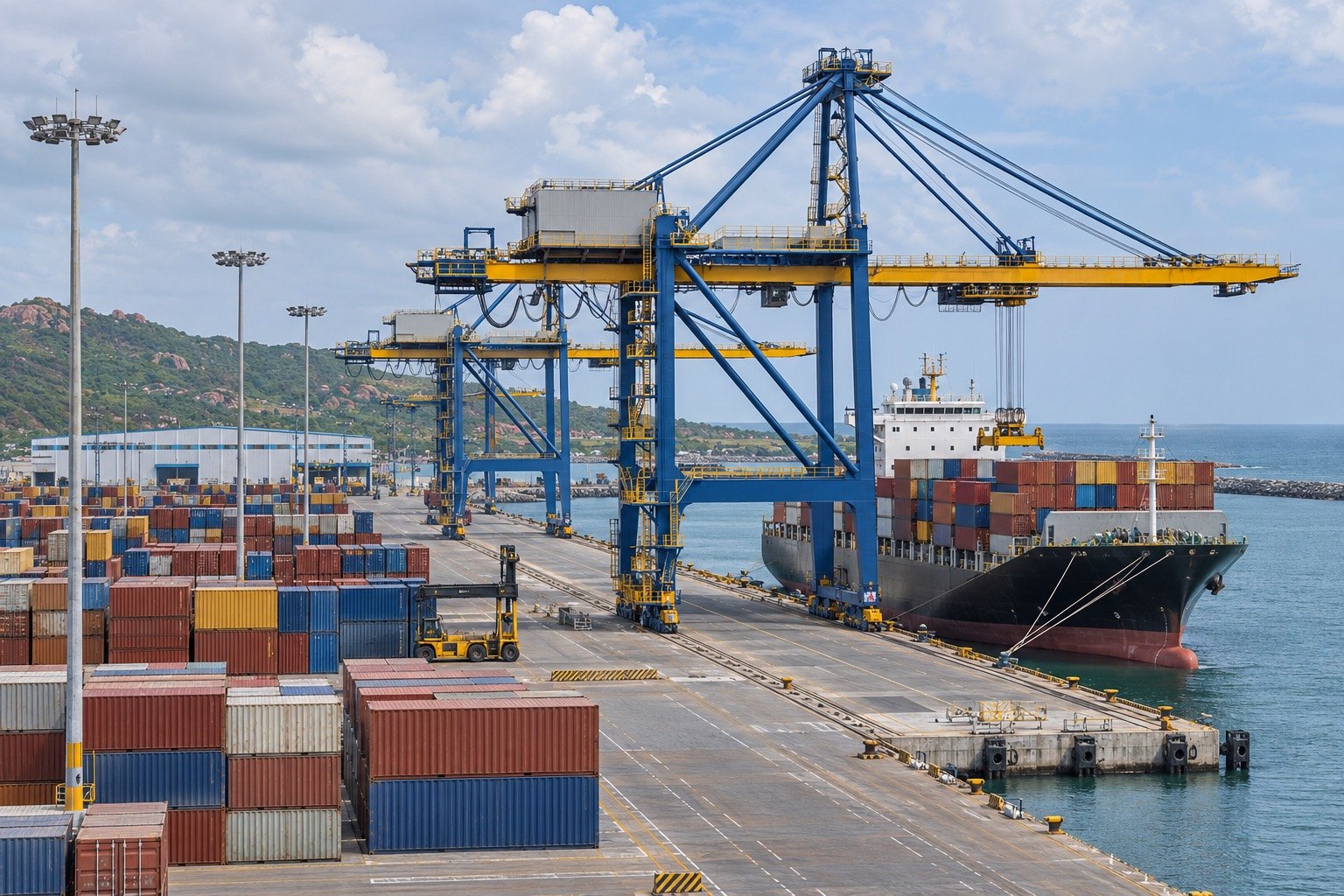
The Cabinet Committee on Economic Affairs has approved a Second Container Terminal at Kamarajar Port Limited as a public-private partnership using the DBFOT model. A private firm designs, builds, finances, operates and later transfers it. The selected private concessionaire will arrange the investment and hold a 40-year concession for the 900-metre-long terminal. The Government of India bears no financial implication.
Syllabus: Prelims · Economy & Social Development; GS3 · Infrastructure; GS3 · Investment Models
Why this matters for UPSC
GS3 infrastructure: ports and PPP investment models. Prelims can ask what DBFOT and the landlord port model mean; Mains, PPP risks and port-led trade.
Why it matters
An auto-parts maker or electronics exporter near Chennai now sends containers by small feeder ships to a foreign hub port, where they move onto mainline vessels. That adds a leg, a cost and a delay. A terminal deep enough for mainline ships could let such cargo leave from the home coast directly. Because the private concessionaire raises the money and recovers it through user charges, the taxpayer is spared the construction bill, while the Government expects new jobs in construction and operation. The risk shifts too: if traffic falls short, the private operator, not the budget, feels it first. For exporters, a second terminal also eases the crowding at the existing one.
Prelims pointers
- DBFOT expands to Design, Build, Finance, Operate and Transfer. The Concession Agreement and the applicable tariff framework govern the user charges the concessionaire may collect.
- Kamarajar Port's own website says it works on the landlord Port model, with new terminals added under PPP and captive models.
- KPL's Major Port declaration, its website says, came under the Indian Ports Act, 1908; incorporation as a company is a separate step.
- PIB lists KPL's dredging separately: about Rs 450 crore is borne by the port, outside the concessionaire's project cost.
Practise a UPSC-style question
With reference to the Design, Build, Finance, Operate and Transfer (DBFOT) mode of a public-private partnership, consider the following statements:
1. The private concessionaire designs and builds the asset.
2. The concessionaire usually recovers its investment through user charges.
3. The Government of India provides the entire construction finance.
Which of the statements given above is/are correct?
- (a) 1 and 2 only
- (b) 2 and 3 only
- (c) 1 and 3 only
- (d) 1, 2 and 3
Show the answer
Answer: (a) 1 and 2 only
Answer: (a) 1 and 2 only. DBFOT puts design, building, finance and operation with the private party.
Statement 1: correct. In DBFOT the concessionaire designs and builds the asset.
Statement 2: correct. The concessionaire earns from user charges under the concession agreement, as in the Kamarajar terminal.
Statement 3: incorrect. The F in DBFOT means the private party finances the project.
Eliminate: statement 3, since the F stands for the concessionaire's finance. Out: (b), (c), (d).
Trap: Swapped attribution. The question gives the financing role to the Government when DBFOT gives it to the concessionaire; the word Finance in the name settles it.
Remember: In DBFOT the private party finances, operates and later transfers the asset.
More from the 26 November 2026 edition
- Six brownfield urea plants taken forward under NIPU-2026 Economy
- Cabinet approves scheme to build India's construction equipment manufacturing base Economy
- Power Ministry proposes net-metering limits and storage mandate for rooftop solar Economy
- MoSPI regional accounts report moves State Domestic Product towards direct estimation Economy
- Mudigere bandh opposes Karnataka's Operation Gaja elephant drive to Bhadra Environment
- Landmine Monitor 2026 records first withdrawals from the Mine Ban Treaty World & IR
- Wildlife board's Standing Committee releases marine conservation assessments Environment
- Karnataka seeks Supreme Court halt to Tamil Nadu's Cauvery-Vaigai-Gundar link works Polity
- SEBI proposes scrapping extra disclosure framework for foreign portfolio investors Economy
- FSSAI sanctions prosecution under FSS Act over unsafe packaged drinking water National