
Karnataka seeks Supreme Court halt to Tamil Nadu's Cauvery-Vaigai-Gundar link works
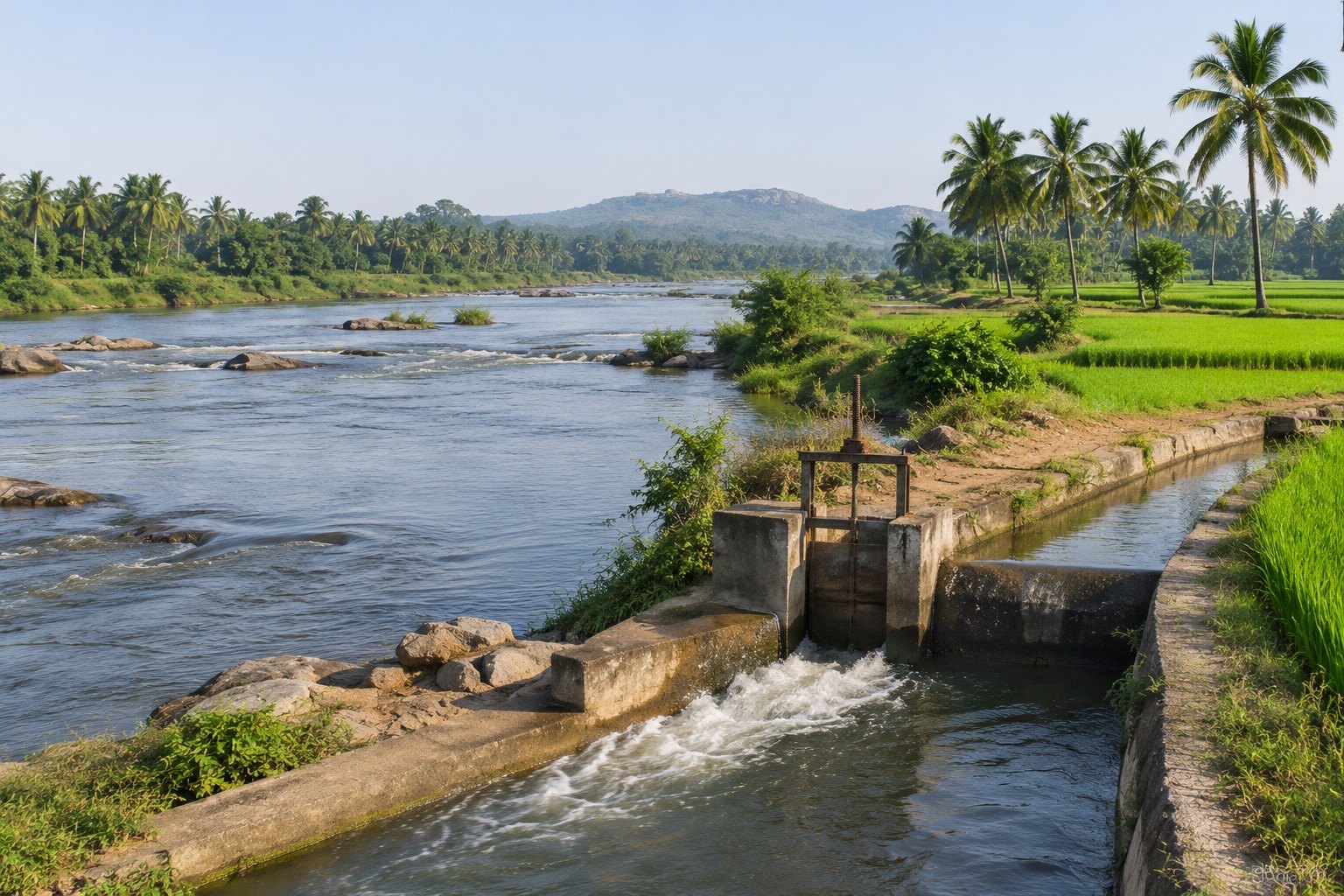
Karnataka has asked the Supreme Court to stop Tamil Nadu building the Cauvery (Kattalai)-South Vellar-Vaigai-Gundar (CVG) link. It says the works lack Union clearance. The new application is part of Karnataka's original suit. It also asks that the Union not act on Tamil Nadu's 2021 request for in-principle approval. Nor should the Union name the link a national project.
Syllabus: GS2 · Federalism & Local Government; GS2 · Separation of Powers; GS3 · Agriculture & Irrigation
Why this matters for UPSC
GS2 polity and federalism: Article 262, Article 131 and the Inter-State River Water Disputes Act, 1956. Prelims can ask who refers water disputes; Mains, consent in river interlinking.
Why it matters
A farmer who draws on the Cauvery, in Karnataka or in Tamil Nadu, has a stake in this case. If Tamil Nadu starts using surplus flows now, Karnataka fears that use could later count as Tamil Nadu's settled right and shrink its own claim. If the works are halted, money already spent may sit idle and the water it was meant to carry stays unused. The case also tests a larger question for India's federal system. Can one State push ahead on a shared river before the other States and the Union agree? And who settles it when they do not, a tribunal or the Supreme Court?
Prelims pointers
- Article 131 is a jurisdiction of the Supreme Court over disputes between governments; Article 262 is a power of Parliament to keep courts out of river water disputes.
- Article 131 does not extend to a dispute arising from a pre-Constitution treaty, agreement, covenant or sanad that continues in operation.
- The 1956 Act's grounds for seeking a Tribunal: another State's executive action or legislation, its failure to use its powers over the waters, or its failure to honour an agreement.
- The NPP identifies 30 link projects: 16 under the Peninsular component and 14 under the Himalayan component, as per PIB (2023).
- The NWDA began with the Peninsular component of the NPP and was given the Himalayan component in 1990.
- The Ken-Betwa link is the first NPP link whose implementation has begun, through the Ken-Betwa Link Project Authority, a special purpose vehicle.
- Article 263 deals with an Inter-State Council for coordination between States, a different subject from river water disputes.
Practise a UPSC-style question
With reference to Article 262 of the Constitution of India, consider the following statements:
1. It enables Parliament to provide by law for the adjudication of disputes over waters of inter-State rivers.
2. It directly bars the Supreme Court from hearing inter-State water disputes, without any law made by Parliament.
Which of the statements given above is/are correct?
- (a) 1 only
- (b) 2 only
- (c) Both 1 and 2
- (d) Neither 1 nor 2
Show the answer
Answer: (a) 1 only
Answer: (a) 1 only. Article 262 empowers Parliament; the courts are excluded only if a law says so.
Statement 1: correct. Article 262(1) lets Parliament provide by law for adjudicating disputes on the use, distribution or control of inter-State river waters.
Statement 2: incorrect. Article 262(2) says Parliament may by law exclude the Supreme Court and other courts; the bar comes from the law, as in the Inter-State River Water Disputes Act, 1956.
Eliminate: statement 1 is plainly the purpose of Article 262. Out: (b), (d).
Eliminate: statement 2 makes the bar automatic, but Article 262(2) needs a law of Parliament. Out: (c).
Trap: Wrong scope. Statement 2 turns an enabling power into a direct constitutional bar, a shift a hurried reader misses.
Remember: Article 262 enables; the 1956 Act actually bars the courts.
More from the 26 November 2026 edition
- Six brownfield urea plants taken forward under NIPU-2026 Economy
- Cabinet approves scheme to build India's construction equipment manufacturing base Economy
- Cabinet clears a PPP container terminal at Kamarajar Port on DBFOT model Economy
- Power Ministry proposes net-metering limits and storage mandate for rooftop solar Economy
- MoSPI regional accounts report moves State Domestic Product towards direct estimation Economy
- Mudigere bandh opposes Karnataka's Operation Gaja elephant drive to Bhadra Environment
- Landmine Monitor 2026 records first withdrawals from the Mine Ban Treaty World & IR
- Wildlife board's Standing Committee releases marine conservation assessments Environment
- SEBI proposes scrapping extra disclosure framework for foreign portfolio investors Economy
- FSSAI sanctions prosecution under FSS Act over unsafe packaged drinking water National