
Landmine Monitor 2026 records first withdrawals from the Mine Ban Treaty
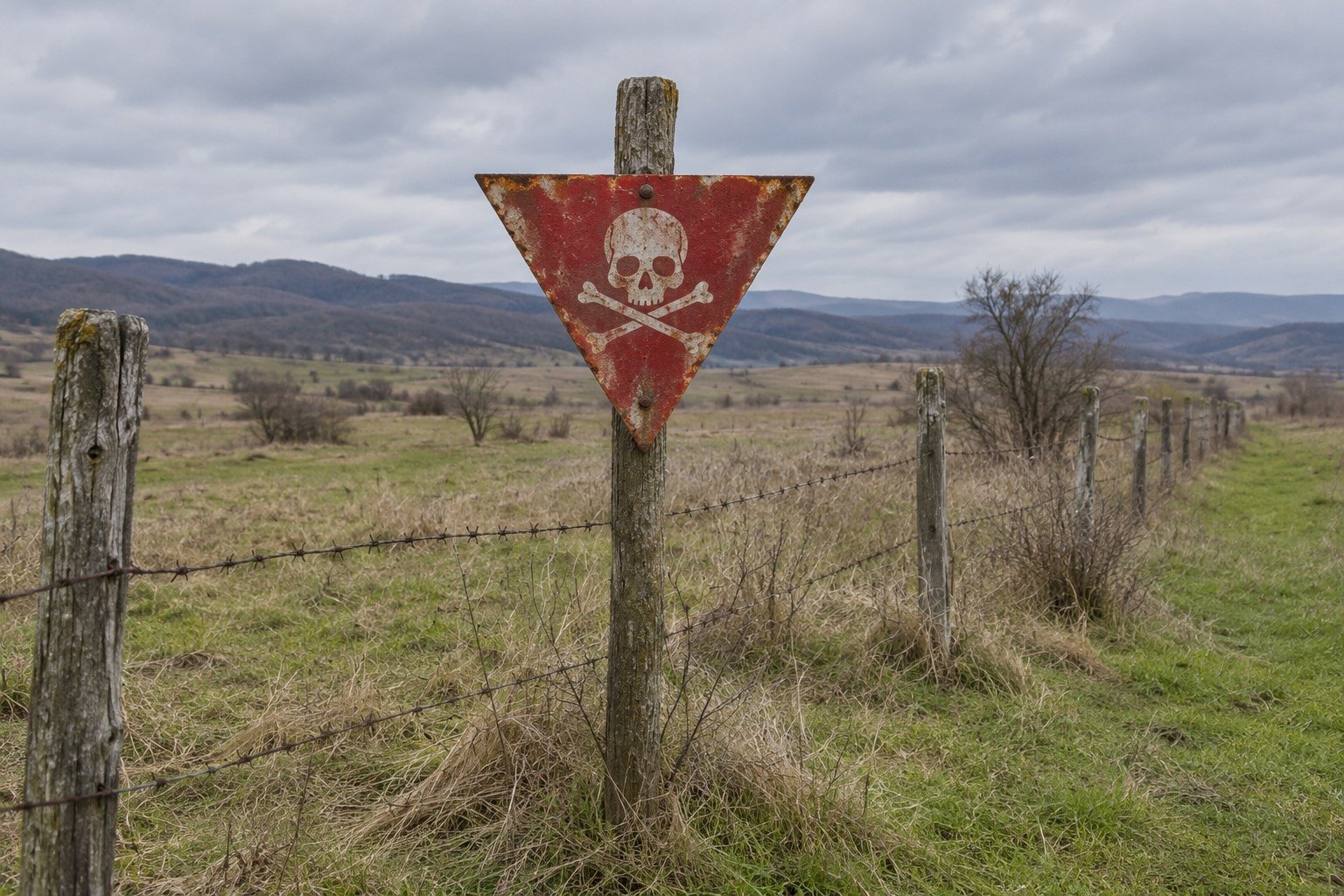
The International Campaign to Ban Landmines (ICBL) released its 28th annual Landmine Monitor on 24 November 2026. It records the first withdrawals from the 1997 Mine Ban Treaty: Estonia, Finland, Latvia, Lithuania and Poland left in 2025 and early 2026. Casualties from mines and explosive remnants of war in 2025 were the highest since 2020. India remains outside the treaty.
Syllabus: Prelims · Current Affairs & IR; GS2 · Groupings & Agreements; GS3 · Border Security & Organised Crime
Why this matters for UPSC
GS2 international relations: the Mine Ban Treaty, the CCW and India's place outside the ban. Prelims can ask what each treaty bans and how a State withdraws; Mains, humanitarian disarmament against security.
Why it matters
A farmer returning to a field after a war is the person a mine ban protects. Mines stay in the ground long after fighting stops, so a State that stops laying them spares civilians for decades. When States bordering Russia and Belarus decide to keep mines as a defence option, the rule that made such weapons unacceptable weakens, and other States may follow. For India, which stays outside the ban but where the report says armed groups use improvised mines, the debate touches both border defence and the safety of villagers in conflict areas.
Prelims pointers
- The Ottawa Convention's full name is the Convention on the Prohibition of the Use, Stockpiling, Production and Transfer of Anti-Personnel Mines and on their Destruction.
- Article 1 of the Mine Ban Treaty also forbids a State Party to assist, encourage or induce anyone to do what the treaty prohibits.
- Article 5 of the Mine Ban Treaty lets a State seek clearance extensions of up to ten years each, decided by a majority of States Parties present and voting.
- The Mine Ban Treaty entered into force on 1 March 1999, on the first day of the sixth month after the 40th ratification.
- Article 20 of the Mine Ban Treaty: a State in armed conflict when its six-month notice ends cannot leave until that conflict ends.
- Amended Protocol II of the CCW, adopted on 3 May 1996 and in force from 3 December 1998, regulates mines; the Ottawa Convention bans antipersonnel mines.
- Amended Protocol II applies to non-international armed conflicts too, and requires antipersonnel mines to be detectable with common mine detection equipment.
Practise a UPSC-style question
With reference to the Mine Ban Treaty of 1997, consider the following statements:
1. It bars States Parties from using, developing, producing, stockpiling or transferring antipersonnel mines.
2. A State Party must destroy its stockpiled antipersonnel mines within ten years of the treaty entering into force for it.
3. A State Party must clear antipersonnel mines from mined areas under its control within ten years, with extensions possible.
Which of the statements given above is/are correct?
- (a) 1 and 2 only
- (b) 2 and 3 only
- (c) 1 and 3 only
- (d) 1, 2 and 3
Show the answer
Answer: (c) 1 and 3 only
Answer: (c) 1 and 3 only. The ban is total; the stockpile deadline is four years, not ten.
Statement 1: correct. Article 1 of the Mine Ban Treaty forbids use, development, production, stockpiling, retention and transfer of antipersonnel mines.
Statement 2: incorrect. Article 4 allows four years, counted from entry into force for that State Party, to destroy stockpiled antipersonnel mines.
Statement 3: correct. Article 5 sets ten years to clear mined areas; a Meeting of the States Parties or a Review Conference may grant an extension of up to ten years.
Eliminate: Statement 2 is wrong, so every code holding 2 goes. Out: (a), (b), (d).
Trap: Near-miss figure. The ten-year clearance deadline is moved onto stockpiles, whose real deadline is four years.
Remember: Mine Ban Treaty: stockpiles destroyed in 4 years, mined areas cleared in 10.
More from the 26 November 2026 edition
- Six brownfield urea plants taken forward under NIPU-2026 Economy
- Cabinet approves scheme to build India's construction equipment manufacturing base Economy
- Cabinet clears a PPP container terminal at Kamarajar Port on DBFOT model Economy
- Power Ministry proposes net-metering limits and storage mandate for rooftop solar Economy
- MoSPI regional accounts report moves State Domestic Product towards direct estimation Economy
- Mudigere bandh opposes Karnataka's Operation Gaja elephant drive to Bhadra Environment
- Wildlife board's Standing Committee releases marine conservation assessments Environment
- Karnataka seeks Supreme Court halt to Tamil Nadu's Cauvery-Vaigai-Gundar link works Polity
- SEBI proposes scrapping extra disclosure framework for foreign portfolio investors Economy
- FSSAI sanctions prosecution under FSS Act over unsafe packaged drinking water National