
Coal Ministry guidelines make mine closure integral to every mining plan
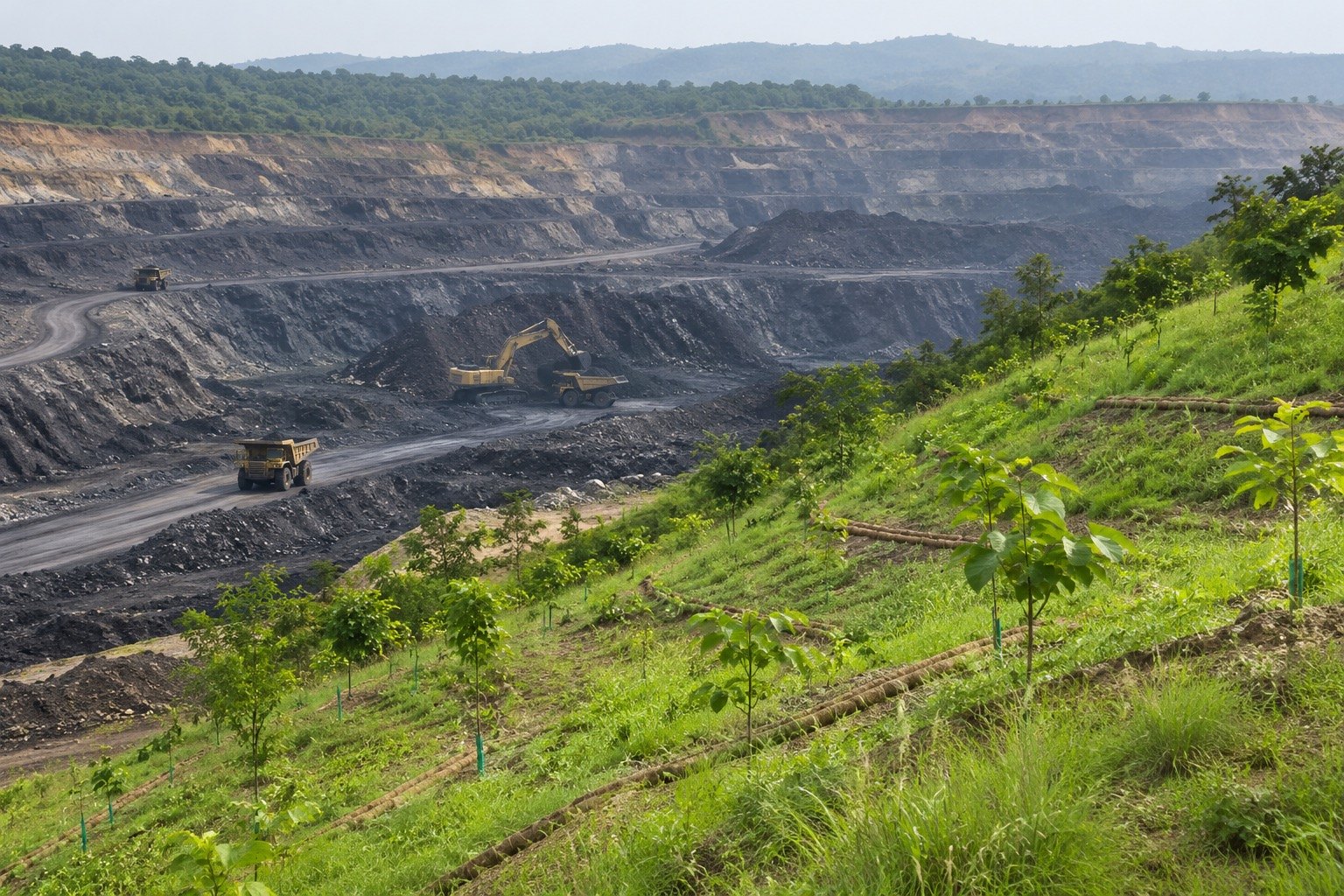
On 20 November 2026, the Ministry of Coal issued guidelines on mining plans and mine closure plans for coal and lignite mines, in force 30 days later. No block may operate without an approved Mining Plan, which includes progressive and final mine closure plans. Project proponents must open an escrow account for closure money before mining starts.
Syllabus: GS3 · Infrastructure; GS2 · Government Policies; GS3 · Environment & Conservation
Why this matters for UPSC
GS3 environment and energy: mine closure, land restoration and coal sector regulation under the MMDR Act, 1957. Prelims can ask who approves Mining Plans and how escrow works; Mains, closure that protects land and communities.
Why it matters
A farmer whose village sits beside an opencast coal pit lives with its voids and dumps long after the coal runs out. Closure is written into the plan a mine needs before it can work. The money for it is set aside in a bank while the mine still earns, so the cost of restoring the land is collected before the company leaves. That makes it harder to walk away from a worked-out pit. Part of the money must go to community development and livelihoods. Closure is meant to leave usable land, such as farms, fish ponds, eco-parks or solar plants, and some work for families that depended on the mine. Quicker repayment also gives companies a reason to restore land as they mine.
Prelims pointers
- The MMDR Act, 1957 also lets a State grant a lease on a mining plan filed under a Centre-approved State system for preparing, certifying and monitoring plans.
- A leased area under the MMDR Act, 1957 is the area in a mining lease where mining may happen, including approved non-mineralised land used for mine activities.
- The Mineral Concession Rules, 1960 are made by the Central Government under the MMDR Act, 1957, and the Centre amends them by notification in the Official Gazette.
- An abandoned mine and a discontinued mine have both stopped working with Board approval; the abandoned mine's owner never means to work it again, the discontinued mine's owner does.
- Closure deposit rates are base rates of May 2024, escalated by the Wholesale Price Index (WPI) on the day the escrow agreement is signed.
- In the guidelines, the life of a mine covers development and production, a post-mining closure period and a post-closure monitoring period, in that order.
- Backfilling a mine void counts as closure work only where it is done for closure, not as part of regular mining.
Practise a UPSC-style question
With reference to the approval of Mining Plans for coal and lignite blocks, consider the following statements:
1. The Directorate General of Mines Safety scrutinises each Mining Plan and recommends its approval or rejection to the Coal Controller.
2. The Ministry of Coal has authorised the Coal Controller to approve Mining Plans under the Mines and Minerals (Development and Regulation) Act, 1957.
3. A public sector company's Board may approve its block's Mining Plan when conditions on land acquisition and plan vetting are met.
Which of the statements given above is/are correct?
- (a) 1 and 2 only
- (b) 2 and 3 only
- (c) 1 and 3 only
- (d) 1, 2 and 3
Show the answer
Answer: (b) 2 and 3 only
Answer: (b) 2 and 3 only. The Coal Controller approves under the MMDR Act, and PSU Boards may approve in set cases; DGMS is not the scrutiny body.
Statement 1: incorrect. Under the Ministry of Coal's 2026 guidelines, a Technical Committee scrutinises each Mining Plan and recommends approval or rejection to the Coal Controller.
Statement 2: correct. A Ministry of Coal notification of 2020 authorised the Coal Controller to approve Mining Plans under the MMDR Act, 1957.
Statement 3: correct. The Board of a central or State public sector undertaking may approve its block's plan if the land came under the coal acquisition or nationalisation laws and CMPDIL prepared or vetted the plan.
Eliminate: statement 1 names the wrong body, so every option with 1 goes. Out: (a), (c), (d).
Trap: Swapped attribution. The Directorate General of Mines Safety is a familiar mining regulator, so a student may credit it with the Technical Committee's scrutiny role.
Remember: Technical Committee scrutinises; the Coal Controller approves; a PSU Board may approve in set cases.
More from the 24 November 2026 edition
- RBI draft proposes trusted-person approval and stop switch against banking fraud Economy
- India's first dedicated human metabolic chamber opens at CMC Vellore Sci-Tech
- RBI keeps SBI, HDFC Bank, ICICI Bank as domestic systemically important banks Economy
- COP31 at Antalya ends without a cover decision over fossil fuels Environment
- ICMR's SAMPADA survey, using venous blood, finds lower anaemia estimates National
- India's landslide susceptibility map covers 4.3 lakh sq km Environment
- India, Nepal adopt Joint Vision; India announces Rs 15,000 crore package World & IR