
TRAI recommends satellite network provider authorisation and direct-to-device services
The Telecom Regulatory Authority of India (TRAI) on 5 November 2026 recommended that the Centre create an authorisation for companies that run satellite networks and rent them to telecom operators. It also backed letting ordinary phones connect straight to satellites, over both mobile-satellite and mobile-network spectrum. The Department of Telecommunications is yet to decide.
Syllabus: Prelims · Current Affairs & IR; GS2 · Statutory & Regulatory Bodies; GS3 · Infrastructure
Why this matters for UPSC
GS3 infrastructure and space technology; GS2 statutory bodies such as TRAI. Prelims can ask about FSS, MSS and the First Schedule; Mains, auction versus administrative spectrum assignment.
Why it matters
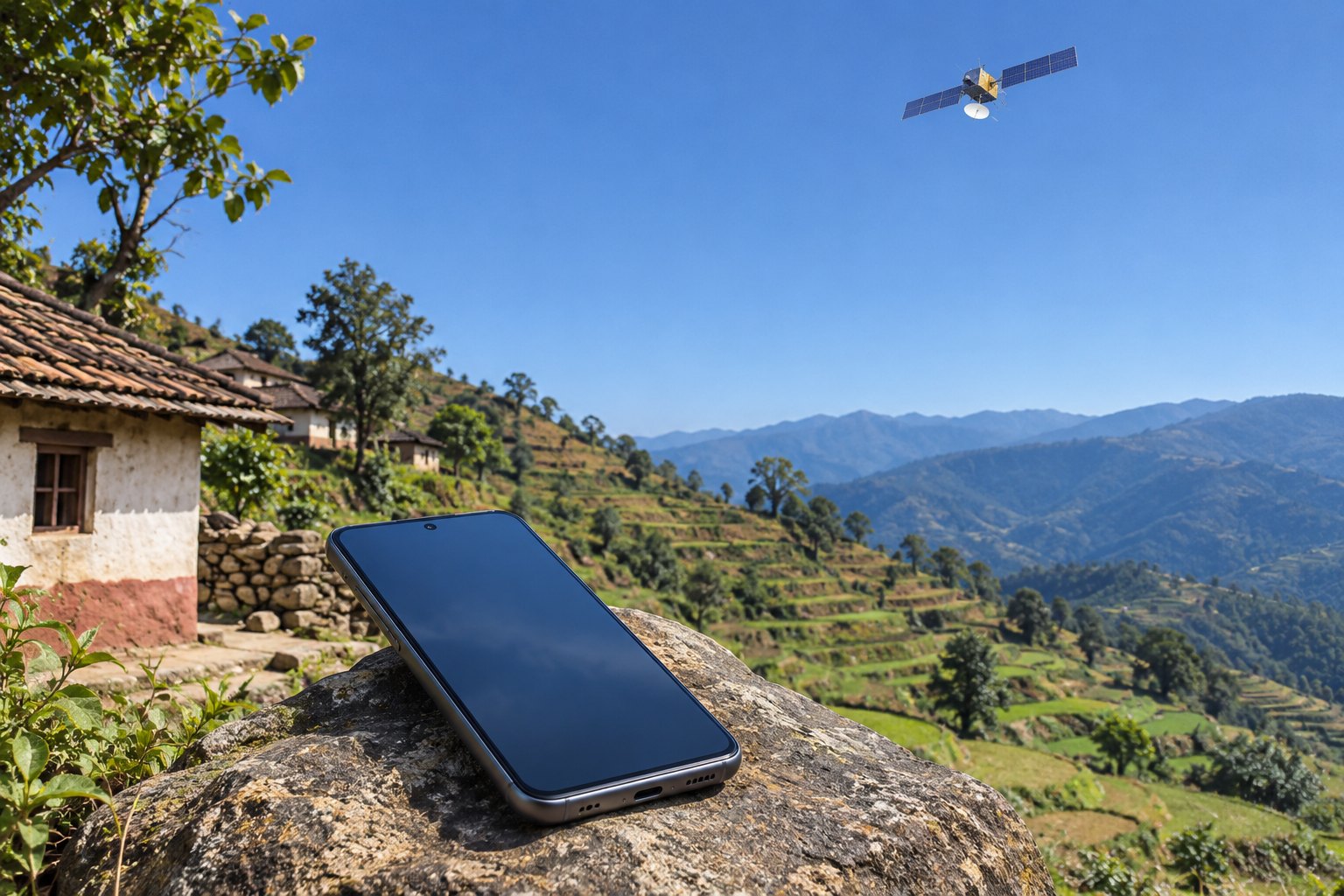
A family in a hill village with no mobile tower could one day get a phone signal straight from a satellite, if the Government accepts these recommendations and handsets carry the needed modules. Telecom companies would not each need to build their own satellite network: they could rent capacity from a network provider, which could lower the cost of entering the business. Because satellite signals cross borders, the plan keeps traffic routed through gateways inside India so that security agencies can still monitor it. The larger issue is how India shares a scarce public resource, spectrum, among many users without auctions while keeping the playing field level.
Prelims pointers
- The Telecommunications Act, 2023 defines administrative process as the assignment of spectrum without holding an auction.
- The First Schedule of the Telecommunications Act, 2023 also covers in-flight and maritime connectivity, community radio stations, radio backhaul and disaster management.
- TRAI recommends terms; the Central Government, through DoT, grants authorisations and assigns spectrum under the Telecommunications Act, 2023.
- FSS links fixed earth stations and uses bands such as C, Ku and Ka; MSS serves mobile terminals, with user links in the L and S bands.
- NFAP-2025 allocates radio spectrum from 8.3 kHz to 3000 GHz and identified the 6425-7125 MHz band for IMT.
- A feeder link joins a satellite to a gateway earth station; a user link joins the satellite to the user's terminal.
Practise a UPSC-style question
With reference to TRAI's November 2026 recommendations on a Satellite Communication Network Provider Authorisation, consider the following statements:
1. Holders of the authorisation would be allowed to sell telecom services directly to individual users.
2. The authorisation would be granted separately for each of the 22 licensed service areas.
3. Spectrum for FSS and MSS would be assigned to authorised entities administratively, without an auction.
Which of the statements given above is/are correct?
- (a) 1 only
- (b) 2 only
- (c) 3 only
- (d) 1, 2 and 3
Show the answer
Answer: (c) 3 only
Answer: (c) 3 only. Only the administrative assignment of FSS and MSS spectrum matches the recommendations.
Statement 1: incorrect. An SCN provider would offer SCNaaS to licensed providers and could not provide telecom services directly to users.
Statement 2: incorrect. TRAI recommended the national area as the network area, for up to 20 years.
Statement 3: correct. TRAI recommended administrative assignment of FSS feeder-link and FSS or MSS user-link spectrum, for up to five years.
Eliminate: statement 1 is surely wrong, since the new holder is a wholesale network provider. Out: (a), (d).
Eliminate: statement 2 is wrong, since the area is national. Out: (b).
Trap: Wrong scope. Statement 2 narrows a nationwide authorisation to service areas, a unit that belongs to the IMT-based D2D condition instead.
Remember: SCN providers are wholesale: they serve licensed providers, nationwide, with administratively assigned spectrum.
Explainers on this topic
More from the 6 November 2026 edition
- Supreme Court: Article 22(2)'s 24 hours run from detention, not arrest Polity
- CERT-In issues AI security audit guidelines with six-hour incident reporting Sci-Tech
- US sanctions India-based network over fake registries for Iran's shadow fleet World & IR
- Eleven arrested after 100-day dharna for rehabilitation at LPAI land port National
- UP Chief Electoral Officer orders Assembly and local body rolls matched Polity
- SEBI allows digital KYC from abroad for NRIs, OCIs and foreign nationals Economy
- India issues guidelines to recognise OECMs towards the 30x30 target Environment
- Supreme Court leaves rotation of SC/ST-reserved seats to Parliament Polity
- Draft Drugs Rules change proposes immediate licence suspension for NSQ drugs National