
India rejects UN rapporteur's 'India-based' D-Company label at UNGA Third Committee
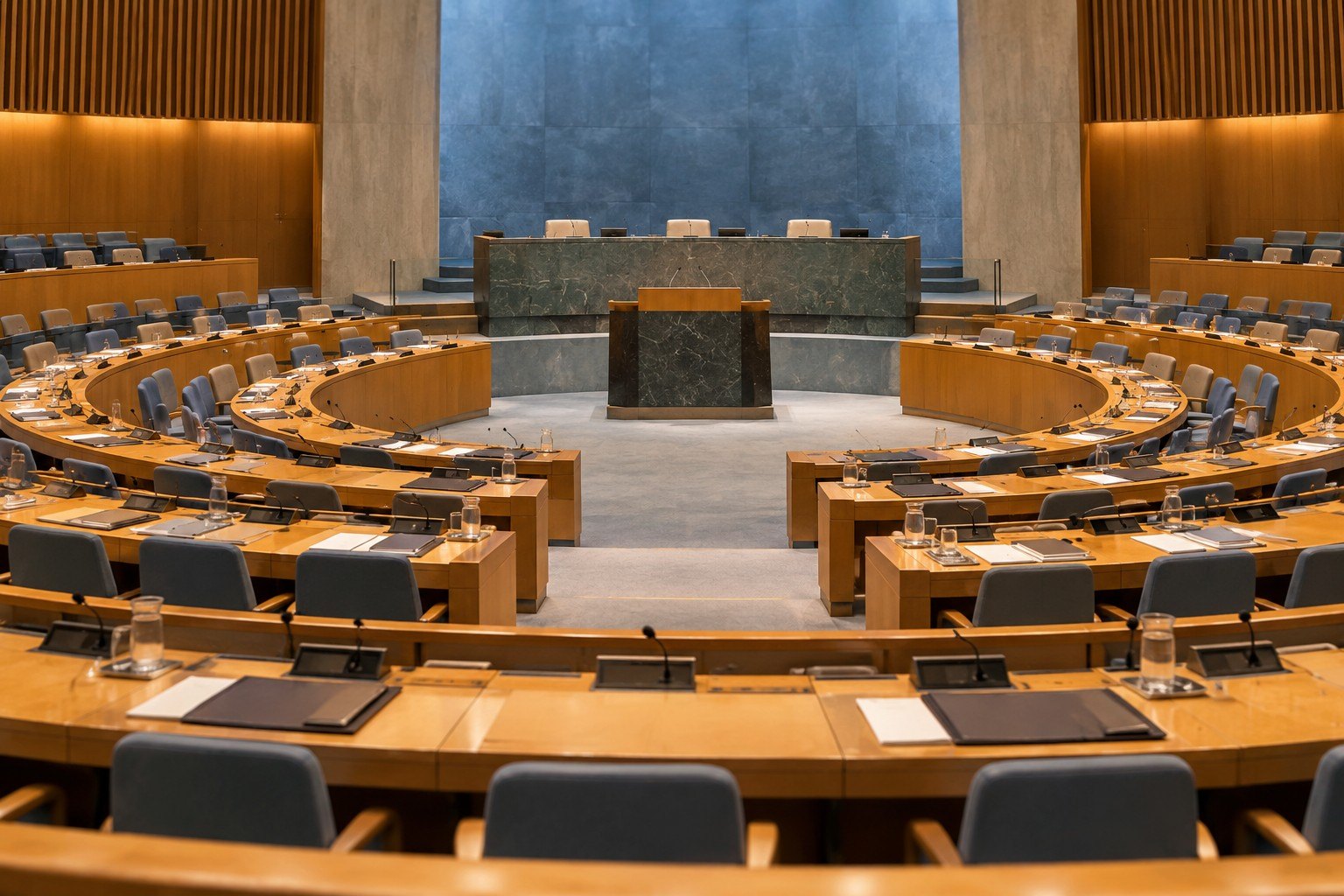
India on 21 October 2026 rejected a UN Special Rapporteur's description of Dawood Ibrahim's D-Company as "India-based", in the UN General Assembly's Third Committee. First Secretary Raghoo Puri said report A/81/227 left out that Dawood has been wanted in India for terror attacks since 1993. The Security Council listed him under its 1267 Al-Qaida sanctions regime in 2003.
Syllabus: Prelims · Current Affairs & IR; GS3 · Border Security & Organised Crime; GS2 · International Institutions
Why this matters for UPSC
GS2 international institutions: Prelims can ask how a Special Rapporteur is mandated, what the Third Committee handles and what the 1267 sanctions regime imposes; GS3 Mains, about the linkages of organized crime with terrorism.
Why it matters
For families of those killed in the 1993 Bombay bombings, how the UN describes Dawood Ibrahim's gang is not a small matter. A UN report is quoted for years by governments, courts and researchers. If his network is called "India-based", the fact that he left India long ago and is listed with addresses abroad drops out of view, and the question of who shelters him fades with it. The exchange also shows a wider tension. UN experts are independent so that they can criticise any government without fear, but governments, India among them, argue that independence must come with accuracy and with some way to correct errors.
Prelims pointers
- Human Rights Council: 47 member states, elected by a majority of the General Assembly by secret ballot for three-year terms; no immediate re-election after two consecutive terms.
- Human Rights Council seats by region: African and Asian groups 13 each, Latin American and Caribbean 8, Western European and others 7, Eastern European 6.
- UNGA main committees: six, and every member state may sit on each; Third Committee covers social, humanitarian and cultural questions, including human rights and crime prevention.
- Ombudsperson to the 1267 Committee: an independent office created by resolution 1904 (2009) that reviews requests to be removed from its sanctions list.
- Resolution 1988 (2011) moved Taliban-linked names to a separate committee; resolution 2253 (2015) widened the criteria to supporters of ISIL (Da'esh).
- UN Convention against Transnational Organized Crime (2000), Article 2(a): an organized criminal group acts to obtain a financial or other material benefit.
- No binding international instrument defines terrorism; the General Assembly's 1994 Declaration on Measures to Eliminate International Terrorism speaks of criminal acts for political purposes.
Practise a UPSC-style question
With reference to Special Rapporteurs of the United Nations, consider the following statements:
1. They are treated as experts on mission under the 1946 Convention on the Privileges and Immunities of the United Nations.
2. Some of them present their reports to the UN General Assembly's Third Committee.
Which of the statements given above is/are correct?
- (a) 1 only
- (b) 2 only
- (c) Both 1 and 2
- (d) Neither 1 nor 2
Show the answer
Answer: (c) Both 1 and 2
Answer: (c) Both 1 and 2. Both describe the status and reporting of UN special procedures experts.
Statement 1: correct. OHCHR Fact Sheet 27 says every mandate holder, whatever the title, is an expert on mission under the 1946 Convention.
Statement 2: correct. The Third Committee hears special rapporteurs mandated by the Human Rights Council and the General Assembly, as it heard Ben Saul in October 2026.
Eliminate: statement 2 is surest, since the news itself is a rapporteur at the Third Committee. Out: (a), (d).
Eliminate: statement 1 is also correct, by the 1946 Convention. Out: (b).
Trap: Sounds right. A student may think an expert on mission must be UN staff and doubt statement 1, but the status comes from the 1946 Convention, not a salary.
Remember: Special Rapporteurs are unpaid, independent experts on mission who report to the Council and often to the Third Committee.
Explainers on this topic
More from the 23 October 2026 edition
- India questions UN rapporteur's funeral-rights report at Third Committee World & IR
- Illegal arrest: Bombay HC orders Rs 5 lakh, officers' suspension Polity
- Loss and Damage Fund makes first country allocation: $21.6 million to Nepal Environment
- India seeks text-based talks on UN Security Council reform World & IR
- Centre launches Khet Bachao Abhiyan for soil health and balanced fertiliser use Economy
- UN Women, World Bank brief maps parenthood leave gap in 190 economies World & IR
- Delhi High Court: hygienic public toilets part of the right to life Polity
- High Courts direct Juvenile Justice Boards: no child in adult jails Polity
- MP High Court: a spouse's consent cannot justify rehab detention Polity
- PM-DAKSH trained 1.87 lakh, placed 96,162 before PMKVY merger National
- Navy's First Training Squadron reaches Maldives under MAHASAGAR vision Defence
- J&K and Ladakh High Court: denying earned wages breaches Article 23 Polity