
India seeks text-based talks on UN Security Council reform
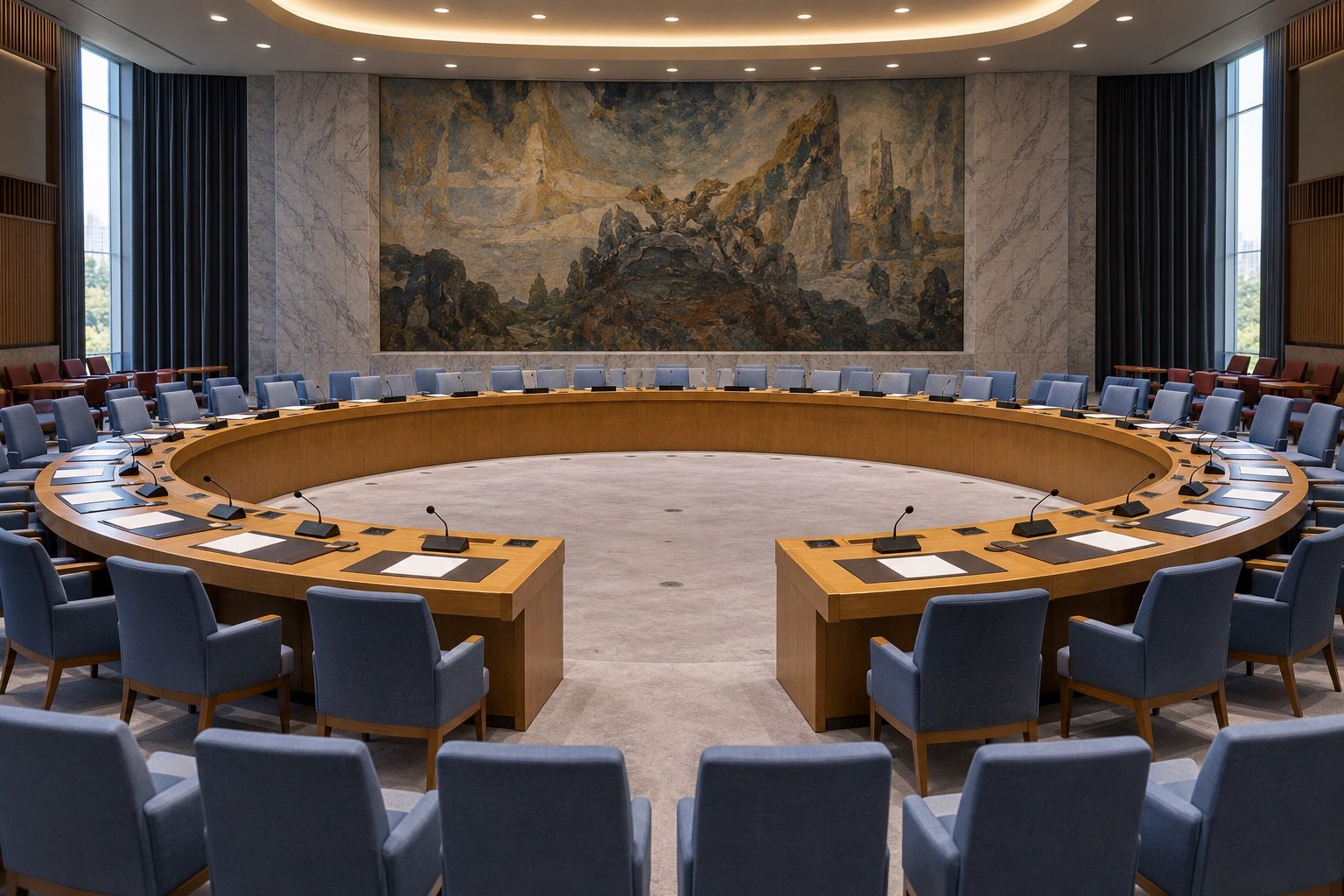
India told the UN General Assembly on 22 October 2026 that an unrepresentative Security Council faces a deficit of legitimacy. Its Permanent Representative, Harish Parvathaneni, sought new permanent and non-permanent seats. He called for a negotiating text in the Intergovernmental Negotiations. On the veto, he said new and old permanent members must both hold it while it exists.
Syllabus: Prelims · Current Affairs & IR; GS2 · Groupings & Agreements; GS2 · International Institutions
Why this matters for UPSC
GS2 international institutions. Prelims can ask about Article 23, Article 27 and Article 108 of the UN Charter and the Intergovernmental Negotiations; Mains, about India's bid for a permanent seat.
Why it matters
The Security Council is the UN organ whose decisions every member state agrees, under Article 25, to carry out, so who sits on it decides whose interests shape sanctions, peacekeeping mandates and responses to war. Hundreds of millions of people in Asia, Africa and Latin America are spoken for by few seats, so their governments have little say when the Council acts, or fails to act, on conflicts near them. For India, a permanent seat would mean a lasting voice on terrorism listings and on the mandates under which its soldiers serve as peacekeepers. The larger issue is whether a body designed after one war can stay credible when power and population have shifted, or whether states will turn to forums outside it.
Prelims pointers
- Article 23 of the UN Charter still names the Republic of China and the Union of Soviet Socialist Republics as permanent members; China and Russia hold those seats today.
- A retiring non-permanent member of the Security Council is not eligible for immediate re-election, under Article 23(2) of the UN Charter.
- Article 27 of the UN Charter: procedural decisions need nine affirmative votes; all other decisions need nine including the concurring votes of the permanent members.
- Article 108 of the UN Charter: an amendment enters into force once adopted by two-thirds of General Assembly members and ratified by two-thirds of UN members, all permanent members included.
- Article 109 of the UN Charter: a General Conference to review the Charter may be called by a two-thirds General Assembly vote and any nine Council members.
- Article 24 of the UN Charter says the Security Council acts on members' behalf; under Article 25, members agree to accept and carry out its decisions.
- Decision 62/557 (2008) lists five key issues: categories of membership, the veto, regional representation, size and working methods, and Council-Assembly relations.
- The 1963 Charter amendments, in force in 1965, also raised the Council's voting threshold from seven to nine affirmative votes.
Practise a UPSC-style question
With reference to amending the Charter of the United Nations, consider the following statements:
1. An amendment enters into force after adoption by two-thirds of the General Assembly and ratification by two-thirds of UN members, including all permanent Council members.
2. A General Conference to review the Charter may be called by a two-thirds General Assembly vote and any seven Security Council members.
3. The Charter has been amended to enlarge the Security Council from eleven to fifteen members.
Which of the statements given above is/are correct?
- (a) 1 and 2 only
- (b) 2 and 3 only
- (c) 1 and 3 only
- (d) 1, 2 and 3
Show the answer
Answer: (c) 1 and 3 only
Answer: (c) 1 and 3 only. Article 108 is right and the 1963 enlargement happened, but Article 109 needs nine Council votes.
Statement 1: correct. Article 108 requires a two-thirds General Assembly vote, then ratification by two-thirds of members including all five permanent members.
Statement 2: incorrect. Article 109 calls a General Conference by a two-thirds General Assembly vote and a vote of any nine Security Council members, not seven.
Statement 3: correct. Amendments adopted on 17 December 1963 and in force from 31 August 1965 raised the Council from eleven to fifteen members.
Eliminate: Statement 2 is wrong because Article 109 asks for nine Council votes. Out: (a), (b), (d).
Trap: Near-miss figure. Seven was the Council's old voting threshold before 1965, so it looks familiar in a Charter provision that actually says nine.
Remember: Article 108 amends, Article 109 reviews; both need every permanent member's ratification to take effect.
More from the 23 October 2026 edition
- India questions UN rapporteur's funeral-rights report at Third Committee World & IR
- Illegal arrest: Bombay HC orders Rs 5 lakh, officers' suspension Polity
- Loss and Damage Fund makes first country allocation: $21.6 million to Nepal Environment
- Centre launches Khet Bachao Abhiyan for soil health and balanced fertiliser use Economy
- UN Women, World Bank brief maps parenthood leave gap in 190 economies World & IR
- Delhi High Court: hygienic public toilets part of the right to life Polity
- High Courts direct Juvenile Justice Boards: no child in adult jails Polity
- MP High Court: a spouse's consent cannot justify rehab detention Polity
- PM-DAKSH trained 1.87 lakh, placed 96,162 before PMKVY merger National
- Navy's First Training Squadron reaches Maldives under MAHASAGAR vision Defence
- J&K and Ladakh High Court: denying earned wages breaches Article 23 Polity
- Vague anti-social allegations cannot justify preventive detention: J&K High Court Polity