
Centre launches Khet Bachao Abhiyan for soil health and balanced fertiliser use
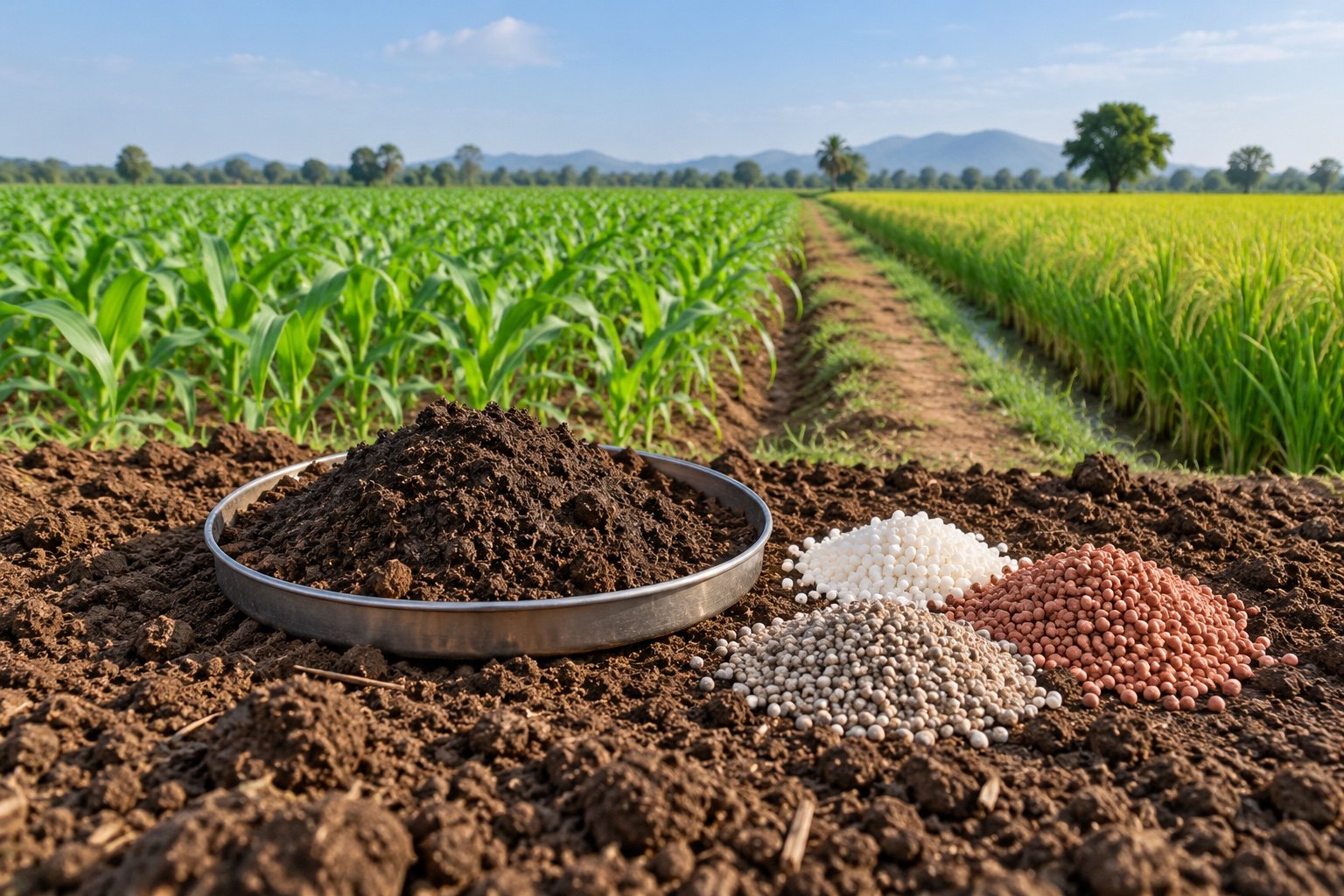
Union Agriculture Minister Shivraj Singh Chouhan launched the nationwide Khet Bachao Abhiyan on 22 October 2026 at Taraori, Haryana. He asked scientists and officials to hold village meetings until 30 November, urging fertiliser use guided by Soil Health Cards, pulses in crop rotation and natural farming. He also handed Haryana an approval for 28,422 rural houses.
Syllabus: GS3 · Agriculture & Irrigation; GS3 · MSP, Subsidies & Food Security; GS2 · Welfare of Vulnerable Sections
Why this matters for UPSC
GS3 agriculture covers fertiliser subsidies and soil health. Prelims can ask about the Soil Health Card Scheme, the Nutrient Based Subsidy scheme, ICAR and PMAY-G; Mains, about balanced nutrient use and natural farming.
Why it matters
A farmer who adds an extra bag of urea because a neighbour does pays more and may harvest no more. Over years, too much of one nutrient and too little of others wears the soil down, so the same field needs ever more fertiliser to hold its yield. The taxpayer also pays, because every subsidised bag costs the government money. Testing the soil first and growing a pulse between cereal crops can cut that bill while keeping land productive. Families who now get help to build a permanent house gain safety and a lasting asset. The larger issue is how India keeps feeding its people without exhausting its soil.
Prelims pointers
- Soil Health Card Scheme: launched by the Prime Minister on 19 February 2015 at Suratgarh, Rajasthan; aims to issue cards to all farmers every two years.
- Soil Health Card parameters: N, P, K (macro); sulphur (secondary); zinc, iron, copper, manganese, boron (micro); pH, electrical conductivity, organic carbon (physical).
- Since 2022-23, the Soil Health Card Scheme runs as the 'Soil Health and Fertility' component of the Rashtriya Krishi Vikas Yojana.
- National Mission on Natural Farming targets 15,000 Gram Panchayat clusters, 1 crore farmers and 7.5 lakh hectares, with Krishi Sakhis for handholding.
- ICAR: founded 16 July 1929 as the Imperial Council of Agricultural Research; a society registered under the Societies Registration Act, 1860.
- First Krishi Vigyan Kendra: Puducherry, 1974, following the Mohan Singh Mehta committee's recommendations.
- PMAY-G replaced Indira Awaas Yojana from 1 April 2016; beneficiaries come from SECC 2011 data, verified by the Gram Sabha.
- PMAY-G cost sharing: 60:40 Centre-State; 90:10 for North-Eastern and Himalayan States and Himalayan UTs; full central funding in other UTs.
Practise a UPSC-style question
With reference to the Soil Health Card Scheme, consider the following statements:
1. It was launched in 2015 at Suratgarh in Haryana.
2. The card reports a holding's soil status on 12 parameters, including organic carbon and electrical conductivity.
3. The scheme aims to issue a fresh card to every farmer once in five years.
Which of the statements given above is/are correct?
- (a) 1 only
- (b) 2 only
- (c) 3 only
- (d) 1, 2 and 3
Show the answer
Answer: (b) 2 only
Answer: (b) 2 only. Only the statement on the card's 12 parameters holds.
Statement 1: incorrect. The Prime Minister launched the scheme on 19 February 2015 at Suratgarh, which is in Rajasthan, not Haryana.
Statement 2: correct. The card covers N, P, K, sulphur, five micronutrients and three physical parameters: pH, electrical conductivity and organic carbon.
Statement 3: incorrect. The scheme's objective is to issue soil health cards to all farmers every two years.
Eliminate: Statement 2 is the surest, since the 12 parameters are the card's defining feature. Out: (a), (c).
Eliminate: Statement 3 is wrong, as cards are due every two years. Out: (d).
Trap: Swapped attribution. The news came from Haryana, so the statement moves the 2015 launch town of Suratgarh into Haryana instead of Rajasthan.
Remember: Soil Health Card: 2015, Suratgarh (Rajasthan), 12 parameters, every two years.
More from the 23 October 2026 edition
- India questions UN rapporteur's funeral-rights report at Third Committee World & IR
- Illegal arrest: Bombay HC orders Rs 5 lakh, officers' suspension Polity
- Loss and Damage Fund makes first country allocation: $21.6 million to Nepal Environment
- India seeks text-based talks on UN Security Council reform World & IR
- UN Women, World Bank brief maps parenthood leave gap in 190 economies World & IR
- Delhi High Court: hygienic public toilets part of the right to life Polity
- High Courts direct Juvenile Justice Boards: no child in adult jails Polity
- MP High Court: a spouse's consent cannot justify rehab detention Polity
- PM-DAKSH trained 1.87 lakh, placed 96,162 before PMKVY merger National
- Navy's First Training Squadron reaches Maldives under MAHASAGAR vision Defence
- J&K and Ladakh High Court: denying earned wages breaches Article 23 Polity
- Vague anti-social allegations cannot justify preventive detention: J&K High Court Polity