
Chennai Metro Phase-II, a 118.9 km project, opens its first stretch
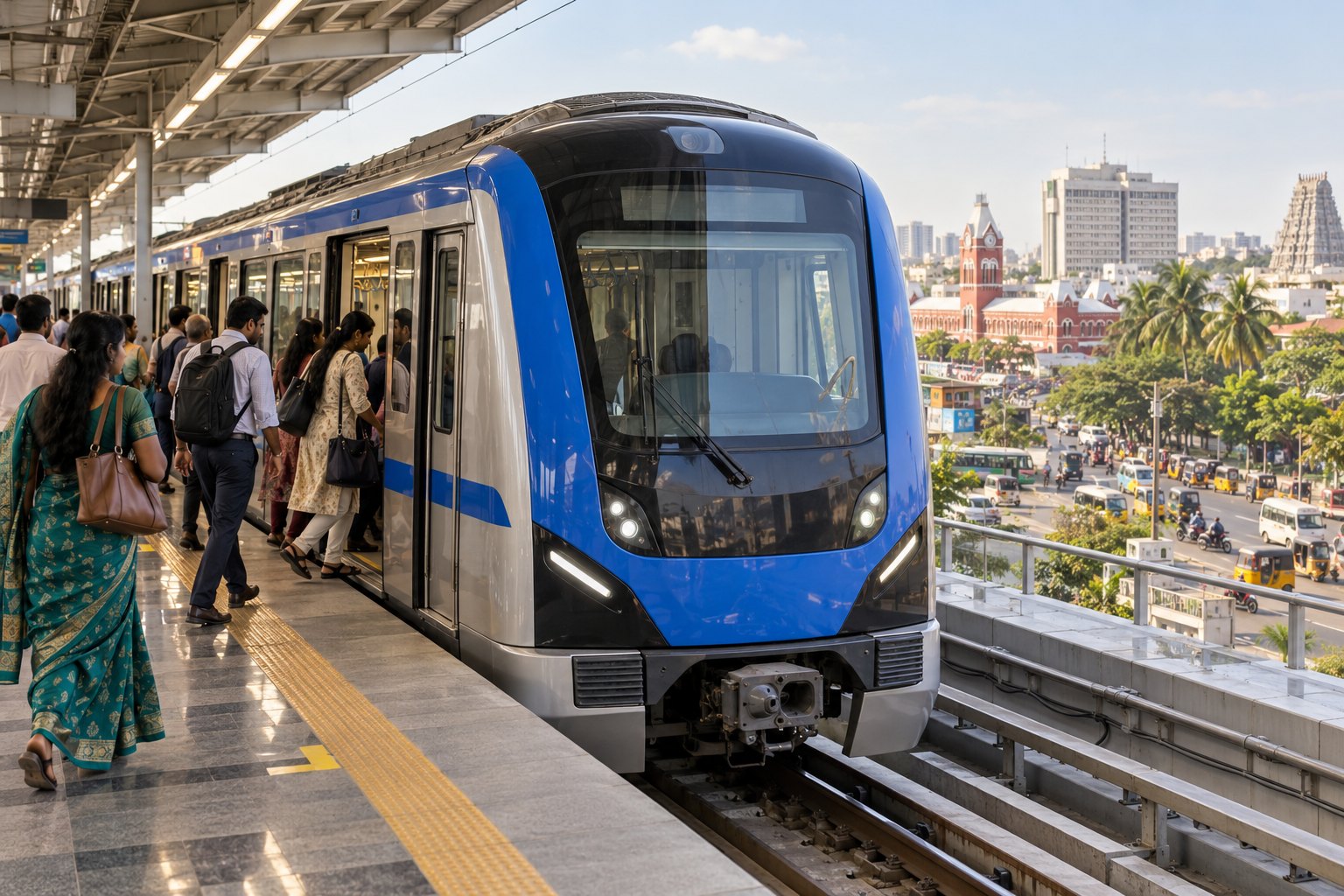
Chennai Metro Rail Phase-II, approved by the Union Cabinet in October 2024 on the Ministry of Housing and Urban Affairs' proposal, adds three corridors, 118.9 km and 128 stations at Rs 63,246 crore, due by 2027. The Prime Minister opened its first stretch, about 15 km and 11 stations from Poonamallee Bypass towards Vadapalani, on 11 October 2026.
Syllabus: Prelims · Current Affairs & IR; GS1 · Women, Population & Urbanisation; GS3 · Infrastructure
Why it matters
A commuter in Chennai's western suburbs, around Poonamallee or Porur, can now take a train that comes every 10 minutes at peak hours instead of sitting in road traffic, and the line is designed to meet Phase-I at Vadapalani. The Cabinet expects Phase-II to ease congestion, cut carbon emissions compared with fossil-fuel transport and bring jobs within easier reach, such as in the IT hub at Sholinganallur. The price is steep: Rs 63,246 crore for 118.9 km, or about Rs 532 crore a km. The larger question for every growing Indian city is whether ridership, feeder links and fares let such lines repay that cost.
Prelims pointers
- Metro Rail Policy, 2017 (Ministry of Housing and Urban Affairs): central help as a 10% grant, 50:50 Centre-State equity, or a PPP with viability gap funding.
- Under the 2017 policy, private participation, for a whole line or parts such as fare collection or operation and maintenance, is essential for central financial assistance.
- National Urban Transport Policy, 2006: move people, not vehicles; favour public and non-motorised transport; set up a Unified Metropolitan Transport Authority in million-plus cities.
- Chennai Metro Rail Limited and Delhi Metro Rail Corporation are each 50:50 joint ventures of the Government of India and the State or Delhi government.
- Kolkata Metro, India's first (1984), is run by Indian Railways as a zonal railway; other city metros come under the Ministry of Housing and Urban Affairs.
- India's first driverless metro operation began on the Delhi Metro's Magenta Line in December 2020.
- Viability gap funding: a scheme of the Department of Economic Affairs, Ministry of Finance, giving capital grants to infrastructure PPP projects that are economically justified but not financially viable.
- Commission of Railway Safety: under the Ministry of Civil Aviation; its Commissioners of Metro Railway Safety inspect a new metro line before it opens to passengers.
Practise a UPSC-style question
With reference to the Chennai Metro Rail Project Phase-II approved by the Union Cabinet in 2024, consider the following statements:
1. It was approved on the proposal of the Ministry of Railways.
2. It comprises three corridors adding about 118.9 km of new metro lines.
3. One of its corridors runs from Lighthouse to Poonamallee Bypass.
4. Once complete, it would take Chennai's metro network to 173 km.
How many of the above statements are correct?
- (a) Only one
- (b) Only two
- (c) Only three
- (d) All four
Show the answer
Answer: (c) Only three
1 is incorrect: the Cabinet approved the proposal of the Ministry of Housing and Urban Affairs, which handles city metro projects; the Ministry of Railways runs Indian Railways. 2 is correct: the three corridors add 118.9 km with 128 stations. 3 is correct: the Lighthouse–Poonamallee Bypass corridor is 26.1 km long with 30 stations, and its first stretch opened in October 2026. 4 is correct: the city's network will total 173 km once Phase-II is fully running.
More from the 12 October 2026 edition
- Stabilisation policy's microfoundations win Hall, Woodford the 2026 economics Nobel Economy
- Seafarer safety and freedom of navigation: two Indians missing off Oman World & IR
- Removing a CEC under Article 324(5): what Keralam's Assembly resolution can do Polity
- State Public Service Commissions: Maharashtra sets up a paper-leak inquiry Polity
- Indians in the Gulf: India condemns Houthi-claimed attack on Riyadh airport World & IR
- NDRF drought aid: central team ends Maharashtra survey; memorandum next National
- Habeas corpus: High Court frees Goa protesters, noting no prohibitory order Polity
- Nino 3.4 sea temperature hits record as El Nino strengthens: Copernicus Environment
- Anti-submarine shallow water craft: Navy commissions third Cochin-built ship, INS Mangrol Defence
- India-Canada CEPA talks: 300-delegate Canadian trade mission begins India visit World & IR
- OHCHR voices concern on Delhi detentions; India calls it interference World & IR
- Census counts residents, not citizens: Mizoram to include refugees Polity