
Supreme Court raps MCD, ASI over encroached Delhi heritage monuments
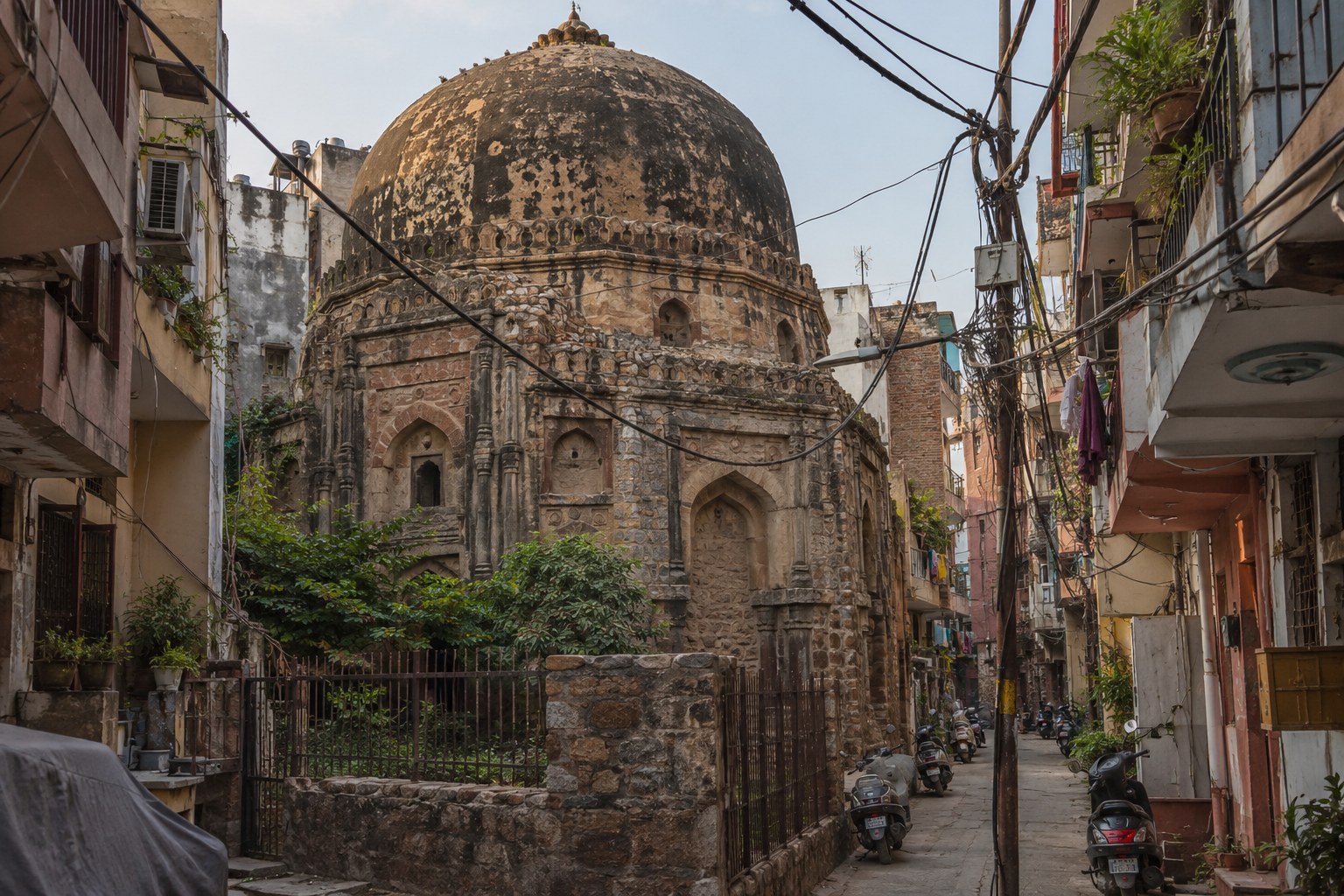
The Supreme Court on October 7 rebuked the Municipal Corporation of Delhi and the Archaeological Survey of India for a lackadaisical approach to encroached heritage monuments. It summoned eight senior officials, including the ASI chief, to appear in person on October 15 and proposed a senior Central officer to coordinate action, granting authorities a last chance.
Syllabus: GS1 · Art & Culture; Prelims · Current Affairs & IR; GS2 · Executive & Judiciary
Why it matters
A monument is protected only if someone guards it on the ground. In Zamrudpur, tombs listed for protection were boxed in by tall buildings, filled with rubbish and once used as a cow shed, while, the court said, the authorities were ignorant of basic details such as ownership and the sites' current state. Eight separate authorities were summoned, a sign of how scattered the duty is. By asking for one senior Central officer to coordinate all of them, the court is testing whether responsibility can be fixed in one place. The ASI's plea that it has too few hands for nearly 4,000 monuments raises a wider question about how well the country funds the care of its past.
Prelims pointers
- INTACH stands for Indian National Trust for Art and Cultural Heritage; its 2020 report listed Lal Mahal in Nizamuddin as missing.
- The Archaeological Survey of India, founded in 1861, works under the Union Ministry of Culture.
- AMASR Act, 1958, as amended in 2010: construction is prohibited within 100 m of a centrally protected monument and regulated in a further 200 m.
- Seventh Schedule: monuments declared of national importance by or under a law of Parliament fall in Union List Entry 67; other ancient and historical monuments in State List Entry 12.
- Article 49 (Directive Principles) obliges the State to protect monuments of national importance; under Article 51A(f), valuing and preserving India's composite culture is a fundamental duty.
- The Lodhi dynasty (1451-1526) was the last ruling house of the Delhi Sultanate; Zamrudpur's Lodhi-era tombs are notified Grade-I structures in the MCD's charge.
- The MCD is examining geomapping of notified heritage sites for location-based monitoring.
Practise a UPSC-style question
Consider the following statements about the Archaeological Survey of India (ASI):
1. The ASI was founded in 1861 and functions under the Union Ministry of Culture.
2. It protects monuments of national importance under the Ancient Monuments and Archaeological Sites and Remains Act, 1958.
3. The five Grade-I Lodhi-era tombs in Zamrudpur, inspected by the court commissioners, are in the ASI's charge.
Which of the statements given above is/are correct?
- (a) 1 and 2 only
- (b) 2 and 3 only
- (c) 1 and 3 only
- (d) 1, 2 and 3
Show the answer
Answer: (a) 1 and 2 only
1 is correct: the ASI dates from 1861 and works under the Union Ministry of Culture. 2 is correct: it protects monuments of national importance under the AMASR Act, 1958. 3 is incorrect: the five Grade-I structures in Zamrudpur are in the charge of the Municipal Corporation of Delhi, not the ASI.
More from the 8 October 2026 edition
- CBAM: US invites comments as EU weighs widening carbon border levy Economy
- Glacial lake outburst flood exposure: Himalayan flood-zone building up 46% Environment
- Nobel Prize in Literature 2026: Swedish Academy honours Canada's Anne Carson World & IR
- World Development Report 2026 on AI gets its India launch Sci-Tech
- Nameri Tiger Reserve in Assam gets CA|TS Approved status Environment
- GST Council recommends scrapping arrest powers, ₹5 crore prosecution threshold Economy
- India joins 14 economies in joint statement on industrial overcapacity Economy
- WMO forecasts December El Niño peak, drier conditions over India Environment
- Chhattisgarh High Court seeks State reply on anti-conversion law challenge Polity
- Centre to release AI regulation consultation paper within a month Sci-Tech
- Supreme Court orders expert panel on statutory curbs for pharma marketing National
- Saudi investment treaty to allow arbitration after two years, officials say Economy