
National Household Travel Survey: most women commuters walk or use public transport
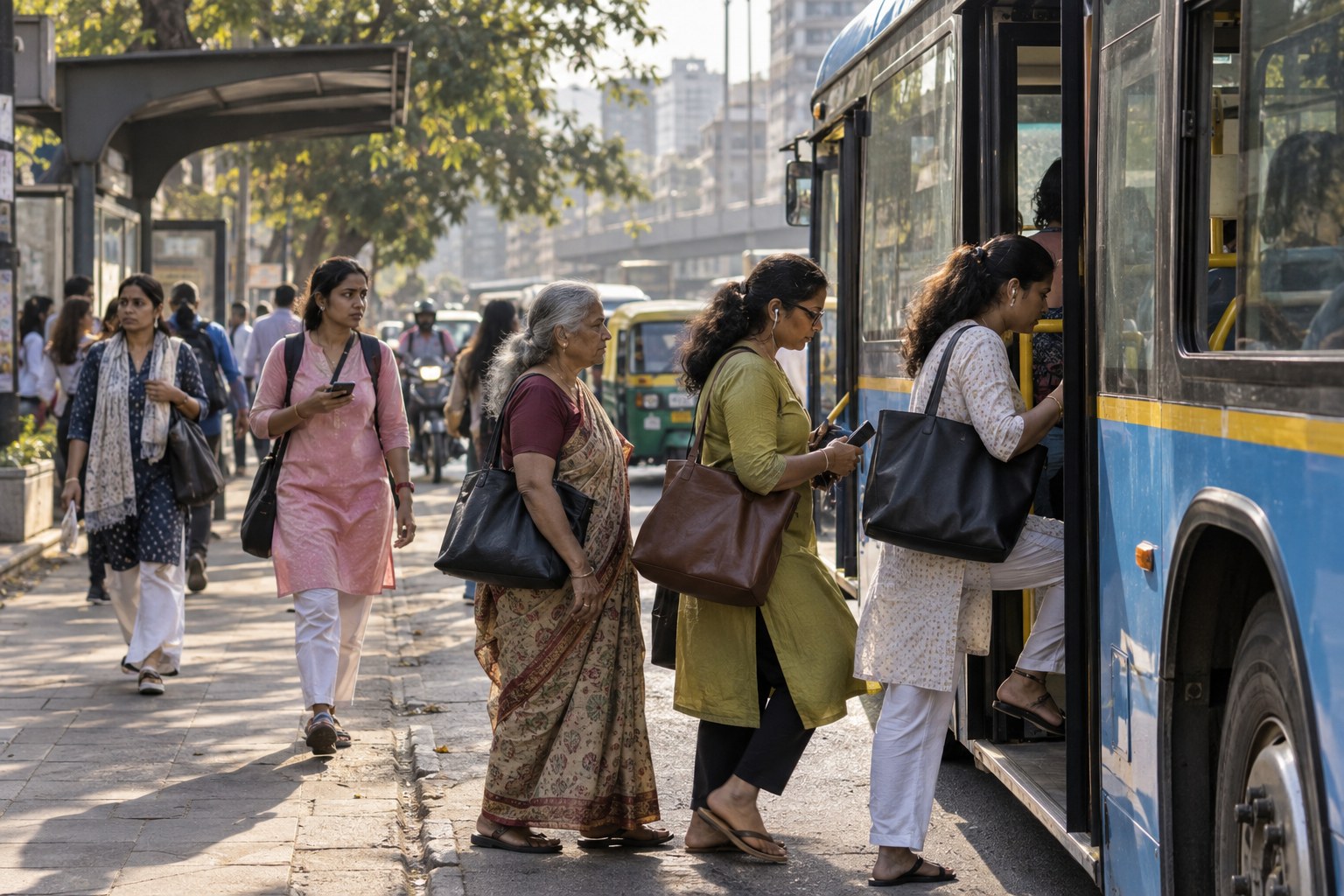
Women are twice as likely as men to walk or take a bus or train to work, the National Statistics Office's first National Household Travel Survey shows: 66.9% of women commuters against 31.7% of men. In rural Madhya Pradesh, 88.7% of women commuters walk; in rural Keralam, 48.6% take a bus, the highest among States.
Syllabus: Prelims · Economy & Social Development; GS1 · Women, Population & Urbanisation; GS3 · Infrastructure
Why it matters
A woman who walks to work can take only the jobs within walking distance. The survey shows that half of women commuters walk and fewer than one in five ride a two-wheeler, so a missing bus route narrows their choices far more than men's. In rural Madhya Pradesh, 88.7% of women commuters walk and 2% take a bus; in rural Keralam, nearly half ride a bus. Fewer women workers travel that far at all: 41.9% make work trips of 1 km or more, against 61.9% of men. Where buses are scarce, distance decides which jobs a woman can take. The State tables show planners where better bus routes and safe footpaths would reach the most women.
Prelims pointers
- The National Household Travel Survey is conducted by the National Statistics Office (NSO) under the Ministry of Statistics and Programme Implementation.
- The NSO's Central Statistics and National Sample Survey wings were earlier the Central Statistics Office and the National Sample Survey Office; it also runs the Periodic Labour Force Survey.
- NHTS definitions: only travel of 1 km or more counts; a trip's primary mode is the one used for the longest distance in it.
- NHTS mode categories: 'bus' includes public, private (chartered), school/company and inter-city buses; 'train/monorail/tram' covers metro and suburban rail.
- NHTS overnight trip: a journey of 50 km or more that keeps a member away from home for over 24 hours.
- The NHTS ran alongside the Domestic Tourism Expenditure Survey; the NSO warns that the two use different definitions and should not be compared.
- Rural women commuters: Keralam has the highest bus share among States (48.6%); Nagaland the highest walking share (91.4%).
Practise a UPSC-style question
Consider the following statements about the National Household Travel Survey (NHTS):
1. It is conducted by the National Statistics Office under the Ministry of Home Affairs.
2. Its 2025-26 round covered more rural households than urban households across the country.
3. It records as travel only trips covering a distance of 1 km or more.
Which of the statements given above is/are correct?
- (a) 1 and 2 only
- (b) 2 and 3 only
- (c) 1 and 3 only
- (d) 1, 2 and 3
Show the answer
Answer: (b) 2 and 3 only
1 is incorrect: the National Statistics Office works under the Ministry of Statistics and Programme Implementation (MoSPI), not the Home Ministry. 2 is correct: the round covered 2,84,769 rural and 2,07,254 urban households. 3 is correct: travel of less than 1 km is not recorded as travel in the survey.
More from the 8 October 2026 edition
- CBAM: US invites comments as EU weighs widening carbon border levy Economy
- Glacial lake outburst flood exposure: Himalayan flood-zone building up 46% Environment
- Nobel Prize in Literature 2026: Swedish Academy honours Canada's Anne Carson World & IR
- World Development Report 2026 on AI gets its India launch Sci-Tech
- Nameri Tiger Reserve in Assam gets CA|TS Approved status Environment
- GST Council recommends scrapping arrest powers, ₹5 crore prosecution threshold Economy
- India joins 14 economies in joint statement on industrial overcapacity Economy
- WMO forecasts December El Niño peak, drier conditions over India Environment
- Chhattisgarh High Court seeks State reply on anti-conversion law challenge Polity
- Centre to release AI regulation consultation paper within a month Sci-Tech
- Supreme Court orders expert panel on statutory curbs for pharma marketing National
- Saudi investment treaty to allow arbitration after two years, officials say Economy