
Tigress T138 released into Bengal's Buxa Tiger Reserve
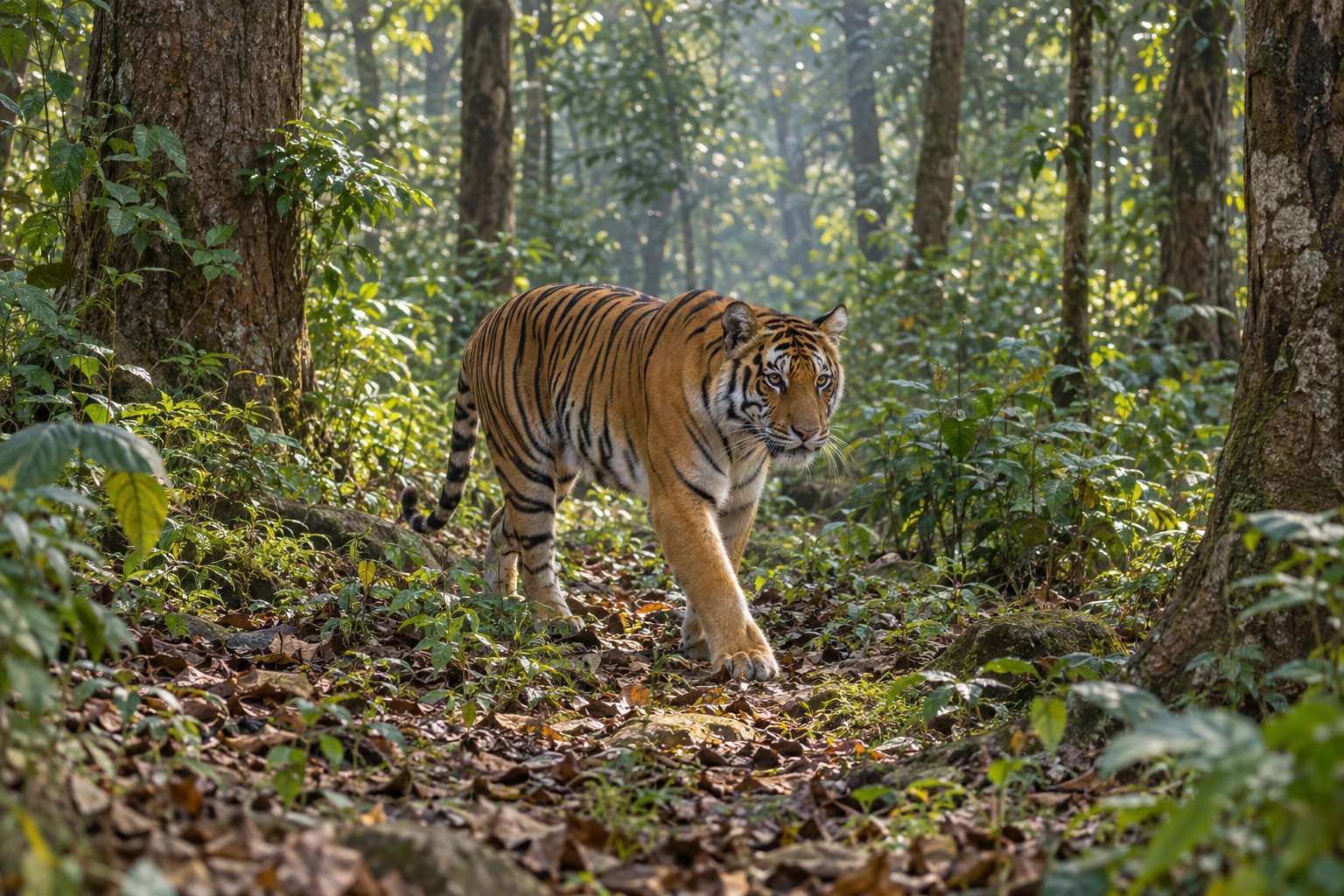
Tigress T138, three years old and brought from Bihar's Valmiki Tiger Reserve, was released in West Bengal's Buxa Tiger Reserve on October 2, 2026, by Union Environment Minister Bhupender Yadav and Chief Minister Suvendu Adhikari. The release opens a phased programme to rebuild a self-sustaining tiger population. Adhikari said three more tigers would follow within two months.
Syllabus: Prelims · Environment & Ecology; GS2 · Government Policies; GS3 · Environment & Conservation
Why it matters
Buxa's buffer has 37 forest villages and is ringed by 34 tea gardens, with about 1.67 lakh people, by the NTCA's count. For them a resident tiger is a daily concern: in Odisha's Satkosia, livestock kills and local opposition followed a 2018 release, and no tiger remains there. So the project works through 64 Eco-Development and Joint Forest Management Committees, and Yadav said two villages had moved out voluntarily. For the forest, the tigress tests whether eight years of prey and grassland work can hold a breeding population. Sariska and Panna show it can be done: each began with three animals and now holds 56 and 88. Success would also secure a stopover for tigers moving between Assam's Manas, Bhutan and north Bengal.
Prelims pointers
- National Tiger Conservation Authority: a statutory body under Section 38L of the Wildlife (Protection) Act, 1972, added by a 2006 amendment; the Union Environment Minister is its Chairperson.
- Section 38V: the State Government notifies a tiger reserve on the NTCA's recommendation and prepares its Tiger Conservation Plan, which the NTCA approves.
- A tiger reserve has a core or critical tiger habitat, to be kept inviolate, and a buffer or peripheral area where wildlife and human activity co-exist.
- Section 38W: a tiger reserve's boundaries cannot be altered, nor the reserve denotified, without the NTCA and the National Board for Wild Life.
- The tiger is in Schedule I of the Wildlife (Protection) Act; under Section 12, the Chief Wild Life Warden permits translocation with the Central Government's previous permission.
- Buxa Tiger Reserve: core 390.58 sq km; forests of Bhutan to the north, links with Manas Tiger Reserve to the east and Jaldapara National Park to the west.
- Valmiki Tiger Reserve: in northernmost Bihar on the India-Nepal border, joined to Nepal's Chitwan-Parsa forests; 54 tigers in the 2022 estimation.
- Project Tiger: launched in 1973, a Centrally Sponsored Scheme of the Environment Ministry; India has 58 tiger reserves in 18 States (NTCA, June 2026).
Practise a UPSC-style question
With reference to the tigress T138 released in Buxa Tiger Reserve in October 2026, consider the following statements:
1. She was translocated to Buxa from Valmiki Tiger Reserve in Bihar.
2. The Tiger Augmentation and Recovery Project for Buxa was initiated by the Government of Bihar with support from the National Tiger Conservation Authority.
3. After her release she is to be monitored through telemetry, camera trapping and field-based monitoring.
Which of the statements given above is/are correct?
- (a) 1 and 2 only
- (b) 2 and 3 only
- (c) 1 and 3 only
- (d) 1, 2 and 3
Show the answer
Answer: (c) 1 and 3 only
1 is correct: T138 was captured in Valmiki Tiger Reserve in Bihar and moved to Buxa Tiger Reserve in West Bengal. 2 is incorrect: the project was initiated by the Government of West Bengal, with support from the National Tiger Conservation Authority and the Wildlife Institute of India; Bihar was the State the tigress came from. 3 is correct: the Union Environment Ministry said she would be followed through telemetry, camera trapping and field-based monitoring, to assess her movement, adaptation, health and behaviour.
More from the 3 October 2026 edition
- Centre allows final decisions on pending post-facto environmental clearance cases Environment
- Law Ministry notifies rules for National Tribunals Commission and tribunal selection Polity
- Strategic petroleum reserves: G7 to release 100 million barrels through IEA Economy
- Split SC Bench sends Election Commissioners law challenge to CJI Polity
- Jal Arpan: over 1,850 panchayats take charge of rural water schemes National
- MHA orders 48-hour reporting of cases against AGMUT officers Polity
- Forest-loss dispute in Udanti Sitanadi tests conservation and community rights Environment
- Allahabad HC rules hookah service barred in designated smoking areas Polity
- Allahabad HC opens noise-enforcement PIL, seeks accountability Environment
- INS Sahyadri and Kulish conclude AIME 2026 in the Philippines Defence