
Report: a fifth of India's GDP rests on the Himalayas
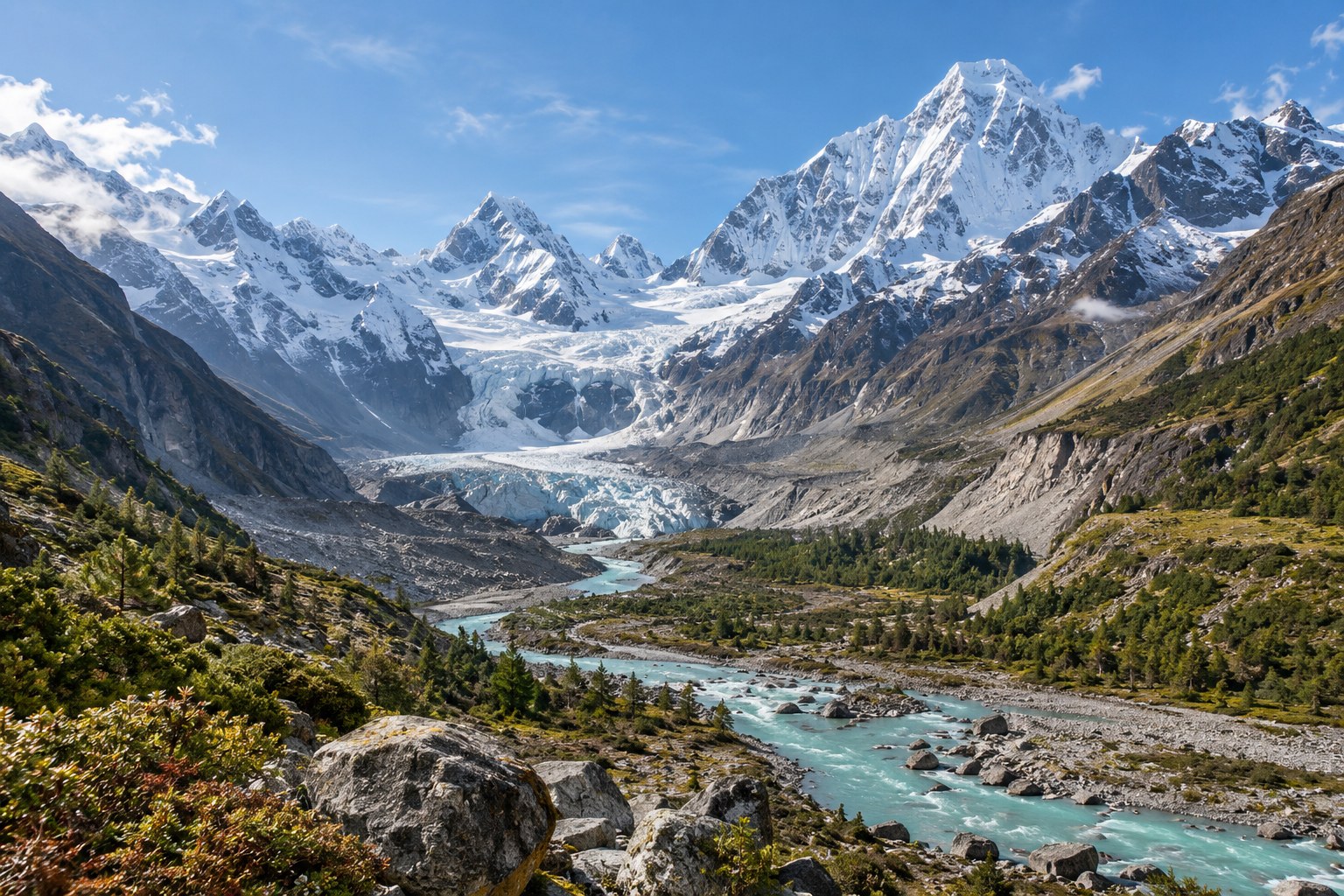
In September, Systemiq and the Integrated Mountain Initiative released 'Prosperous and Resilient Himalayas', estimating that ₹64.8 lakh crore, or 21.5% of India's FY24 GDP, depends on Himalayan water. The report warns that the Hindu Kush Himalaya could lose up to 80% of its present glacier volume by 2100, with most river basins expected to reach 'Peak Water' around mid-century.
Syllabus: GS3 · Indian Economy & Growth; Prelims · Geography; Prelims · Environment & Ecology
Why it matters
A wheat or rice farmer on the Indo-Gangetic Plain may never see a glacier, yet part of the canal and well water on that field is Himalayan: rivers fed by snow and ice, and the groundwater they recharge. The report traces over a fifth of India's GDP to that water, from these farms to tea in Assam and Bengal, hydropower in the Northeast and pilgrimage towns downstream. Once glaciers pass Peak Water, the dry-season flow that melting ice now supplies begins to shrink, so farms, cities and power stations get less water in the months they need it most. The mountain States keep only a small share of this value but carry much of the disaster risk, and every emergency rebuild leaves less money for prevention.
Prelims pointers
- Peak Water: the point at which glacier meltwater runoff is greatest; after it, shrinking glaciers send progressively less water downstream.
- Black carbon: soot from the incomplete burning of fossil fuels, biofuels and biomass; a short-lived climate pollutant that stays in the air for days to weeks.
- Albedo: the share of sunlight a surface reflects; black carbon settling on snow and ice lowers it, so the surface absorbs more heat and melts faster.
- The Himalayas feed the Indus, Ganga and Brahmaputra river systems; the Brahmaputra flows into India from Tibet, where it is called the Yarlung Tsangpo.
- ICIMOD: the International Centre for Integrated Mountain Development, an intergovernmental knowledge centre for the Hindu Kush Himalaya, based in Kathmandu, Nepal.
- G.B. Pant National Institute of Himalayan Environment: an autonomous institute of the Ministry of Environment, Forest and Climate Change, set up in 1988-89, headquartered at Kosi near Almora, Uttarakhand.
- GSDP (gross state domestic product): the value of all final goods and services produced within a State in a year, the State-level counterpart of GDP.
Practise a UPSC-style question
With reference to 'Peak Water' in glacier-fed river basins, consider the following statements:
1. It is the point at which glacier meltwater reaches its maximum, after which flows from the melt begin to decline.
2. Most Himalayan river basins are expected to reach it around the end of this century.
3. Glaciers store water as ice and release it gradually as meltwater, sustaining river flows through the dry season.
Which of the statements given above is/are correct?
- (a) 1 and 2 only
- (b) 2 and 3 only
- (c) 1 and 3 only
- (d) 1, 2 and 3
Show the answer
Answer: (c) 1 and 3 only
1 is correct: as warming speeds melting, meltwater runoff rises to a peak and then falls as the ice reserve shrinks. 2 is incorrect: most Himalayan river basins are expected to reach Peak Water around the middle of this century; 2100 is the horizon by which, on current trajectories, the Hindu Kush Himalaya could lose up to 80% of its present glacier volume. 3 is correct: glaciers act as natural water stores, releasing meltwater gradually and sustaining river flows through the dry season.
More from the 18 September 2026 edition
- US Bill threatens up to 100% tariffs on buyers of Russian oil World & IR
- UPI gets a 0.4% merchant fee above ₹2,000 Economy
- Shaksgam Valley and the 1963 pact: India rejects China-Pakistan boundary commission World & IR
- EPFO wage ceiling raised to ₹25,000 after 12 years Economy
- Centre proposes Article 371K for Ladakh Polity