
NBA splits AYUSH Access and Benefit Sharing money by forest cover
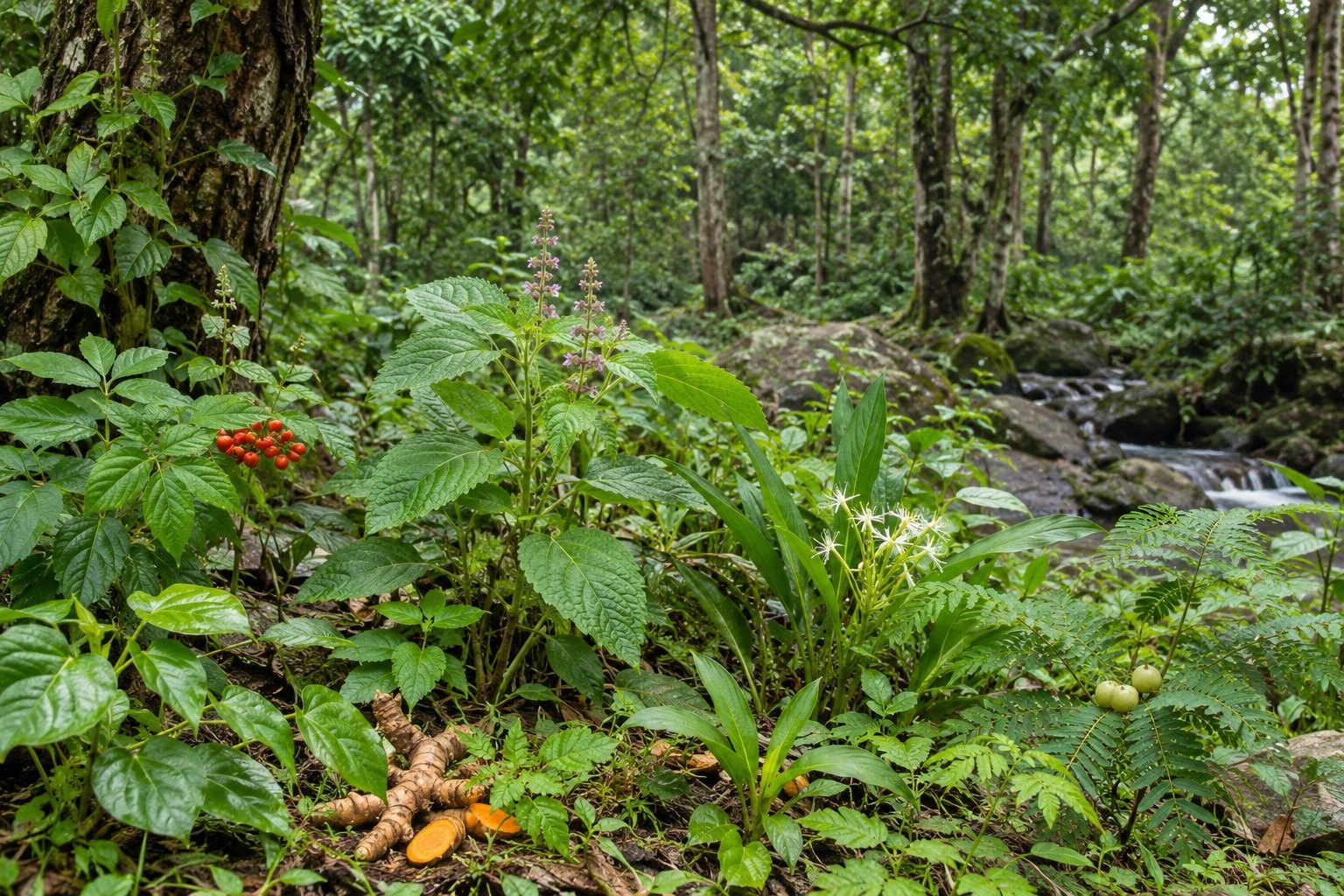
The National Biodiversity Authority (NBA) has released Rs 13.76 crore to 28 States and 4 Union Territories, PIB said on 27 November 2026. The sum is Access and Benefit Sharing (ABS) money paid by AYUSH product makers for using 234 plant species. With the benefit claimers untraceable, each State's share follows its forest cover and where the plants occur.
Syllabus: Prelims · Environment & Ecology; GS2 · Statutory & Regulatory Bodies; GS3 · Environment & Conservation
Why this matters for UPSC
GS3 environment: the Biological Diversity Act, 2002, the NBA and access and benefit sharing. Prelims can ask about benefit claimers, BMCs and the Nagoya Protocol; Mains, whether benefits reach conservers.
Why it matters
A villager who digs Ashwagandha roots for a local trader seldom learns which company finally buys them, and the company seldom learns of her. This release shows how the law still sends part of the firm's gain back towards the forests the plants grew in. State boards can pass it to village committees, pay for registers that record local plants and the knowledge about them, and back cultivation and careful harvesting. The catch is that money spread by forest cover reaches regions, not the gatherer herself. Better records of who supplied what would let payments reach the actual conservers, and would make collectors more willing to protect wild plants instead of stripping them.
Prelims pointers
- Under the amended Biological Diversity Act, 2002, "biological resources" exclude value added products and human genetic material.
- Cultivated medicinal plants, vaids, hakims, registered AYUSH practitioners and local communities need not give prior intimation; cultivated plants need a BMC certificate of origin.
- BMCs are set up by local bodies at the Gram Panchayat and municipal levels; each has seven to eleven members, as the State prescribes.
- Under the 2025 regulations, 10 to 15% of benefits from an NBA-approved deal stay with the Authority, which may pass half to the State Board; claimers get the rest.
- If a resource comes from an unknown source, the NBA may keep the whole benefit amount and spend it through the National Biodiversity Fund.
- The Nagoya Protocol is an instrument of the Convention on Biological Diversity, not of the UN climate convention; India is a Party to it.
- Within the KMGBF, Target 13 is the benefit-sharing target; Target 3 is the one on conserving at least 30% of land, inland water and sea by 2030.
Practise a UPSC-style question
With reference to the Biological Diversity Act, 2002, as amended in 2023, consider the following statements:
1. Value added products made from plants come within the definition of biological resources under the Act.
2. Human genetic material is kept outside the definition of biological resources under the Act.
3. Holders of traditional knowledge linked to biological resources are counted among benefit claimers under the Act.
Which of the statements given above is/are correct?
- (a) 1 and 2 only
- (b) 2 and 3 only
- (c) 1 and 3 only
- (d) 1, 2 and 3
Show the answer
Answer: (b) 2 and 3 only
Answer: (b) 2 and 3 only. The Act leaves out both value added products and human genetic material, and counts knowledge holders as claimers.
Statement 1: incorrect. The amended Biological Diversity Act, 2002 defines biological resources to include plants, animals and micro-organisms but excludes value added products.
Statement 2: correct. The same definition says biological resources do not include human genetic material.
Statement 3: correct. The 2023 amendment defines benefit claimers as conservers of biological resources and creators or holders of associated traditional knowledge.
Eliminate: statement 1 is false because value added products are excluded. Out: (a), (c), (d).
Trap: Wrong scope. Statement 1 widens the definition to finished products, which the Act expressly excludes, so it reads plausible to a student who thinks of AYUSH goods.
Remember: Biological resources exclude value added products and human genetic material.
More from the 28 November 2026 edition
- RBI lowers daily cash reserve ratio floor to 90% from December Economy
- Cabinet approves Constitution Amendment Bill on delimitation and women's reservation Polity
- India, as IORA Chair, hosts ministerial meeting in New Delhi World & IR
- NAVYA 2.0: MWCD-MSDE girls' skilling scheme to cover 100 districts National
- Centre asks Speaker and Chairman to reconvene unprorogued Monsoon Session Polity
- UNCTAD Review of Maritime Transport forecasts flat trade; Indian ports gain Economy
- PMLA Adjudicating Authority Bench must include a judicial member: Supreme Court Polity
- Agriculture Ministry's final estimates: 2025-26 foodgrain at record 3785.38 lakh tonnes Economy