
MoRTH ties PUC certificate validity to Bharat Stage norm and vehicle age
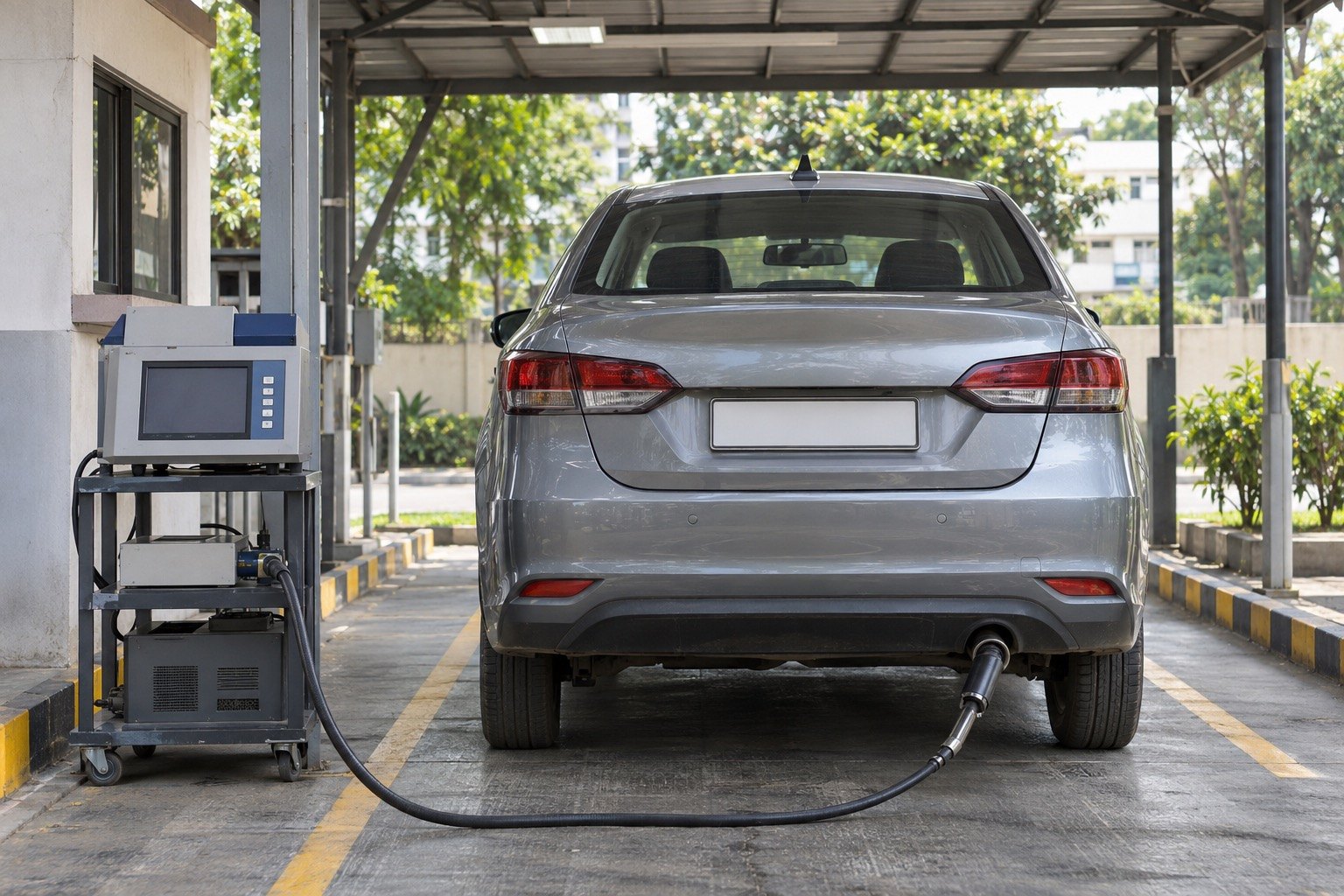
The Ministry of Road Transport and Highways (MoRTH) has revised the validity of Pollution Under Control (PUC) certificates, linking it to a vehicle's Bharat Stage (BS) emission norm and age. A private BS-VI vehicle up to six years old needs a fresh certificate once in three years. Vehicles built to BS-I, BS-II or BS-III norms must renew every three months.
Syllabus: Prelims · Current Affairs & IR; Prelims · Environment & Ecology; GS3 · Environment & Conservation
Why this matters for UPSC
GS3 environment: vehicular air pollution, Bharat Stage norms and the PUC regime. Prelims can ask BS-VI fuel sulphur limits; Mains, age-based emission testing.
Why it matters
The owner of a new BS-VI car will now visit a testing centre far less often while the car is young, saving time and fees. The owner of an ageing car, or of a vehicle built to an older norm, stays on short cycles. The idea is that newer and cleaner vehicles need checking less often, so testing effort shifts towards the vehicles more likely to foul city air. The risk runs the other way too: a newer vehicle whose emission system fails could go longer before a test catches it. How well the change works will depend on the continued monitoring of vehicles in use that the ministry promises, and on honest testing at PUC centres.
Prelims pointers
- The Central Motor Vehicles Rules, 1989 are made by the Centre under the Motor Vehicles Act, 1988; MoRTH amends them, PUC provisions included.
- The government leapfrogged from BS-IV to BS-VI emission norms from 1 April 2020, skipping BS-V, citing rising pollution.
- BS-VI compliant fuel allows a maximum of 10 ppm sulphur, against 50 ppm in BS-IV fuel; the cut enabled DPF and SCR in BS-VI vehicles.
- An expert committee under a Member of the Planning Commission (now NITI Aayog) drew up the Auto Fuel Vision and Policy-2025; it proposed BS-V by 2020 and BS-VI from 2024.
- Under the earlier Auto Fuel Policy, auto fuels of BS-II, BS-III and BS-IV quality were introduced in the country by 1 April 2017.
- Vehicle emission limits sit in the Central Motor Vehicles Rules under the Motor Vehicles Act, 1988; the Air (Prevention and Control of Pollution) Act, 1981 is the general air-pollution law.
Practise a UPSC-style question
With reference to Bharat Stage emission norms in India, consider the following statements:
1. India enforced BS-V norms across the country from 1 April 2020 before moving on to BS-VI.
2. BS-VI compliant auto fuel may carry a maximum sulphur content of 50 parts per million.
Which of the statements given above is/are correct?
- (a) 1 only
- (b) 2 only
- (c) Both 1 and 2
- (d) Neither 1 nor 2
Show the answer
Answer: (d) Neither 1 nor 2
Answer: (d) Neither 1 nor 2. India skipped BS-V, and the 50 ppm figure belongs to BS-IV fuel.
Statement 1: incorrect. Citing rising pollution, the government leapfrogged from BS-IV straight to BS-VI from 1 April 2020; BS-V was never enforced.
Statement 2: incorrect. BS-VI fuel allows at most 10 ppm of sulphur; 50 ppm was the limit for BS-IV fuel (PIB, 2022).
Eliminate: Statement 2 uses the BS-IV sulphur figure. Out: (b), (c).
Eliminate: Statement 1 adds a BS-V stage India skipped. Out: (a).
Trap: Outdated fact. The expert committee had proposed BS-V by 2020, so a student who remembers that plan may think it was carried out.
Remember: BS-IV to BS-VI on 1 April 2020; sulphur 50 ppm down to 10 ppm.
More from the 20 November 2026 edition
- EPFO board approves Systematic Withdrawal Plan, eases final PF withdrawal Economy
- Fourth India-Japan 2+2 backs Japanese live-fire training at Indian ranges World & IR
- Health Ministry drafts rules to make GSDP binding on drug licensees National
- Draft rule would make antimicrobials 'new drugs' needing central approval National
- UNFPA's State of World Population 2026 finds money worries delay parenthood World & IR
- Cyclone Akvan nears Andhra-Odisha coast as Odisha evacuates 50,000 National
- UP Cabinet clears ordinance extending panchayat administrators' term pending OBC commission report Polity