
Cyclone Akvan nears Andhra-Odisha coast as Odisha evacuates 50,000
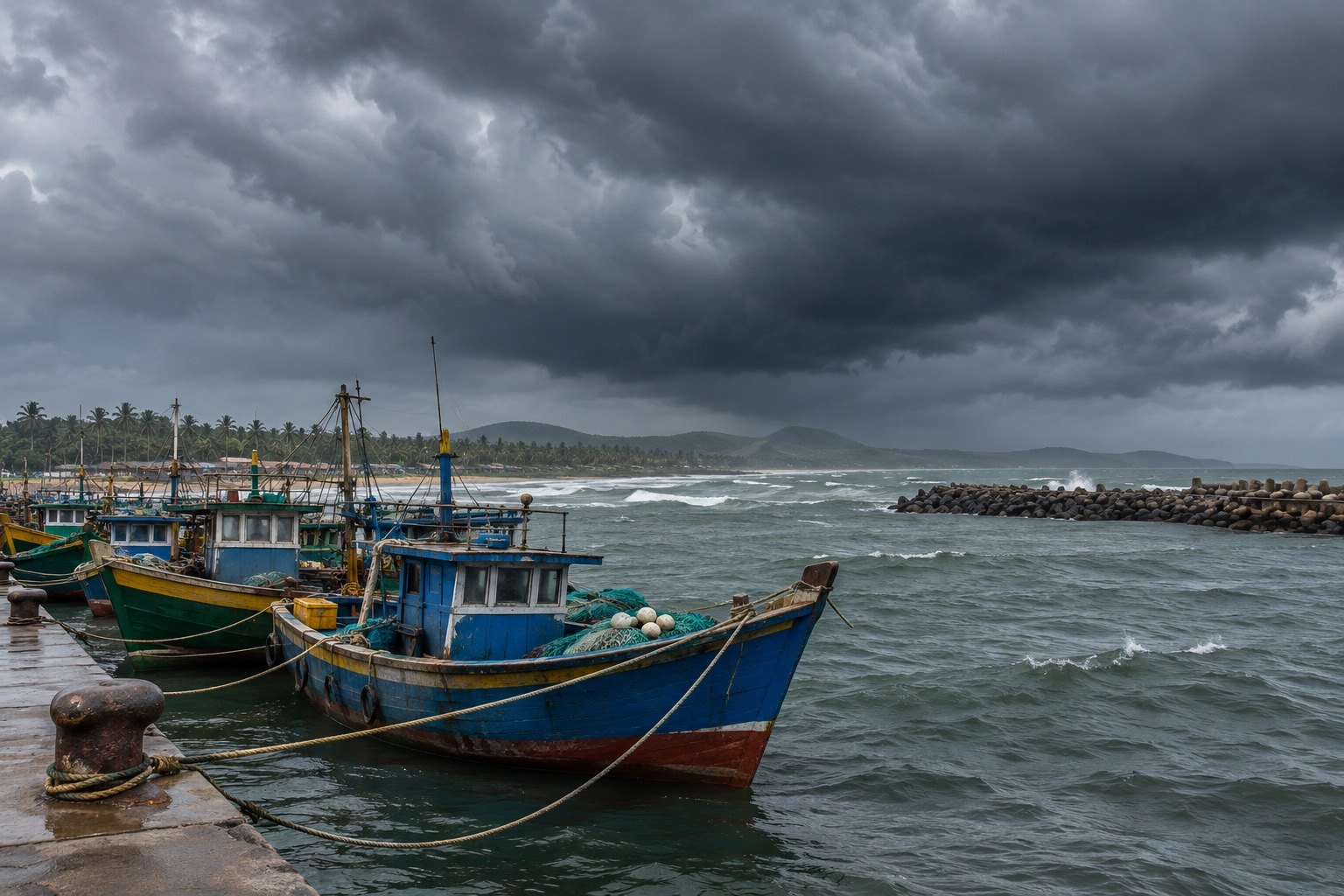
Severe cyclonic storm Akvan was expected to strike the coast between Puri in Odisha and Narsapur in Andhra Pradesh by noon on 20 November, the India Meteorological Department (IMD) said on 19 November. Odisha said it had moved nearly 50,000 people to safety, aiming for zero deaths. Over 130 NDRF, ODRAF and fire service teams stood deployed.
Syllabus: Prelims · Current Affairs & IR; GS1 · Geophysical Phenomena; GS3 · Disaster Management
Why this matters for UPSC
GS3 disaster management and GS1 cyclones: NCRMP, IMD warnings and cyclone naming. Prelims can ask NCRMP's phases or who names storms; Mains, preparedness over relief.
Why it matters
For a fishing family in a thatched hut near the Odisha coast, a forecast helps only if it arrives early and a strong building stands close by. That is why the State moved people a day before the storm was due, starting with hill villages where rain can bring down slopes. Officials expected this storm to hurt Odisha more through heavy rain than through wind: flooded roads, cut power and landslides inland. A shelter that has been kept in working order, with its committee and its funds in place, decides whether those people sit out the storm safely or are caught in the open.
Prelims pointers
- NCRMP covered eight coastal States in two phases: Andhra Pradesh and Odisha in Phase I; Goa, Gujarat, Karnataka, Kerala, Maharashtra and West Bengal in Phase II.
- Under NCRMP, States were asked to give each Cyclone Shelter Maintenance and Management Committee a one-time corpus of Rs 5 lakh and budget for long-term repairs.
- RSMC New Delhi names a storm over the Bay of Bengal or Arabian Sea once its maximum wind speed is analysed at 34 knots or more.
- North Indian Ocean cyclone names are used column by column and never repeated; the north Atlantic lists, by contrast, are reused in six-year rotation.
- Naming of north Indian Ocean cyclones began in September 2004, after the WMO/ESCAP Panel agreed to it in principle at its 2000 session in Muscat.
- The WMO/ESCAP Panel on Tropical Cyclones names north Indian Ocean storms; the ESCAP/WMO Typhoon Committee is a separate regional body among five worldwide.
- A proposed north Indian Ocean cyclone name must be neutral to politics, religion, culture and gender, and no longer than eight letters.
Practise a UPSC-style question
With reference to the National Cyclone Risk Mitigation Project (NCRMP), consider the following statements:
1. Andhra Pradesh and Odisha were the States covered in its first phase.
2. The upkeep of the shelters it built rests with the Union Ministry of Home Affairs.
3. It envisaged registered societies to manage and maintain multi-purpose cyclone shelters.
Which of the statements given above is/are correct?
- (a) 1 and 2 only
- (b) 2 and 3 only
- (c) 1 and 3 only
- (d) 1, 2 and 3
Show the answer
Answer: (c) 1 and 3 only
Answer: (c) 1 and 3 only. The States, not the Union ministry, keep NCRMP's shelters in order.
Statement 1: correct. The Ministry of Home Affairs said in 2025 that Phase I covered Andhra Pradesh and Odisha; six other States came in Phase II.
Statement 2: incorrect. The Ministry said maintenance and sustainability of NCRMP infrastructure rests with the State Governments.
Statement 3: correct. Cyclone Shelter Maintenance and Management Committees were envisaged as registered societies, funded by a one-time Rs 5 lakh corpus.
Eliminate: statement 2 is wrong, so every option holding 2 goes. Out: (a), (b), (d).
Trap: Swapped attribution. The project is run by a Union ministry, so a student may assume the Centre also maintains what it built.
Remember: NCRMP Phase I meant Andhra Pradesh and Odisha; upkeep is the States' job.
More from the 20 November 2026 edition
- EPFO board approves Systematic Withdrawal Plan, eases final PF withdrawal Economy
- Fourth India-Japan 2+2 backs Japanese live-fire training at Indian ranges World & IR
- MoRTH ties PUC certificate validity to Bharat Stage norm and vehicle age Environment
- Health Ministry drafts rules to make GSDP binding on drug licensees National
- Draft rule would make antimicrobials 'new drugs' needing central approval National
- UNFPA's State of World Population 2026 finds money worries delay parenthood World & IR
- UP Cabinet clears ordinance extending panchayat administrators' term pending OBC commission report Polity