
ICMR's AMRSN Annual Report 2025 finds resistance spreading to smaller hospitals
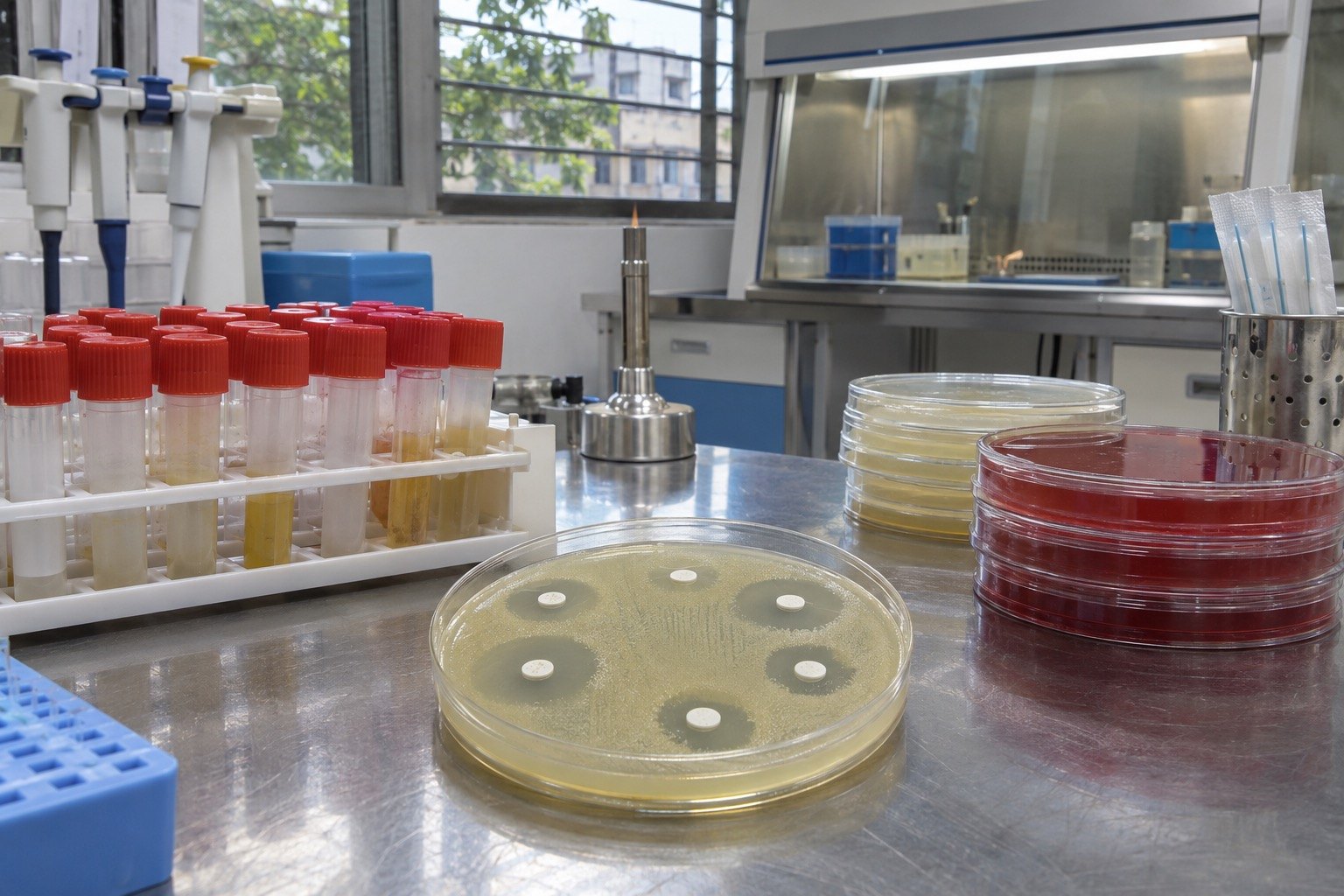
The 2025 annual report of the Antimicrobial Resistance Surveillance and Research Network (AMRSN), run by the Indian Council of Medical Research (ICMR), covers 1,13,008 positive samples from 30 large hospitals. Only 18.4% of E. coli samples responded to cefotaxime. For the first time, 34 secondary-care hospitals, 12 of them district hospitals, joined, adding 20,529 samples.
Syllabus: Prelims · Science & Technology; GS3 · Science & Technology; GS2 · Health, Education & Human Resources
Why this matters for UPSC
GS2 health and GS3 science: antimicrobial resistance and India's surveillance of it. Prelims can ask about the AMRSN, carbapenems and NAP-AMR; Mains, stewardship and infection control.
Why it matters
A mother whose newborn develops sepsis needs the first antibiotic to work. When the bacterium causing it shrugs off common medicines, doctors lose hours trying drugs that fail, and the baby's risk climbs. The same holds for an elderly patient in an intensive-care unit or a woman with a urinary infection at a district hospital. Resistance now shows up beyond big city hospitals, so local doctors cannot assume an old prescription still works. Each failed course also raises the cost of care for families and pushes doctors towards reserve drugs, which then wear out faster. Cleaner hospitals and testing before prescribing slow that cycle.
Prelims pointers
- AMRSN regional centres are laboratories of tertiary care hospitals, and the bacterial and fungal data they enter are validated first by the nodal centres.
- AMRSN's six pathogen groups include enteric fever pathogens, Enterobacteriaceae causing sepsis, Gram-negative non-fermenters, diarrhoeagenic bacteria, Gram-positive staphylococci and enterococci, and fungi.
- AMRSN nodal centres sit at AIIMS New Delhi, PGIMER Chandigarh, CMC Vellore and JIPMER Puducherry; JIPMER leads the Gram-positive group, including MRSA.
- Fungal pathogens such as Candida and Aspergillus are tracked by the AMRSN but left out of the WHO priority pathogen list of 2017.
- A National Task Force on AMR Containment was formed in 2010, leading to a national policy on AMR containment in 2011.
- Kerala and Gujarat were the first States to ban over-the-counter sale of antibiotics, the Principal Scientific Advisor said in November 2025.
Practise a UPSC-style question
With reference to the Antimicrobial Resistance Surveillance and Research Network (AMRSN), consider the following statements:
1. The Department of Biotechnology set up the AMRSN in 2013 to collect nationally representative resistance data.
2. In the AMRSN, data entered by the regional centres is first validated by the nodal centres.
Which of the statements given above is/are correct?
- (a) 1 only
- (b) 2 only
- (c) Both 1 and 2
- (d) Neither 1 nor 2
Show the answer
Answer: (b) 2 only
Answer: (b) 2 only. The network belongs to the ICMR, not the Department of Biotechnology; the validation step is right.
Statement 1: incorrect. The Indian Council of Medical Research (ICMR) started the AMRSN in 2013, as its own network page states.
Statement 2: correct. Regional centres enter bacterial and fungal data, and the nodal centres validate it first.
Eliminate: Statement 1 credits the network to the wrong body. Out: (a), (c).
Eliminate: Statement 2 matches the AMRSN page, so (d) goes too. Out: (d).
Trap: Swapped attribution. The year 2013 is right, which makes the wrong parent body easy to miss.
Remember: AMRSN is the ICMR's network, started in 2013, with nodal and regional centres.
More from the 19 November 2026 edition
- Andaman and Nicobar prisons regulation repeals the Prisons Act, 1894 Polity
- Jal Shakti Ministry notifies one-time scheme to settle groundwater environmental compensation Environment
- UNDRR names GIFT City India's first MCR2030 Resilience Hub National
- Commerce widens exporter support under Export Promotion Mission's Niryat Disha Economy
- Rural Development Ministry issues Ombudsperson guidelines under VB-G RAM G Act Polity
- GSI inspects Narmada fossil jaw preliminarily linked to Palaeoloxodon namadicus Sci-Tech
- Quad leaders unveil maritime surveillance collaboration at Manila summit World & IR