
GSI inspects Narmada fossil jaw preliminarily linked to Palaeoloxodon namadicus
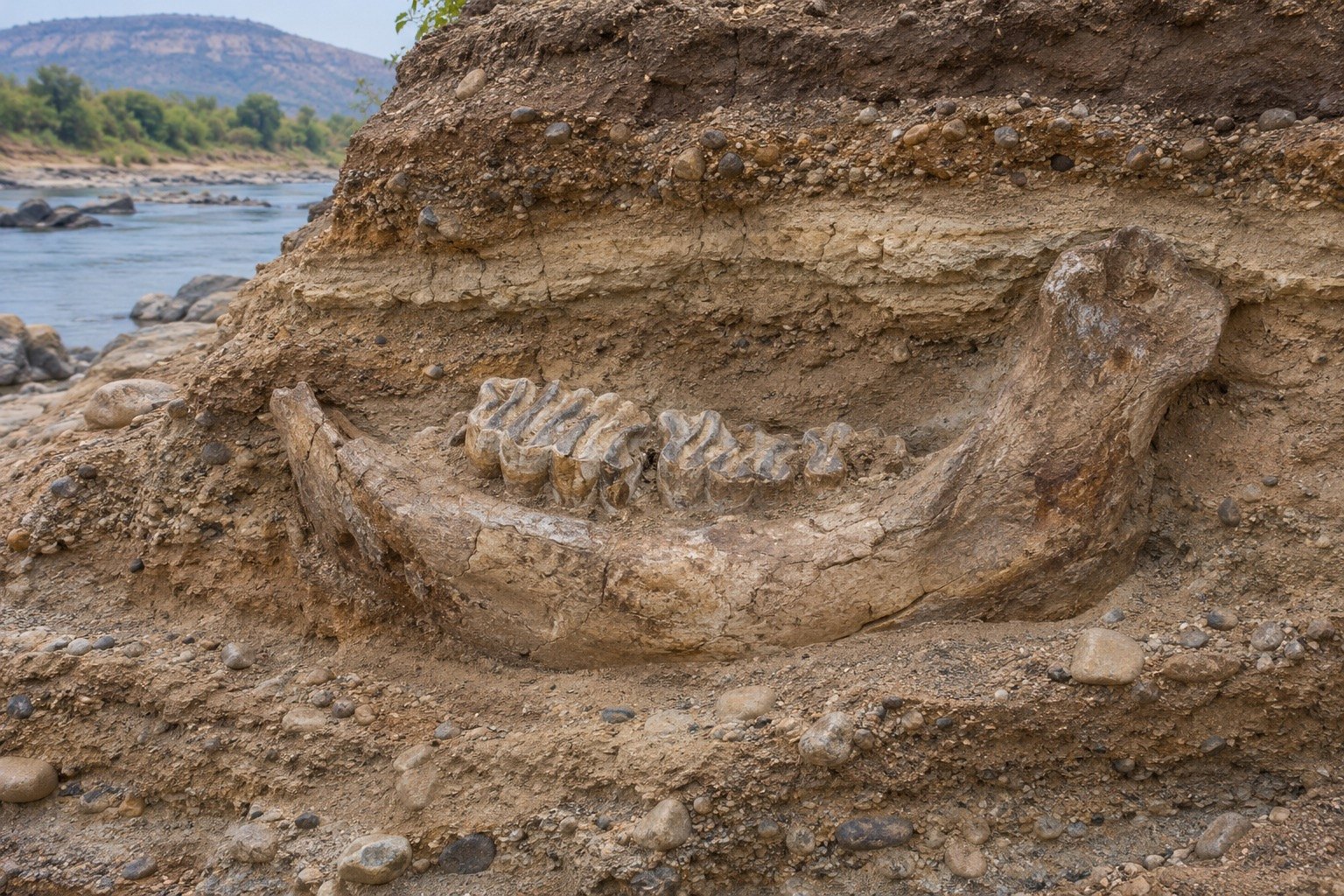
A Geological Survey of India (GSI) team from Bhopal inspected a fossil jaw at Patai Ghat on the Narmada in Raisen district, Madhya Pradesh, on 13 November. River erosion had exposed it. Researchers have preliminarily identified it as the extinct straight-tusked elephant Palaeoloxodon namadicus. The site is cordoned off, and the GSI's final report is awaited.
Syllabus: Prelims · Geography; Prelims · Science & Technology; GS3 · Science & Technology
Why this matters for UPSC
GS1 geography and GS3 science: the Narmada valley's Pleistocene fossils. Prelims can ask about Palaeoloxodon, the Pleistocene, India's fossil finds and the GSI's parent ministry and research branches.
Why it matters
A student of India's past wildlife learns from finds like this one what large animals roamed the centre of the country long before farming began. The river that uncovers a fossil can also wash it away, and visitors can damage it, so guarding the spot decides whether the jaw survives whole. A planned dig could bring up more of the skeleton and other animals from nearby layers, giving a clearer picture of the valley's old climate and landscape. Until the teeth are studied and dated, the name and the age stay provisional, and anyone citing the find should treat them as early estimates.
Prelims pointers
- India's first dinosaur bones were found near Jabalpur, Madhya Pradesh, in 1822; later finds span Rajasthan, Gujarat, Tamil Nadu and other States, and central India has yielded dinosaur eggs.
- Palaeoloxodon and Stegodon are both extinct genera; Palaeoloxodon namadicus is a straight-tusked species counted among the largest elephants known.
- GSI works through five Missions: surveys, resource assessment, information dissemination, fundamental research, and training and capacity building.
- The GSI, not the ASI, is the attached office of the Ministry of Mines; it became one after a High Power Committee's advice accepted in 2011.
Practise a UPSC-style question
With reference to dinosaur fossils in India, consider the following statements:
1. The first dinosaur bones recorded in India were found near Jaisalmer in Rajasthan.
2. Evidence of dinosaurs has been found in Gujarat and Tamil Nadu.
3. Fossilised dinosaur eggs have been found in central India.
Which of the statements given above is/are correct?
- (a) 1 and 2 only
- (b) 2 and 3 only
- (c) 1 and 3 only
- (d) 1, 2 and 3
Show the answer
Answer: (b) 2 and 3 only
Answer: (b) 2 and 3 only. The place of the first find is wrong; the other two hold.
Statement 1: incorrect. India's first dinosaur bones were found in 1822 near Jabalpur in Madhya Pradesh, not in Rajasthan.
Statement 2: correct. Dinosaur evidence has since come from several States, among them Gujarat, Tamil Nadu, Rajasthan and Karnataka.
Statement 3: correct. Central India has yielded fossilised dinosaur eggs in the past.
Eliminate: statement 1 is wrong, which removes (a), (c) and (d). Out: (a), (c), (d).
Trap: Swapped attribution. Rajasthan has dinosaur finds of its own, but the first recorded bones came from near Jabalpur.
Remember: India's first dinosaur bones, near Jabalpur (1822); dinosaur eggs in central India.
More from the 19 November 2026 edition
- Andaman and Nicobar prisons regulation repeals the Prisons Act, 1894 Polity
- Jal Shakti Ministry notifies one-time scheme to settle groundwater environmental compensation Environment
- UNDRR names GIFT City India's first MCR2030 Resilience Hub National
- Commerce widens exporter support under Export Promotion Mission's Niryat Disha Economy
- Rural Development Ministry issues Ombudsperson guidelines under VB-G RAM G Act Polity
- ICMR's AMRSN Annual Report 2025 finds resistance spreading to smaller hospitals Sci-Tech
- Quad leaders unveil maritime surveillance collaboration at Manila summit World & IR