
Pune DEO issues show-cause notice over bulk shifting of voters' addresses
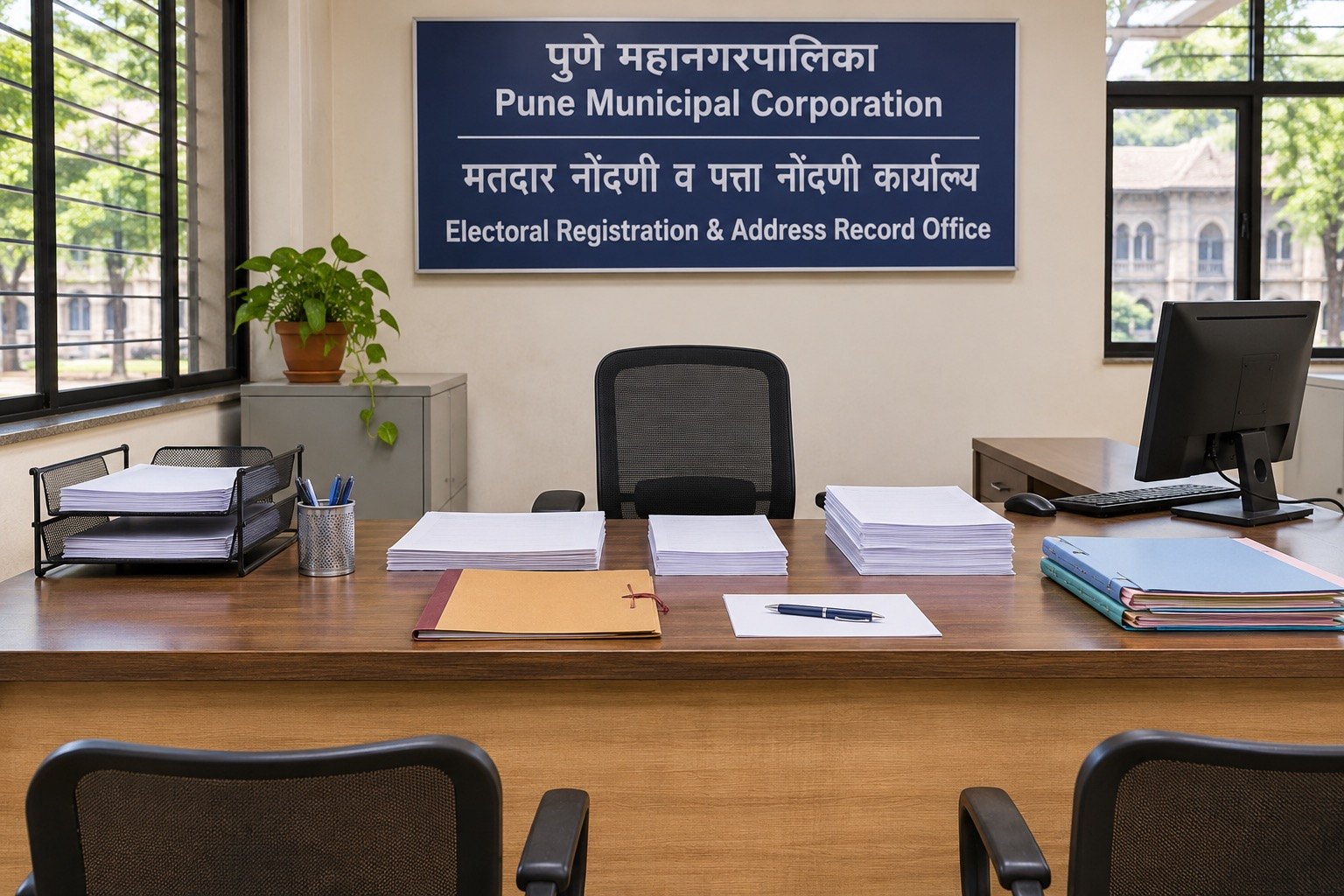
The Pune District Election Officer (DEO) issued a show-cause notice on 31 October 2026 to the Pimpri Electoral Registration Officer (ERO). It had accepted address changes without field checks. Next day, the Pimpri Assistant ERO lodged a police report citing the Representation of the People Act, 1950, section 31. It covers 40 Form 8 applications from four mobile numbers.
Syllabus: Prelims · Polity & Governance; GS2 · Representation of the People Act; GS2 · Governance & e-Governance
Why this matters for UPSC
GS2 polity: the Representation of the People Act, 1950 and electoral roll revision. Prelims can ask Forms 6, 7 and 8 and the officers; Mains, safeguards against wrongful deletion.
Why it matters
A worker who has never moved house can reach the polling booth and find that her name now sits on a roll in another town. That happens because one approved address change quietly removes her from her own constituency, and the officer there has no way to stop it. If officers accept forms on paper without a visit to the home, anyone holding a voter's details can move that voter away. Getting back on the roll then takes a fresh application and time, and an election may pass in between. The case asks whether speed in cleaning rolls before polls is worth the risk of silently disenfranchising real residents.
Prelims pointers
- Under the RP Act, 1950, a State's chief electoral officer is designated or nominated by the Election Commission in consultation with that State's government.
- The Election Commission may designate more than one district election officer for a district, each with a specified area, if one officer cannot do the work.
- Under the 1960 rules, Form 8 is filed by the person the entry concerns, while Form 7 may be filed by anyone whose name is in that roll.
- No entry may be amended, transposed or deleted, and no name included, between the last date for nominations and the completion of that election.
- When a person already enrolled elsewhere is added to a roll, the new ERO informs the old constituency's ERO, who strikes the name off after verification.
- Under the RP Act, 1950, a knowingly false written statement about including or excluding a roll entry draws up to one year in prison, a fine, or both.
- Per the Election Commission's FAQ, a voter who moves files Form 8 with the ERO of the constituency where the new home lies.
Practise a UPSC-style question
With reference to the officers who handle electoral rolls under the Representation of the People Act, 1950, consider the following statements:
1. A district election officer supervises roll work in the district under the superintendence of the State Election Commission.
2. A State's chief electoral officer is designated by the Election Commission in consultation with the State government.
Which of the statements given above is/are correct?
- (a) 1 only
- (b) 2 only
- (c) Both 1 and 2
- (d) Neither 1 nor 2
Show the answer
Answer: (b) 2 only
Answer: (b) 2 only. The DEO works under the chief electoral officer, not the State Election Commission.
Statement 1: incorrect. The DEO coordinates and supervises roll work under the superintendence, direction and control of the chief electoral officer, who in turn works under the Election Commission.
Statement 2: correct. The 1950 Act has the Election Commission designate or nominate each State's chief electoral officer in consultation with that State's government.
Eliminate: statement 1 names the wrong superior body, so it is false. Out: (a), (c).
Eliminate: statement 2 matches the designation rule in the 1950 Act. Out: (d).
Trap: Look-alike names. A State-level body sounds like the right superior for a district officer, but roll work for Parliament and Assembly seats answers to the Election Commission through the CEO.
Remember: ERO under DEO, DEO under CEO, CEO under the Election Commission.
More from the 15 November 2026 edition
- AIIMS repairs spina bifida in the womb, a first for India Sci-Tech
- Bihar Police flag 1.09 lakh suspected mule accounts across 38 districts National
- Indian Railways approves weekly Janakpur Dham-Ayodhya train, a new India-Nepal link World & IR
- H5N1 avian influenza confirmed in Cuddalore; 1-km culling under national plan National
- India commits over 7 million euros as Elettra 2.0 synchrotron co-partner Sci-Tech
- DPDP Act: Consent Manager registration takes effect, Data Protection Board opens applications Polity
- Tamil Nadu caps paddy, rice and pulse stocks under Essential Commodities Act Economy