
Tamil Nadu caps paddy, rice and pulse stocks under Essential Commodities Act
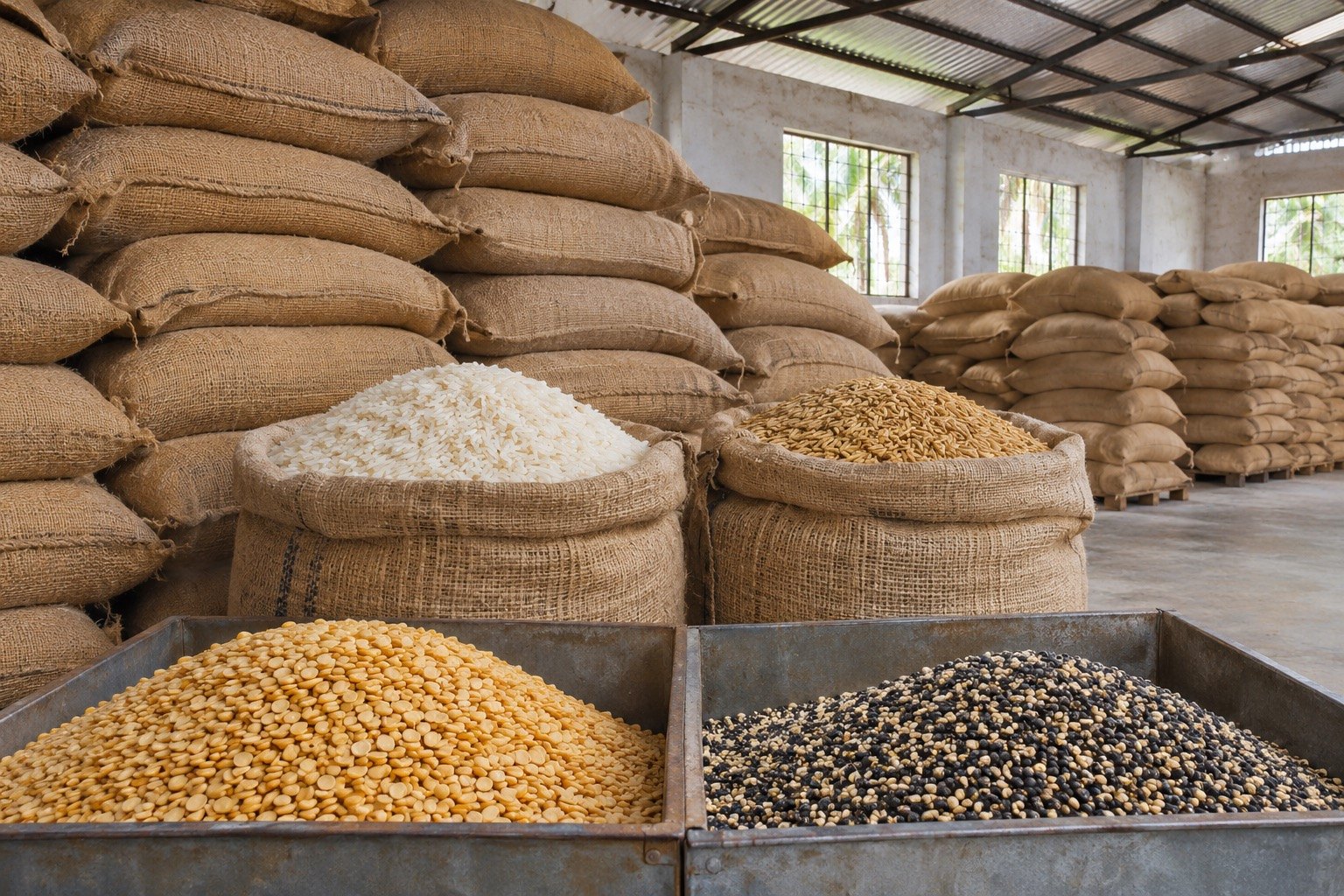
Tamil Nadu imposed stock limits on paddy, rice, tur and urad on 13 November 2026, using the Essential Commodities Act, 1955. Wholesalers may now keep no more than 2,000 tonnes of paddy or rice and 200 tonnes of each pulse. Anyone holding more must bring stocks within the limits by 16 November.
Syllabus: GS3 · Indian Economy & Growth; GS2 · Federalism & Local Government; GS3 · Agriculture & Irrigation
Why this matters for UPSC
GS3 economy: food prices, storage and the Essential Commodities Act, 1955. Prelims can ask what an order under it covers; Mains, stock limits and Centre-State roles.
Why it matters
A wholesaler in Tamil Nadu sitting on large rice stocks now has to release the excess into the market within days. More grain on sale can ease the pressure that hoarding puts on prices, which is the outcome the State government is aiming for. Millers, importers and chain stores must report what they hold, so officials can see where stocks pile up. There is a trade-off: tight limits can make traders wary of buying at harvest, which may weaken the price a farmer gets. The step also shows a State, not just the Centre, using a central law to manage food supply, a live question of cooperative federalism.
Prelims pointers
- Under the Essential Commodities Act, 1955, an essential commodity is one specified in the Schedule to the Act.
- The Central Government adds or removes a commodity by Gazette notification after consulting the States, and lays each notification before both Houses of Parliament.
- A notification may deem a commodity essential for up to six months; the Centre may extend that period in the public interest.
- An order under Section 3 may control prices, license storage and transport, ban withholding goods from sale and require traders to keep records for inspection.
- Section 3 vests the order-making power in the Central Government; Section 5 lets the Centre direct that a State Government or an officer may also use it.
- Section 6 lets a Section 3 order prevail over inconsistent provisions of other laws, though not over the Essential Commodities Act itself.
- The Centre's power to amend the Schedule extends to commodities on which Parliament can legislate under Entry 33 of List III of the Seventh Schedule.
Practise a UPSC-style question
With reference to the stock limits Tamil Nadu imposed on paddy, rice, tur and urad in 2026, consider the following statements:
1. The two orders were made under the Essential Commodities Act, 1955.
2. The two orders were issued by the Union Department of Consumer Affairs for Tamil Nadu.
Which of the statements given above is/are correct?
- (a) 1 only
- (b) 2 only
- (c) Both 1 and 2
- (d) Neither 1 nor 2
Show the answer
Answer: (a) 1 only
Answer: (a) 1 only. The orders are State orders made under the 1955 Act.
Statement 1: correct. Both orders, on rice and on tur and urad, rest on Section 3 of the Essential Commodities Act, 1955.
Statement 2: incorrect. Tamil Nadu's Cooperation, Food and Consumer Protection Department issued them; the Union department only hosts the portal where traders declare stocks.
Eliminate: statement 2 swaps the State department for a Union one. Out: (b), (c).
Eliminate: statement 1 is right, since the orders cite the 1955 Act. Out: (d).
Trap: Swapped attribution. The Union department appears in the orders because stocks are declared on its portal, so a student may credit it with issuing them.
Remember: a State department issued these stock limits under a central law.
More from the 15 November 2026 edition
- AIIMS repairs spina bifida in the womb, a first for India Sci-Tech
- Bihar Police flag 1.09 lakh suspected mule accounts across 38 districts National
- Indian Railways approves weekly Janakpur Dham-Ayodhya train, a new India-Nepal link World & IR
- H5N1 avian influenza confirmed in Cuddalore; 1-km culling under national plan National
- India commits over 7 million euros as Elettra 2.0 synchrotron co-partner Sci-Tech
- DPDP Act: Consent Manager registration takes effect, Data Protection Board opens applications Polity
- Pune DEO issues show-cause notice over bulk shifting of voters' addresses Polity