
India holds VAJRA-SAT drill for FMD serotype SAT-1 spreading in West Asia
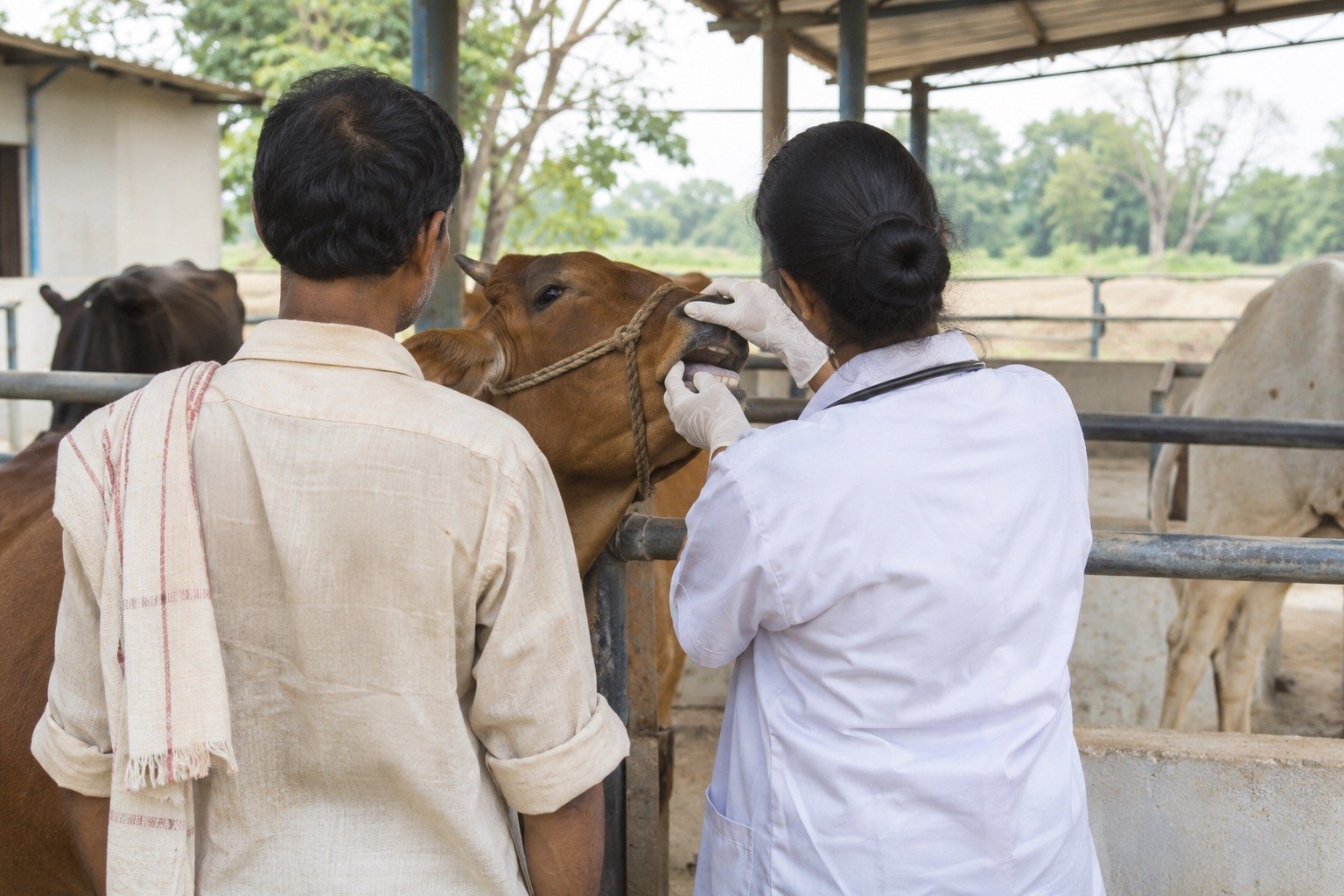
The Department of Animal Husbandry and Dairying (DAHD) and ICAR-NIVEDI held VAJRA-SAT, a national tabletop exercise on foot-and-mouth disease (FMD) serotype SAT-1, in Bengaluru on 4-5 November 2026. It prepared for a serotype India has not yet recorded, which is now circulating in parts of West Asia. Teams from 25 States and three Union Territories worked through simulated outbreaks.
Syllabus: Prelims · Current Affairs & IR; GS3 · MSP, Subsidies & Food Security; GS3 · Disaster Management
Why this matters for UPSC
GS3 economics of animal-rearing and disaster management: FMD and transboundary animal diseases. Prelims can ask FMD's serotypes, WOAH's role and NADCP; Mains, livestock biosecurity.
Why it matters
A dairy farmer whose cow catches FMD can lose most of its milk for months, and a village herd under quarantine cannot be sold or moved. SAT-1 would be harder still, because it has not been reported in India and immunity to other serotypes gives no cover. If it slipped in through animal movement, it could spread widely before any laboratory confirmed it. Rehearsing who reports, who tests and who stops movement shortens that delay. Disease-free semen stations matter as well. A bull can shed the virus in semen before it looks ill, so clean breeding centres protect the genetics that millions of farmers depend on, and they make livestock trade safer.
Prelims pointers
- WOAH lists seven FMD serotypes: A, O, C, SAT1, SAT2, SAT3 and Asia1; serotype C has not been isolated since 2004.
- FMD affects cattle, pigs, sheep, goats and other cloven-hoofed animals; it is not readily transmissible to humans and is not a public health risk.
- FMD and brucellosis are both covered by NADCP, but brucellosis can pass to farm workers and causes infertility, while FMD poses no human health risk.
- FMD was the first disease for which WOAH set up an official list of disease-free Members; freedom can cover a whole country or defined zones.
- Paraguay and Uruguay are recognised by WOAH as FMD-free where vaccination is practised.
- WOAH asks for FMD vaccination coverage of at least 80% with inactivated vaccines; live virus vaccines are not acceptable because they can revert to virulence.
- FAO notes the SAT serotypes are usually confined to sub-Saharan Africa; SAT2 was detected in Western Asia in 2022.
- The FMD virus can be present in milk and semen for up to four days before an animal shows clinical signs.
Practise a UPSC-style question
With reference to foot-and-mouth disease (FMD), consider the following statements:
1. FMD is caused by a bacterium of the family Picornaviridae.
2. Each FMD serotype requires a specific vaccine to give immunity to a vaccinated animal.
3. FMD spreads readily to humans and is treated as a major public health risk.
Which of the statements given above is/are correct?
- (a) 1 only
- (b) 2 only
- (c) 3 only
- (d) 1, 2 and 3
Show the answer
Answer: (b) 2 only
Answer: (b) 2 only. Only the statement on serotype-specific vaccines is correct.
Statement 1: incorrect. WOAH says FMD is caused by an Aphthovirus of the family Picornaviridae, a virus, not a bacterium.
Statement 2: correct. WOAH states that each of the seven serotypes requires a specific vaccine to protect an animal.
Statement 3: incorrect. WOAH says FMD is not readily transmissible to humans and is not a public health risk.
Eliminate: Statement 3 is false, as FMD is not a human health risk. Out: (c), (d).
Eliminate: Statement 1 is false, as FMD is caused by a virus. Out: (a).
Trap: Swapped attribution. The family Picornaviridae is right, but the pathogen is pinned on a bacterium instead of a virus.
Remember: FMD is viral, serotype-specific in immunity, and not a human health risk.
More from the 8 November 2026 edition
- CAQM invokes GRAP Stage III across Delhi-NCR at AQI 382 Environment
- Election Commission lets SIR-excluded electors return through enumeration forms Polity
- DRDO flight-tests quasi-ballistic missile Pralay in user trials off Odisha Defence
- Forest Advisory Committee recommends in-principle forest clearance for 1,000-MW Naying project Environment
- Agasthyamalai: SC bars temporary residents, outsiders from Forest Rights Act claims Environment
- India and EU conclude talks on India's association with Horizon Europe World & IR