
Supreme Court allows certified green crackers in Delhi-NCR on 7-8 November
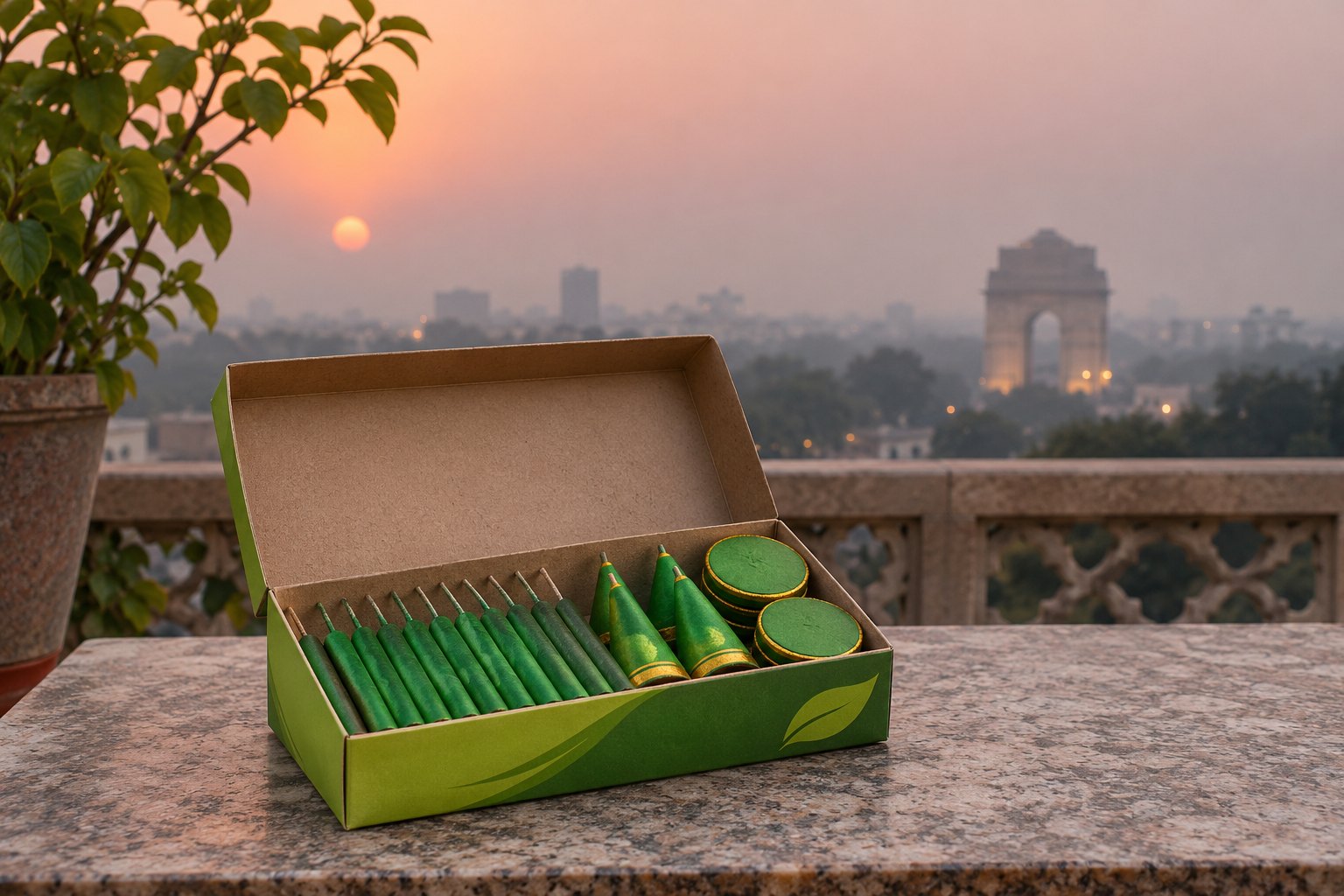
The Supreme Court has eased the firecracker ban in Delhi-NCR for Deepavali 2026. Certified green crackers may be burst on two days, 7 and 8 November, in short morning and evening slots. Makers need certification from CSIR-NEERI and PESO. Crackers stay barred near hospitals, health centres and schools, and the full ban then returns.
Syllabus: GS2 · Constitution; Prelims · Polity & Governance; Prelims · Environment & Ecology
Why this matters for UPSC
GS2 polity and GS3 environment: Article 25(1), Article 21 and green crackers. Prelims can ask the limits on freedom of religion and CSIR-NEERI's definition; Mains, religion against health.
Why it matters
A family in Delhi with an asthmatic child or an ageing parent faces the worst air of the year around Deepavali. The court has kept the festival but shrunk it to two short evenings and two short mornings. It has also moved the burden onto sellers and makers, who lose their licence and their deposit if they cheat. Hospitals, nursing homes and schools get a quiet buffer around them. The larger question is how a court weighs a practice many people hold dear against the health of everyone who breathes the same air. The answer here is regulation that can be checked, since a total ban had only pushed the trade underground.
Prelims pointers
- Under CSIR-NEERI's definition, a green cracker cuts particulate matter by at least 30%, or by 20% plus 10% in gaseous emissions, and keeps sound under 125 dBA.
- CSIR-NEERI measures a green cracker's cut in emissions against the conventional composition of the same category of cracker, and treats metals as part of particulate matter.
- The National Centre of Excellence on Green Firecrackers sits at CSIR-NEERI, Nagpur; a separate Centre of Excellence is proposed at CSIR-CECRI, Karaikudi.
- Crackers release PM2.5, PM10, sulphur dioxide, nitrogen dioxide and metals such as barium, which worsen air quality most in already polluted areas.
- In Arjun Gopal v. Union of India (2018), the Supreme Court allowed reduced-emission crackers and green crackers while weighing pollution against Diwali's religious place.
Practise a UPSC-style question
With reference to Article 25(1) of the Constitution of India, consider the following statements:
1. It entitles all persons to freedom of conscience and the right to profess, practise and propagate religion.
2. The right it confers is subject to public order, morality and health.
3. The right it confers is not subject to the other provisions of Part III of the Constitution.
Which of the statements given above is/are correct?
- (a) 1 and 2 only
- (b) 2 and 3 only
- (c) 1 and 3 only
- (d) 1, 2 and 3
Show the answer
Answer: (a) 1 and 2 only
Answer: (a) 1 and 2 only. Article 25(1) gives the right to all persons, subject to three grounds and to Part III.
Statement 1: correct. Article 25(1) says all persons are equally entitled to freedom of conscience and to profess, practise and propagate religion.
Statement 2: correct. Its opening words make the right subject to public order, morality and health.
Statement 3: incorrect. Article 25(1) is also subject to the other provisions of Part III, the chapter on Fundamental Rights.
Eliminate: statement 3 is wrong, since the Article itself names the other provisions of Part III. Out: (b), (c), (d).
Trap: Reversed direction. Statement 3 keeps the right phrase about Part III but turns its direction, so a student who remembers the words but not their sense marks it true.
Remember: Article 25(1) yields to public order, morality, health and the rest of Part III.
Explainers on this topic
More from the 4 November 2026 edition
- Draft Drugs Rules amendment: drug makers to authorise a batch-release person National
- India seeks COP31 decision to launch Climate Finance Work Programme Environment
- NITI Aayog launches India S&T Scoreboard to benchmark States' science Sci-Tech
- Centre can direct airlines on fares in extraordinary situations Economy
- Indian Navy frees hijacked fishing vessel Azini from pirates off Somalia Defence
- North Central Railway commissions Kavach 4.0 on Karchana-Mirzapur, reaching 785 km Sci-Tech
- Supreme Court sets aside Rajasthan SEC's voter awareness refusal: no monopoly Polity
- Supreme Court sets time limits for rehabilitating rescued bonded labourers Polity
- Home Ministry plans FRROs in every State capital by 2027 Polity