
Indian Navy frees hijacked fishing vessel Azini from pirates off Somalia
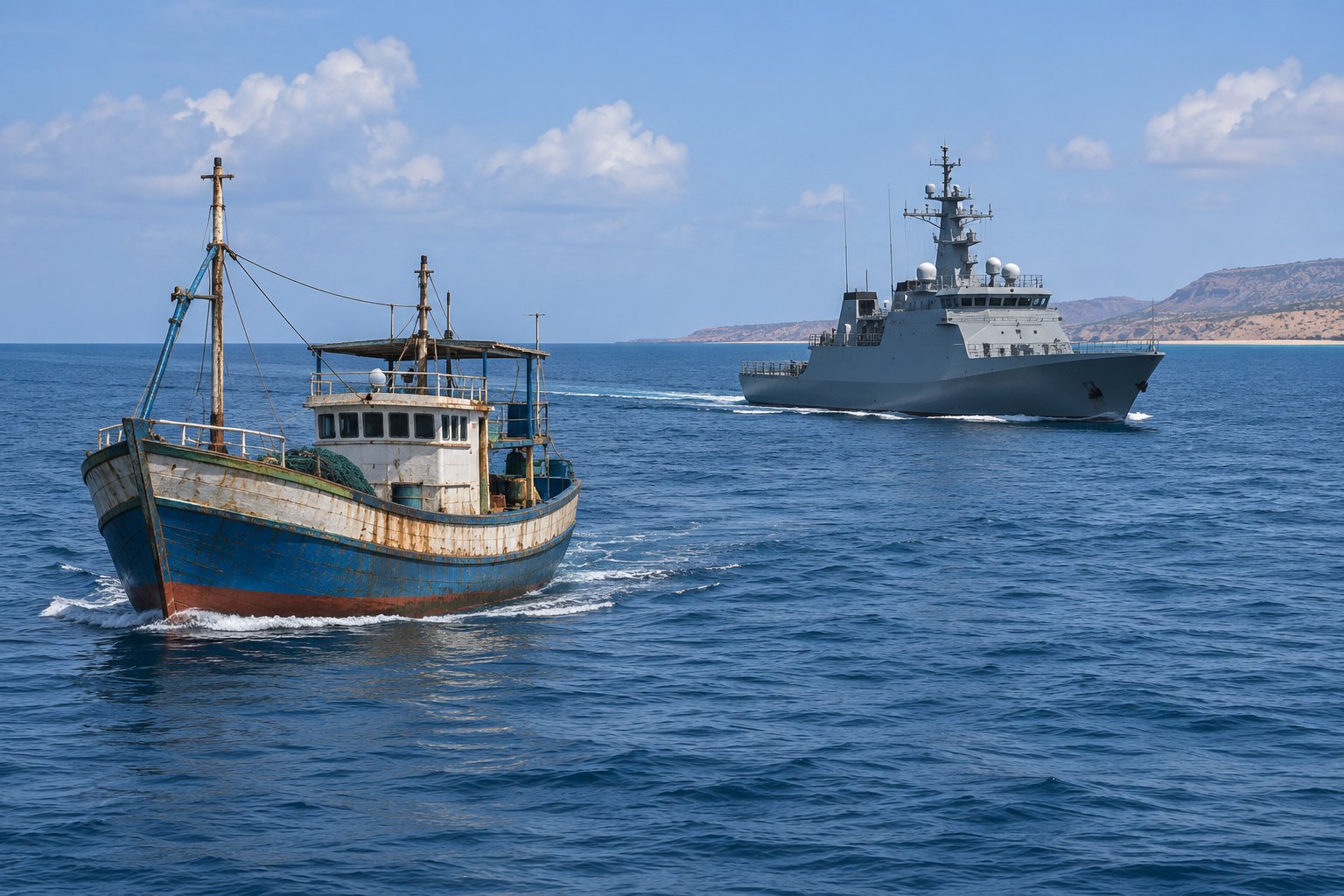
The Indian Navy freed the hijacked fishing vessel Azini from armed pirates off Somalia, the Ministry of Defence said on 3 November 2026. All 20 crew members were rescued with no casualties after an operation of over 48 hours. A mission-deployed warship, a maritime reconnaissance aircraft and Marine Commandos airdropped by an Indian Air Force C-17 took part.
Syllabus: Prelims · Current Affairs & IR; GS3 · External Threats to Security; GS2 · International Institutions
Why this matters for UPSC
GS3 security and GS2 international law: the Indian Navy's anti-piracy role under UNCLOS. Prelims can ask how UNCLOS defines piracy and who may seize pirates; Mains, India's maritime security role.
Why it matters
Pirates who seize a fishing boat off Somalia hold its crew captive and can use the boat to trap other sailors. That is why the Navy treated one hijacked fishing vessel as a regional threat. A captured boat gives pirates a floating base, so a small gang can reach merchant ships far from the coast. These waters carry trade routes the Navy calls vital, and every successful raid puts shipping and its crews at greater risk. Freeing the boat without a single casualty also shows that force at sea can be measured: the crew's safety came first, and the pirates were contained before they could strike again.
Prelims pointers
- Article 101 of UNCLOS needs three elements for piracy: an act for private ends, by a private ship or aircraft, against another vessel or persons on board.
- Look-alike: an attack inside a coastal State's territorial sea is not piracy under UNCLOS, which covers only the high seas or places outside any State's jurisdiction.
- Article 107 of UNCLOS: a seizure for piracy may be made only by warships, military aircraft or clearly marked, authorised government ships or aircraft.
- Under UNCLOS, a pirate ship may keep its nationality; the law of the State that granted it decides whether it is kept or lost.
- Under UNCLOS, piracy by a warship whose crew has mutinied is treated as piracy by a private ship.
- A State that seizes a ship on suspicion of piracy without adequate grounds is liable to the ship's flag State for the loss caused.
- Part VII of UNCLOS reserves the high seas for peaceful purposes and bars any State from claiming sovereignty over them.
Practise a UPSC-style question
With reference to piracy under the United Nations Convention on the Law of the Sea (UNCLOS), consider the following statements:
1. Piracy covers illegal acts of violence committed for private ends by the crew of a private ship.
2. An armed attack on a ship inside a coastal State's territorial sea counts as piracy under UNCLOS.
3. Acts by a warship whose crew has mutinied and taken control are treated like acts of a private ship.
Which of the statements given above is/are correct?
- (a) 1 and 2 only
- (b) 2 and 3 only
- (c) 1 and 3 only
- (d) 1, 2 and 3
Show the answer
Answer: (c) 1 and 3 only
Answer: (c) 1 and 3 only. UNCLOS piracy needs private ends and the high seas or a place outside any State's jurisdiction.
Statement 1: correct. Article 101 of UNCLOS covers violence, detention or depredation for private ends by the crew or passengers of a private ship or aircraft.
Statement 2: incorrect. Article 101 covers acts on the high seas or outside any State's jurisdiction; a territorial sea lies within the coastal State's jurisdiction.
Statement 3: correct. Article 102 of UNCLOS assimilates acts by a mutinied warship's crew to acts of a private ship.
Eliminate: statement 2 is wrong because piracy is defined by place, the high seas. Out: (a), (b), (d).
Trap: Wrong scope. The statement stretches piracy into territorial waters, where the coastal State's own law applies, so a familiar idea of sea robbery looks like piracy.
Remember: UNCLOS piracy is private ends plus the high seas or a place outside any State's jurisdiction.
More from the 4 November 2026 edition
- Draft Drugs Rules amendment: drug makers to authorise a batch-release person National
- India seeks COP31 decision to launch Climate Finance Work Programme Environment
- NITI Aayog launches India S&T Scoreboard to benchmark States' science Sci-Tech
- Centre can direct airlines on fares in extraordinary situations Economy
- North Central Railway commissions Kavach 4.0 on Karchana-Mirzapur, reaching 785 km Sci-Tech
- Supreme Court sets aside Rajasthan SEC's voter awareness refusal: no monopoly Polity
- Supreme Court sets time limits for rehabilitating rescued bonded labourers Polity
- Home Ministry plans FRROs in every State capital by 2027 Polity
- Supreme Court allows certified green crackers in Delhi-NCR on 7-8 November Environment