
Punjab Assembly resolutions seek to reopen Ravi-Beas and Yamuna water sharing
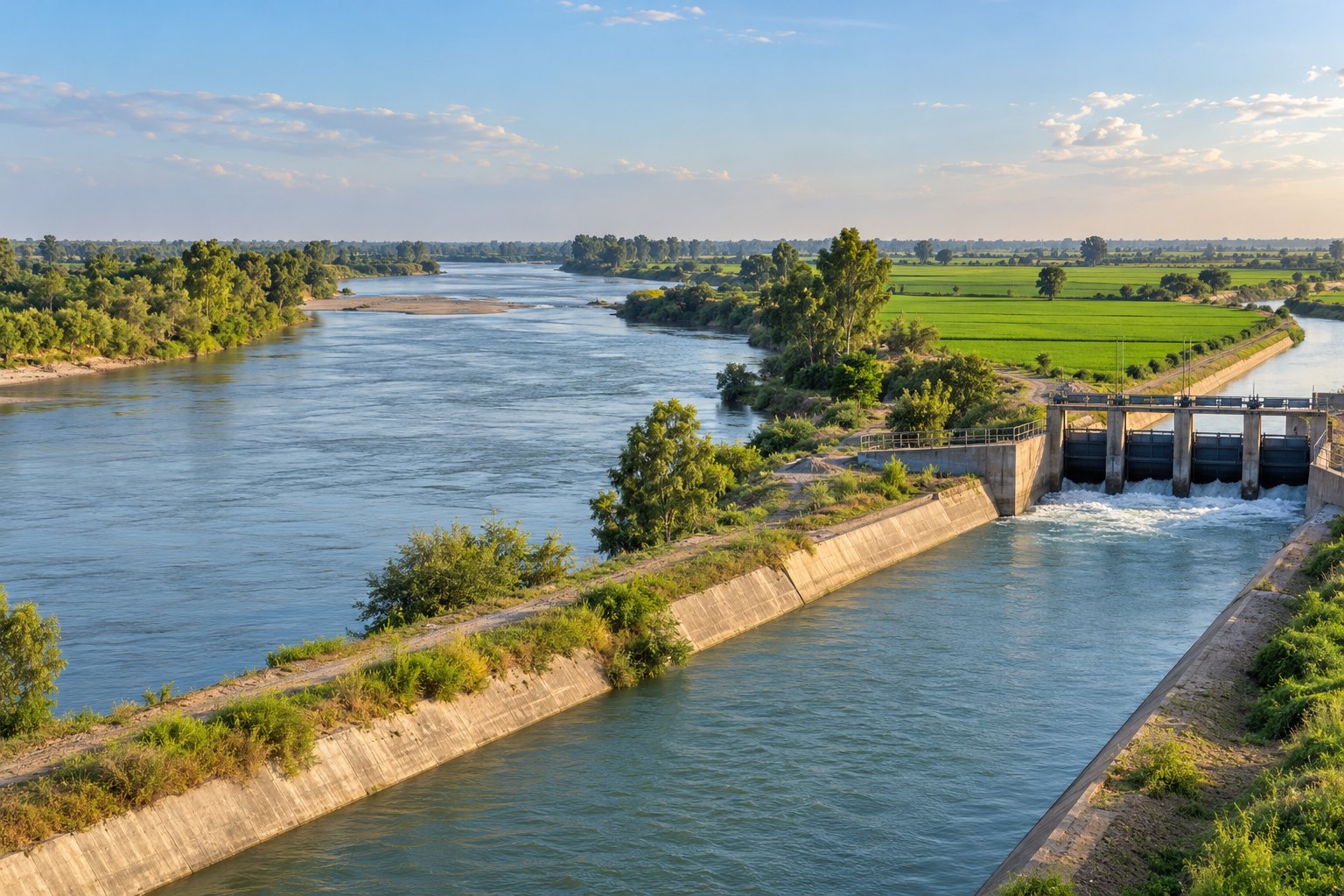
The Punjab Assembly passed five resolutions on 27 October 2026 to reopen river-water sharing. They seek an equitable Yamuna share and a Rs 1.44 lakh crore royalty from Rajasthan for Sutlej, Ravi and Beas water. They also seek control of key headworks and repeal of the Dam Safety Act, 2021. Another seeks projects to use Ravi water flowing to Pakistan.
Syllabus: GS2 · Federalism & Local Government; GS2 · Separation of Powers; Prelims · Polity & Governance
Why this matters for UPSC
GS2 polity: inter-State river disputes under Article 262 and the Inter-State River Water Disputes Act, 1956. Prelims can ask how tribunals work; Mains, federal water sharing and its limits.
Why it matters
A farmer in Punjab, Haryana or Rajasthan who irrigates from a canal depends on how much river water each State is allowed to draw. Punjab's resolutions show a State pressing for a bigger share through its Assembly. Yet they cannot alter a Central law or a signed agreement on their own; that needs Parliament, a tribunal or a negotiated deal. While the canal meant for Haryana stays unfinished, the quarrel keeps returning to politics, and farmers on both sides live with uncertain supply. The episode tests cooperative federalism: rivers cross State lines, so a lasting settlement needs an umpire both sides accept and a decision delivered in time.
Prelims pointers
- Clause (2) of Article 262 lets Parliament provide that neither the Supreme Court nor any other court shall hear an inter-State river water dispute.
- A Water Disputes Tribunal has a Chairman and two other members nominated by the Chief Justice of India from Supreme Court or High Court judges.
- A tribunal reports within three years, extendable by two; its decision, once published in the Official Gazette, has the force of a Supreme Court decree.
- A matter that may go to arbitration under the River Boards Act, 1956 cannot be referred to a tribunal under the Inter-State River Water Disputes Act, 1956.
- Under the 1956 Act, a water dispute also covers the interpretation or implementation of an agreement on sharing inter-State river waters.
- The Centre may frame a scheme setting up an authority to give effect to a tribunal's decision, and must lay it before both Houses of Parliament.
Practise a UPSC-style question
With reference to inter-State river water disputes in India, consider the following statements:
1. Article 262 allows Parliament to provide by law that the Supreme Court shall not hear such disputes.
2. Under the Inter-State River Water Disputes Act, 1956, the Supreme Court constitutes a Water Disputes Tribunal on a State's petition.
3. A tribunal's decision, once published in the Official Gazette, has the same force as an order or decree of the Supreme Court.
Which of the statements given above is/are correct?
- (a) 1 and 2 only
- (b) 2 and 3 only
- (c) 1 and 3 only
- (d) 1, 2 and 3
Show the answer
Answer: (c) 1 and 3 only
Answer: (c) 1 and 3 only. Statements 1 and 3 restate the Constitution and the 1956 Act; statement 2 names the wrong body.
Statement 1: correct. Article 262 lets Parliament bar the Supreme Court and other courts from disputes over the waters of inter-State rivers.
Statement 2: incorrect. A State asks the Central Government, which constitutes the tribunal by notification when the dispute cannot be settled by negotiation.
Statement 3: correct. Under the Inter-State River Water Disputes Act, 1956, a published tribunal decision is final, binding and has the force of a Supreme Court decree.
Eliminate: statement 2 is the surest, since the Centre, not a court, sets up a tribunal. Out: (a), (b), (d).
Trap: Swapped attribution. The power to set up a tribunal is moved from the Central Government to the Supreme Court, the very court the Act keeps out of such disputes.
Remember: a State requests, the Centre constitutes, the tribunal decides, the courts stay out.
More from the 2 November 2026 edition
- DAC accords in-principle approval to Project 18A next-generation stealth destroyers Defence
- Election Commission orders suspension of two Pilibhit EROs over roll irregularities Polity
- NASA's Swift observatory ends mission as orbital decay forces uncontrolled re-entry Sci-Tech
- IMD forecasts cyclonic storm near Andhra coast, to be named Murasu Environment
- CPCB orders closure of NCR units without pollution control device orders Environment
- U.P. CEO orders ECINET logins of all ERO computer assistants deactivated Polity
- Forces take over Suspension of Operations camp in Manipur amid abrogation rallies National
- CBIC halts arrests under GST ahead of CGST Act amendments Economy
- Quad ministers warn on economic coercion, back critical-minerals and maritime steps World & IR