
CPCB orders closure of NCR units without pollution control device orders
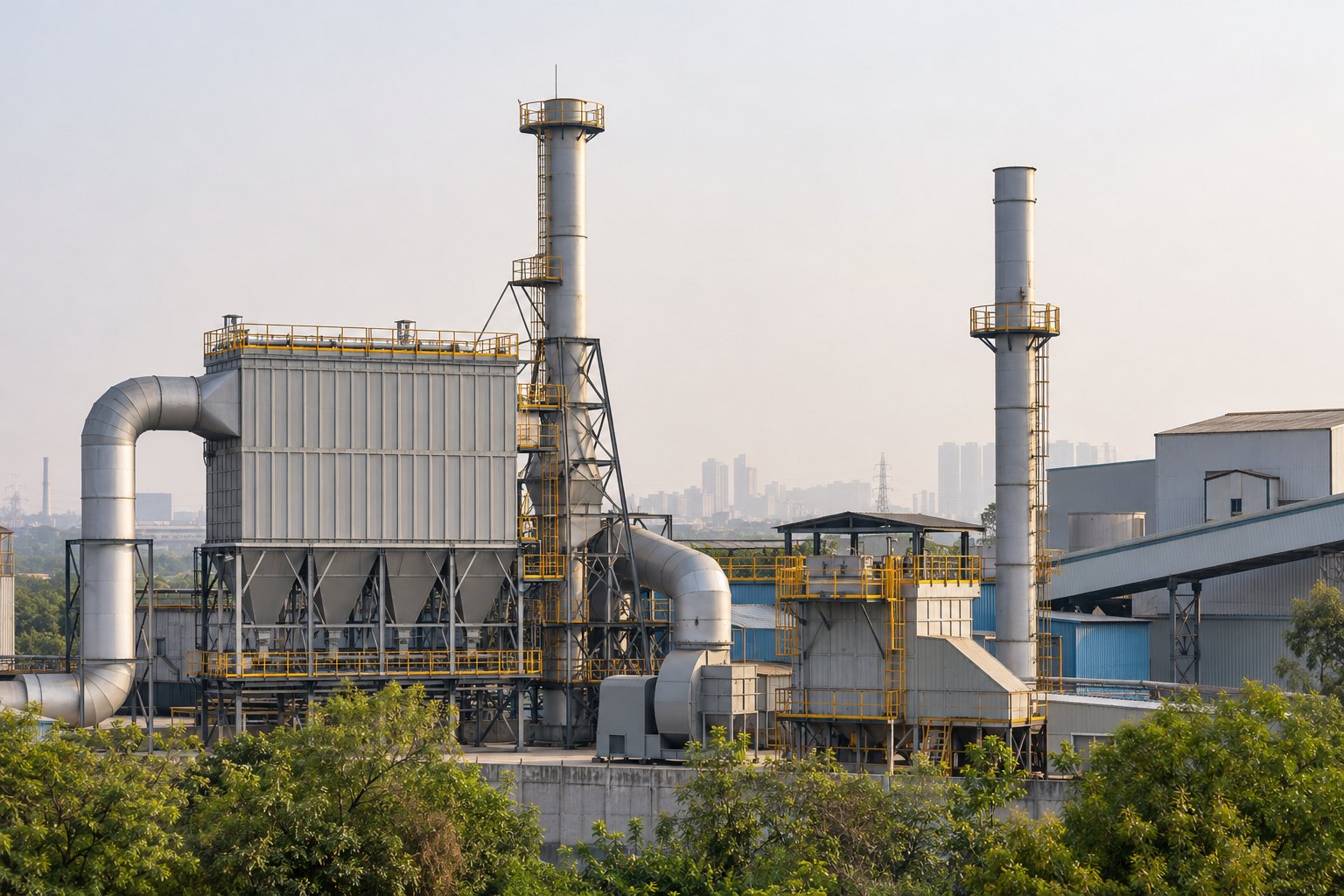
The Central Pollution Control Board (CPCB) issued a direction on 30 October 2026 to the pollution control bodies of Delhi, Haryana, Uttar Pradesh and Rajasthan. They must serve show-cause notices on units yet to order air pollution control devices (APCDs). Units that cannot show work orders within five days face closure. The limit on their particulate emissions is 50 mg/Nm³.
Syllabus: Prelims · Environment & Ecology; GS2 · Statutory & Regulatory Bodies; GS3 · Environment & Conservation
Why this matters for UPSC
GS3 environment: industrial air pollution control and its regulators in NCR. Prelims can ask how APCDs work and what the CAQM does; Mains, why emission norms fail at enforcement.
Why it matters
A family living beside an industrial area in the National Capital Region breathes the dust that nearby chimneys release, and winter is when the region's air is at its worst. Fitting filters costs money, so many owners waited while the deadline moved. A five-day test for proof of orders, with closure as the penalty, makes delay costlier than compliance. Workers at units that are shut may lose wages for a while, and equipment suppliers, already stretched, will face a rush of orders. The larger issue is old: India writes strict emission limits but often enforces them late, and enforcement decides whether a norm actually cleans the air people breathe.
Prelims pointers
- In NCR, the CAQM made the 50 mg/Nm³ industrial limit binding by statutory direction; the CPCB recommended it, and the State boards and DPCC enforce it.
- A cyclone separator uses centrifugal force and suits coarse particles; a bag filter traps finer dust in fabric membranes.
- A scrubber uses a liquid and can capture certain gases as well as dust; bag filters, cyclones and precipitators remove particles.
- Industrial stack emissions raise particulate levels directly and also through secondary particulate formation from the gases released.
- An emission standard such as 50 mg/Nm³ caps what a stack releases; it is not an ambient air quality standard for the surrounding air.
Practise a UPSC-style question
With reference to air pollution control devices fitted to industrial stacks, consider the following statements:
1. An electrostatic precipitator gives particles an electric charge with high voltage and then collects them.
2. A cyclone separator traps the finest dust particles by passing exhaust through fabric membranes.
3. A scrubber uses a liquid and can capture some gases along with dust.
Which of the statements given above is/are correct?
- (a) 1 and 2 only
- (b) 2 and 3 only
- (c) 1 and 3 only
- (d) 1, 2 and 3
Show the answer
Answer: (c) 1 and 3 only
Answer: (c) 1 and 3 only. The precipitator and scrubber are described rightly; the cyclone is not.
Statement 1: correct. An electrostatic precipitator uses high-voltage electricity to charge particles and collect them from the exhaust.
Statement 2: incorrect. Fabric membranes are how a bag filter works; a cyclone separator spins out coarse particles by centrifugal force.
Statement 3: correct. A scrubber passes exhaust through a liquid, which holds dust and certain gases.
Eliminate: Statement 2 describes a bag filter, not a cyclone, so every option with 2 goes. Out: (a), (b), (d).
Trap: Look-alike names. The question pins the bag filter's fabric method, and the fine-dust job, on the cyclone separator, which handles coarse particles.
Remember: Cyclone: centrifugal force, coarse particles. Bag filter: fabric. Precipitator: charge. Scrubber: liquid.
More from the 2 November 2026 edition
- Punjab Assembly resolutions seek to reopen Ravi-Beas and Yamuna water sharing Polity
- DAC accords in-principle approval to Project 18A next-generation stealth destroyers Defence
- Election Commission orders suspension of two Pilibhit EROs over roll irregularities Polity
- NASA's Swift observatory ends mission as orbital decay forces uncontrolled re-entry Sci-Tech
- IMD forecasts cyclonic storm near Andhra coast, to be named Murasu Environment
- U.P. CEO orders ECINET logins of all ERO computer assistants deactivated Polity
- Forces take over Suspension of Operations camp in Manipur amid abrogation rallies National
- CBIC halts arrests under GST ahead of CGST Act amendments Economy
- Quad ministers warn on economic coercion, back critical-minerals and maritime steps World & IR