
NASA's Swift observatory ends mission as orbital decay forces uncontrolled re-entry
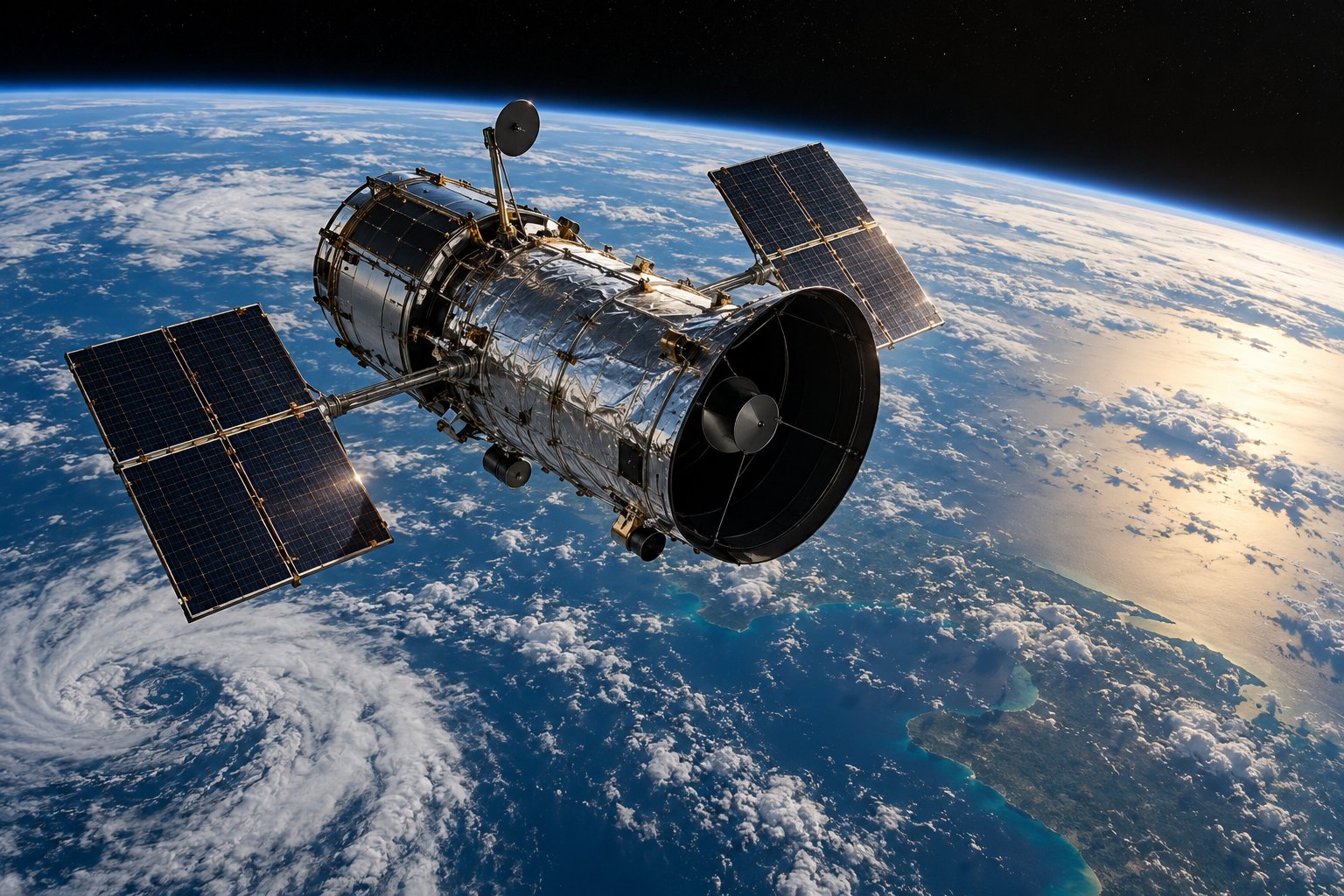
NASA ended its Neil Gehrels Swift Observatory after the gamma-ray burst telescope sank to 275 km on 20 October, where atmospheric drag stopped steady observation. The US Space Force predicted an uncontrolled re-entry on or around 30 October. Most of the craft is expected to burn up, and any surviving pieces would most likely fall into the ocean.
Syllabus: Prelims · Current Affairs & IR; Prelims · Science & Technology; GS3 · IT, Space, Biotech & IPR
Why this matters for UPSC
GS3 science and technology: space, orbital decay and space debris. Prelims can ask how solar activity raises drag; Mains, liability for falling debris.
Why it matters
An astronomer chasing a sudden cosmic explosion loses a telescope that could turn to it within about a minute, so short-lived events may fade before bigger observatories learn where to look. NASA says it is studying existing telescopes, fast commercial launches and new missions to fill the gap. For people under the flight path the danger is small, since most of the craft burns up and what survives will most likely land in the sea. The bigger lesson is that the Sun's moods can cut a satellite's working life short, and that rescuing a sinking spacecraft is still hard. As low orbits crowd with satellites, decay, debris and who pays for damage matter to every spacefaring country, India included.
Prelims pointers
- Absolute versus fault liability: on Earth and for aircraft no fault need be shown; for damage to another State's space object in outer space, fault must be proved.
- Solar maximum raises satellite drag because extra solar energy creates denser layers in low Earth orbit, shortening orbital lifetimes.
- Gamma-ray bursts fade quickly, so a rapid-response telescope must locate one and pass its position to larger observatories within minutes.
- Swift was a multiwavelength observatory: co-aligned optical/ultraviolet and X-ray telescopes imaged each burst and refined its position.
- NASA renamed Swift in 2018 after Neil Gehrels, its first principal investigator.
Practise a UPSC-style question
With reference to the Convention on International Liability for Damage Caused by Space Objects, 1972, consider the following statements:
1. A launching State is absolutely liable for damage its space object causes to another State's space object in outer space.
2. A launching State is absolutely liable for damage its space object causes on the surface of the Earth.
Which of the statements given above is/are correct?
- (a) 1 only
- (b) 2 only
- (c) Both 1 and 2
- (d) Neither 1 nor 2
Show the answer
Answer: (b) 2 only
Answer: (b) 2 only. The Convention sets absolute liability on the ground and in the air, but fault-based liability in space.
Statement 1: incorrect. For damage caused in outer space to another State's space object, the Liability Convention, 1972 makes the launching State liable only if the damage is due to its fault.
Statement 2: correct. The Liability Convention, 1972 makes a launching State absolutely liable to pay compensation for damage on the Earth's surface or to aircraft in flight.
Eliminate: Statement 1 is false, because damage in outer space is compensated only on proof of fault. Out: (a), (c).
Eliminate: Statement 2 is the Convention's core rule of absolute liability for surface damage, so it is true. Out: (d).
Trap: Wrong scope. Absolute liability is stretched from the Earth's surface and aircraft to collisions in space, where the Convention asks for fault.
Remember: Liability Convention, 1972: absolute on the ground and for aircraft; fault-based in outer space.
More from the 2 November 2026 edition
- Punjab Assembly resolutions seek to reopen Ravi-Beas and Yamuna water sharing Polity
- DAC accords in-principle approval to Project 18A next-generation stealth destroyers Defence
- Election Commission orders suspension of two Pilibhit EROs over roll irregularities Polity
- IMD forecasts cyclonic storm near Andhra coast, to be named Murasu Environment
- CPCB orders closure of NCR units without pollution control device orders Environment
- U.P. CEO orders ECINET logins of all ERO computer assistants deactivated Polity
- Forces take over Suspension of Operations camp in Manipur amid abrogation rallies National
- CBIC halts arrests under GST ahead of CGST Act amendments Economy
- Quad ministers warn on economic coercion, back critical-minerals and maritime steps World & IR