
SEBI recasts Closing Auction Session; expiry settlement moves to VWAP
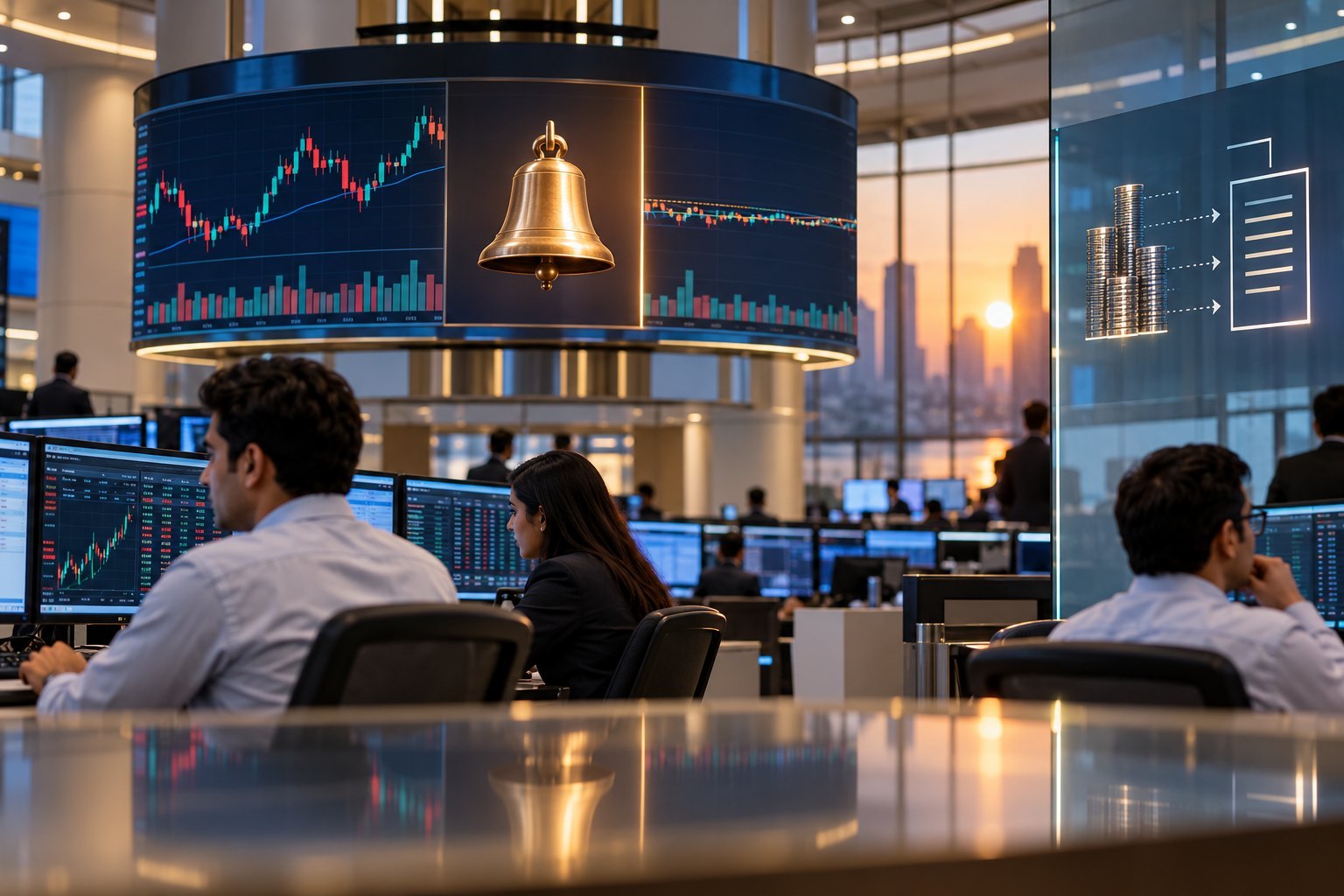
The Securities and Exchange Board of India (SEBI) revised its Closing Auction Session (CAS) framework on 15 October 2026. From 7 December 2026, the cash segment's closing auction will run from 3:30 to 3:40 pm and most derivatives will trade until 3:45 pm. Expiring index and stock derivatives will settle on the last 30 minutes' volume-weighted average price.
Syllabus: GS3 · Indian Economy & Growth; Prelims · Economy & Social Development; GS2 · Statutory & Regulatory Bodies
Why this matters for UPSC
GS3 Indian economy, capital markets: Prelims can ask how a call auction discovers a closing price, what volume-weighted average price means and under which Act SEBI regulates; Mains, about market integrity on derivatives expiry days.
Why it matters
A closing price is used far beyond the trading screen. A mutual fund values its units on it, an index fund buys and sells at it, and an investor's portfolio is marked to it every evening. If a few large orders in the final minutes could push it up or down, all of them would pay for it. Expiry days are where the stakes are highest, because every expiring futures and options contract is settled at a single price. Averaging over half an hour makes that price harder to move with one burst of orders. The larger question is how a regulator balances fair price discovery against the risk that the one price which settles a whole expiry can be gamed.
Prelims pointers
- SEBI Act, 1992, section 11(1): it is SEBI's duty to protect the interests of investors in securities and to promote the development of, and regulate, the securities market.
- Securities Contracts (Regulation) (Stock Exchanges and Clearing Corporations) Regulations, 2018: SEBI's regulations governing recognised stock exchanges and clearing corporations.
- Call auction priority: market orders are matched before limit orders; carried-over limit orders rank ahead of limit orders placed during the auction.
- Tie rule: if several prices clear the same maximum volume, the one with the least unmatched quantity wins, then the one nearest the reference price.
- If no equilibrium price is discovered in a call auction, the reference price itself becomes the closing price.
- Pre-open session: a call auction from 9:00 to 9:15 am that discovers the opening price, with a random close between 9:08 and 9:10 am.
- Closing prices also serve index computation and mutual fund net asset value (NAV), and let passive funds trade at the close to cut tracking error.
Practise a UPSC-style question
With reference to the Closing Auction Session in Indian stock exchanges, consider the following statements:
1. The closing price is the equilibrium price at which the maximum volume of orders is executable.
2. Stop loss orders and new iceberg orders can be placed during the auction.
3. The order entry period closes at a random moment chosen by the trading system.
Which of the statements given above is/are correct?
- (a) 1 and 2 only
- (b) 2 and 3 only
- (c) 1 and 3 only
- (d) 1, 2 and 3
Show the answer
Answer: (c) 1 and 3 only
Answer: (c) 1 and 3 only. The auction closes at a random moment and sets one equilibrium price; stop loss and new iceberg orders are barred.
Statement 1: correct. SEBI's CAS framework defines the equilibrium price as the price at which the maximum volume is executable, and it becomes the closing price.
Statement 2: incorrect. Only limit and market orders may be placed in CAS; stop loss orders and new iceberg orders are not allowed, so every order shows its full quantity.
Statement 3: correct. The order entry period ends at a system-driven random moment, between 3:38 and 3:40 pm under the October 2026 revision.
Eliminate: Statement 2 is the surest, since an auction that wants full disclosure cannot accept hidden iceberg orders. Out: (a), (b), (d).
Trap: Sounds right. Stop loss and iceberg orders are common in normal trading, so their presence in the auction sounds natural but is barred.
Remember: Closing auction: only limit and market orders, random close, one equilibrium price.
More from the 18 October 2026 edition
- Ethanol blending: 2026-27 tender shuts out sugar-based feedstocks Economy
- NPPA notifies 30% trade-margin cap on 137 anti-cancer drugs National
- Deep magnitude-6.9 quake jolts Kamchatka on the Pacific Ring of Fire World & IR
- First tranche of India-US Bilateral Trade Agreement finalised, in legal drafting World & IR
- PRODES satellite survey puts Brazil's Amazon clearing at a series low Environment
- DGMA bars Indian seafarers from Sarawak's inland and coastal vessels National