
Sarus crane: BNHS holds all-India count to set national baseline
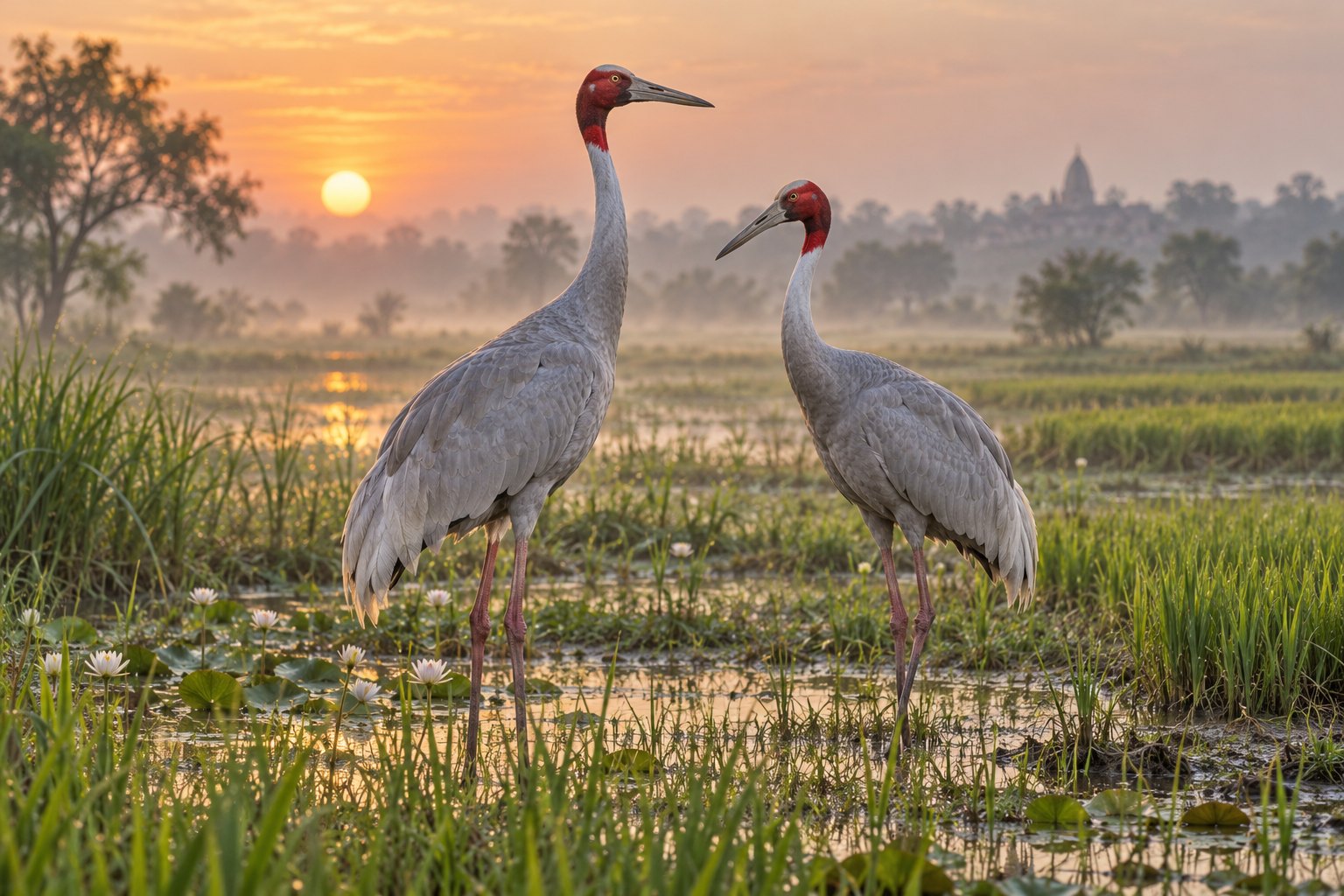
The Bombay Natural History Society (BNHS), a non-government body, is holding an All-India Sarus Crane Survey on October 10 and 11, 2026 to set a standard national population baseline. The sarus crane is listed as Vulnerable on the IUCN Red List, in Appendix II of CITES and in Schedule I of the Wild Life (Protection) Act, 1972. Results are awaited.
Syllabus: Prelims · Environment & Ecology; GS2 · NGOs, SHGs & Civil Society; GS3 · Environment & Conservation
Why it matters
The sarus crane lives beside people: in village ponds, marshes and crop fields, not deep inside forests. Its survival therefore depends on farmers, irrigation departments and power companies as much as on forest staff. When a wetland is drained, or a power line is strung across a feeding ground, birds are lost. Without one comparable national count, nobody can say whether the species is recovering or declining across the country, or where money for wetland restoration and safer power lines should go first. A common population baseline, repeated in later years, lets planners measure real change. Saving the bird's habitat also protects wetlands, which store water and support farming.
Prelims pointers
- Sarus crane: a resident crane that does not make long migrations; habitat is wetlands, marshes, grasslands and farmland.
- The sarus crane is the State bird of Uttar Pradesh.
- Wild Life (Protection) Act, 1972: after the 2022 amendment it has four Schedules; Schedule I gives animals the highest protection, and Schedule IV lists CITES specimens.
- CITES Appendix II: international trade is allowed but controlled through permits. The whole crane family (Gruidae) is listed in the CITES Appendices.
- Bombay Natural History Society: a non-government organisation founded in 1883, headquartered in Mumbai; it is BirdLife International's partner in India.
- Siberian crane: a Critically Endangered migratory crane that once wintered at Keoladeo National Park, Bharatpur; it was last seen there in 2002.
- World Migratory Bird Day: observed twice a year, in May and October; the October 2026 day fell on October 10.
- Central Asian Flyway: a bird migration route between the Arctic and Indian Oceans across Central and South Asia, India included; it is covered by the Convention on Migratory Species.
Practise a UPSC-style question
With reference to the sarus crane, consider the following statements:
1. It is listed as Critically Endangered on the IUCN Red List.
2. It is included in Appendix II of the Convention on International Trade in Endangered Species of Wild Fauna and Flora.
3. It is protected under Schedule I of the Wild Life (Protection) Act, 1972.
Which of the statements given above is/are correct?
- (a) 1 and 2 only
- (b) 2 and 3 only
- (c) 1 and 3 only
- (d) 1, 2 and 3
Show the answer
Answer: (b) 2 and 3 only
1 is incorrect: the sarus crane is listed as Vulnerable on the IUCN Red List, not Critically Endangered. 2 is correct: it is in Appendix II of CITES, so its international trade is controlled through permits. 3 is correct: it is in Schedule I, the Act's highest level of protection.
More from the 10 October 2026 edition
- WHO uses International Health Regulations to verify Russian lab worker's death World & IR
- IISc simulation: magnetic fields may push white dwarfs past Chandrasekhar limit Sci-Tech
- PM Dhan-Dhaanya Krishi Yojana: all 100 districts have action plans Economy
- NIA invokes Anti-Hijacking Act, 2016 over attack on Indian pilot abroad Polity
- External Affairs Standing Committee seeks public technology strategy document Polity
- Draft Drugs Rules amendment extends prescription-drug ad curb to chemists National
- Form 7 for voter-roll deletions: Election Commission caps filings at 10 Polity
- MoSPI proposes expenditure-side Gross State Domestic Product estimates for all States Economy
- RBI raises daily CRR maintenance floor to 99%, plans OMO sale Economy
- Inter-Parliamentary Union elects new President as 153rd Assembly closes in Arusha World & IR
- SEBI notifies Settlement Regulations, 2026 with a fast-track route Economy
- Bab el-Mandeb Strait: Yemen's war reaches the Red Sea chokepoint World & IR