
IISc simulation: magnetic fields may push white dwarfs past Chandrasekhar limit
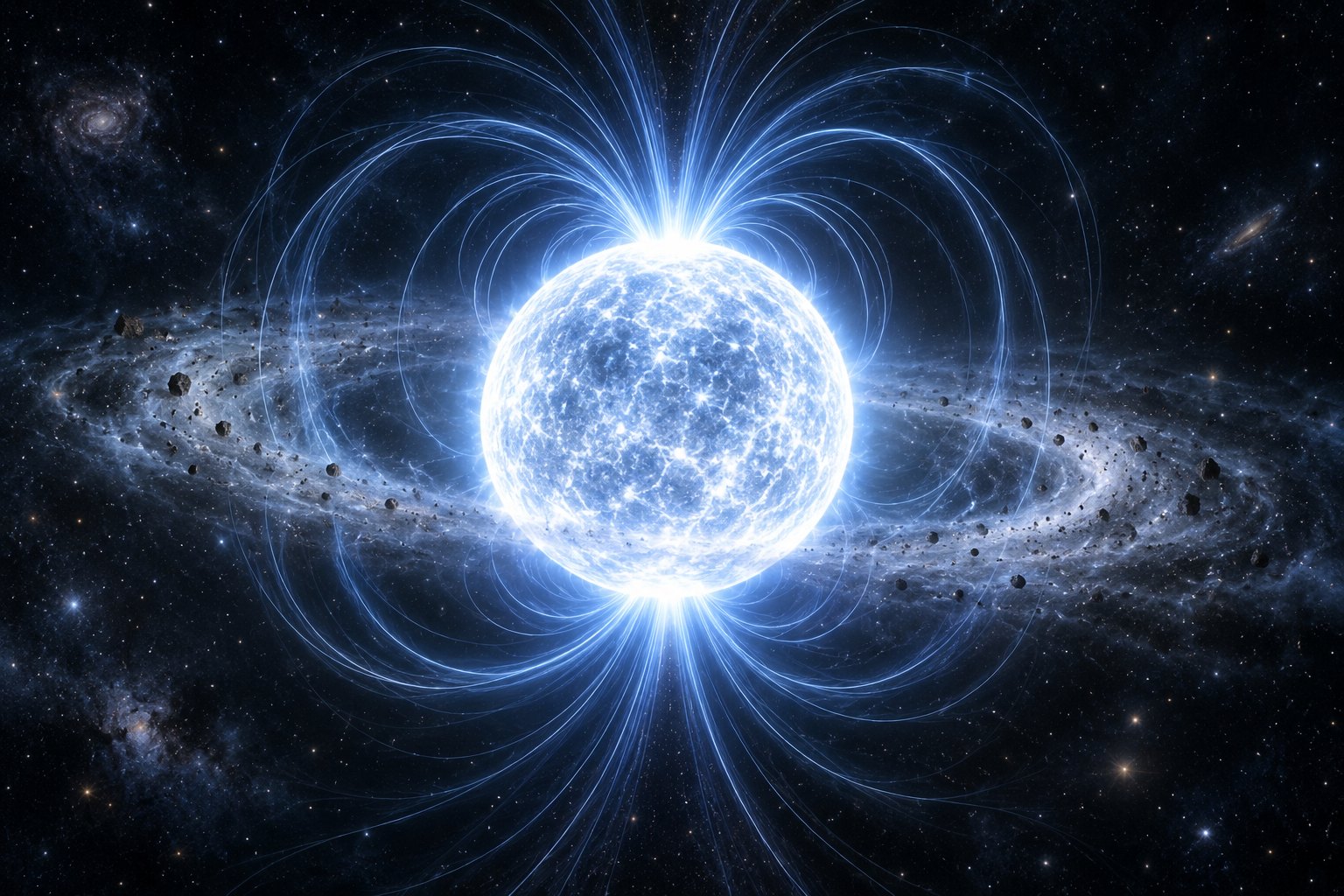
Simulations led by the Indian Institute of Science (IISc), Bengaluru, show that strong internal magnetic fields could let a white dwarf grow well beyond the Chandrasekhar limit of about 1.4 solar masses. One magnetised model reached about 2.4 solar masses. The study, published in The Astrophysical Journal Letters, is a model result and not an observation.
Syllabus: Prelims · Science & Technology; GS3 · Indian Achievements in S&T; GS3 · IT, Space, Biotech & IPR
Why it matters
An astronomer measuring the distance to a faraway galaxy counts on Type Ia supernovae reaching nearly the same peak brightness. That rests on white dwarfs exploding close to one fixed mass. If some white dwarfs grow much heavier before exploding, those explosions could be brighter, and distances worked out from them might need correcting. The same supernovae showed in 1998 that the universe is expanding faster with time, so the question touches the basic picture of the cosmos. The result is a possibility shown on a computer, which telescopes still have to confirm. It also shows researchers in India extending the work of an Indian-born Nobel laureate, with a PhD student as first author.
Prelims pointers
- White dwarf: the Earth-sized remnant core of a low or medium-mass star; it has stopped fusion and slowly cools. The Sun will end as one.
- Electron degeneracy pressure: arises from the Pauli exclusion principle, which bars two electrons from occupying the same quantum state; it does not depend on heat.
- Chandrasekhar limit: about 1.4 solar masses, the most a white dwarf can weigh while electron degeneracy pressure holds it up.
- Subrahmanyan Chandrasekhar: Indian-born astrophysicist; shared the 1983 Nobel Prize in Physics with William A. Fowler. NASA's Chandra X-ray Observatory is named after him.
- Type Ia supernova: the thermonuclear explosion of a carbon-oxygen white dwarf that gains matter in a binary system. A core-collapse supernova is the death of a massive star.
- A heavier collapsing core becomes a neutron star, held up by neutron degeneracy pressure; a still heavier one becomes a black hole.
- Standard candles: objects of known true brightness; comparing it with how bright they appear from Earth gives their distance.
- The 2011 Nobel Prize in Physics went to Saul Perlmutter, Brian P. Schmidt and Adam G. Riess for finding the accelerating expansion; its cause is called dark energy.
Practise a UPSC-style question
With reference to white dwarfs, consider the following statements:
1. A white dwarf is the remnant core of a star like the Sun that has exhausted its nuclear fuel.
2. A white dwarf no longer produces energy by nuclear fusion and gradually cools over time.
Which of the statements given above is/are correct?
- (a) 1 only
- (b) 2 only
- (c) Both 1 and 2
- (d) Neither 1 nor 2
Show the answer
Answer: (c) Both 1 and 2
1 is correct: when a star like the Sun runs out of fuel and sheds its outer layers, the roughly Earth-sized core left behind is a white dwarf. 2 is correct: a white dwarf makes no new heat by fusion; it is held up by electron degeneracy pressure and slowly cools.
More from the 10 October 2026 edition
- WHO uses International Health Regulations to verify Russian lab worker's death World & IR
- PM Dhan-Dhaanya Krishi Yojana: all 100 districts have action plans Economy
- Sarus crane: BNHS holds all-India count to set national baseline Environment
- NIA invokes Anti-Hijacking Act, 2016 over attack on Indian pilot abroad Polity
- External Affairs Standing Committee seeks public technology strategy document Polity
- Draft Drugs Rules amendment extends prescription-drug ad curb to chemists National
- Form 7 for voter-roll deletions: Election Commission caps filings at 10 Polity
- MoSPI proposes expenditure-side Gross State Domestic Product estimates for all States Economy
- RBI raises daily CRR maintenance floor to 99%, plans OMO sale Economy
- Inter-Parliamentary Union elects new President as 153rd Assembly closes in Arusha World & IR
- SEBI notifies Settlement Regulations, 2026 with a fast-track route Economy
- Bab el-Mandeb Strait: Yemen's war reaches the Red Sea chokepoint World & IR