
Punjab's groundwater extraction rate eases to 152%; 110 of 153 blocks over-exploited
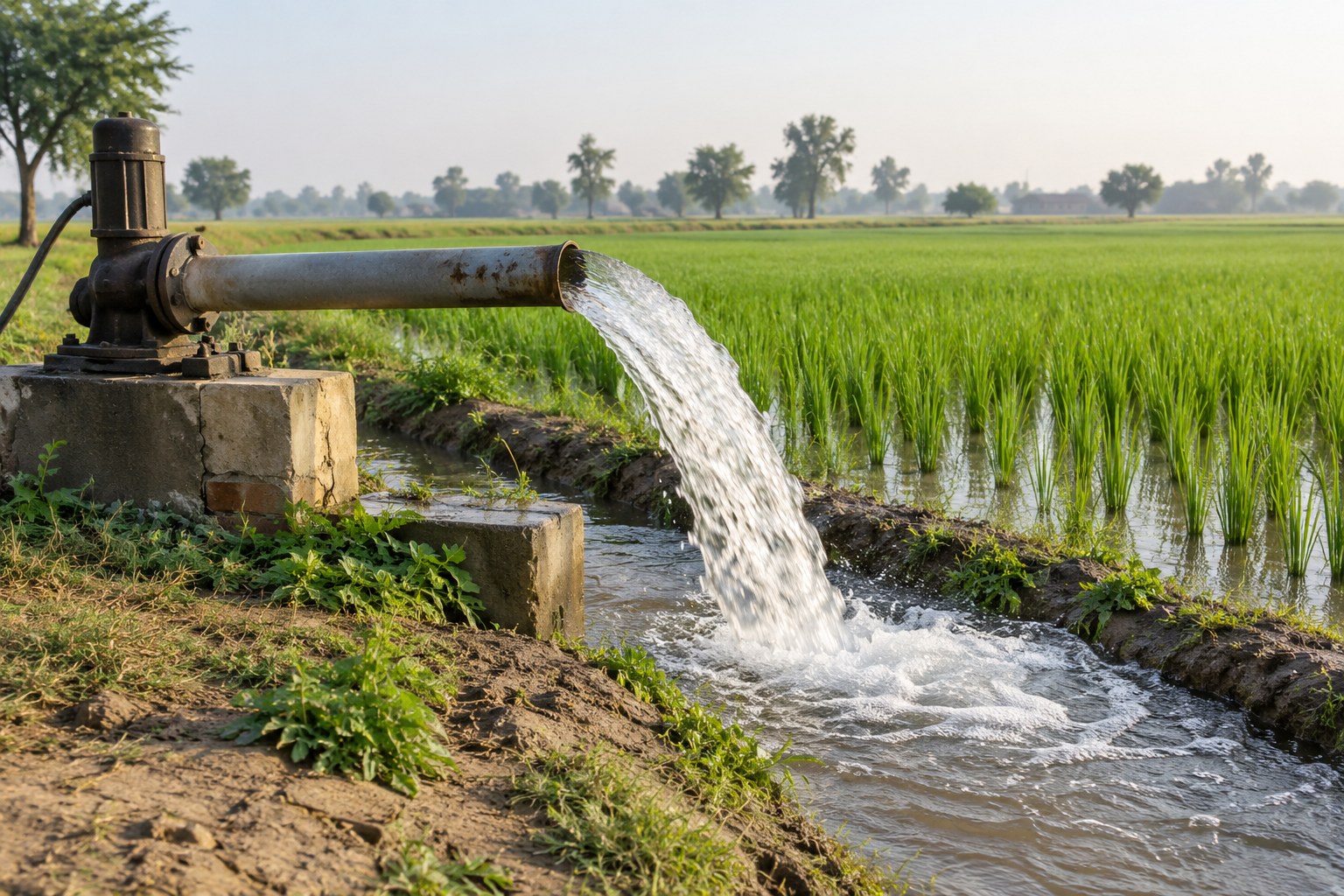
Punjab extracted 26.32 billion cubic metres (BCM) of groundwater in 2025-26 against an annual extractable resource of 17.29 BCM, its latest Dynamic Ground Water Resource Assessment shows: a stage of groundwater extraction of 152.22%, down from 156.36% in the 2025 national assessment. Of its 153 assessment blocks, 110 are over-exploited and only 20 safe. Irrigation alone drew 24.95 BCM.
Syllabus: GS3 · Agriculture & Irrigation; GS3 · MSP, Subsidies & Food Security; Prelims · Environment & Ecology
Why it matters
A Punjab farmer running a tubewell is drawing on aquifers that the State empties about one and a half times as fast as they can sustainably yield. Irrigation accounts for roughly 95 of every 100 litres pumped, so the remedy lies on the farm: more canal water, crop diversification and more efficient irrigation, the measures the authorities are pushing. The label a block carries has consequences too. In over-exploited blocks the Central Ground Water Authority's guidelines bar new large-scale industries, and stressed blocks face higher extraction charges. The fall from 156.36% in the 2025 national assessment to 152.22% is an improvement, yet 110 of Punjab's 153 blocks are still over-exploited and only 20 are safe.
Prelims pointers
- Central Ground Water Board (CGWB): the national apex agency for groundwater, under the Ministry of Jal Shakti; formed in 1970 from the Exploratory Tube wells Organization; headquartered at Faridabad.
- Stage of groundwater extraction: annual groundwater extraction for all uses (irrigation, industrial, domestic) as a percentage of the annual extractable groundwater resource.
- Categories by stage of extraction: safe below 70%, semi-critical 70% to 90%, critical 90% to 100%, over-exploited above 100%.
- Central Ground Water Authority: constituted under the Environment (Protection) Act, 1986 to regulate and control groundwater extraction; its guidelines of September 2020 apply across India.
- Water is Entry 17 of the State List, subject to Entry 56 of the Union List on inter-State rivers and river valleys.
- Atal Bhujal Yojana: community-led groundwater management in 80 water-stressed districts of seven States: Gujarat, Haryana, Karnataka, Madhya Pradesh, Maharashtra, Rajasthan and Uttar Pradesh.
- Punjab Preservation of Subsoil Water Act, 2009: bars farmers from sowing paddy nursery or transplanting paddy before the dates the State government notifies.
Practise a UPSC-style question
With reference to the Dynamic Groundwater Assessment, consider the following statements:
1. A unit is classed as over-exploited when its annual groundwater extraction exceeds its annual extractable groundwater resource.
2. It is carried out jointly by the Central Ground Water Board and the State groundwater departments.
3. The Central Ground Water Board functions under the Ministry of Environment, Forest and Climate Change.
Which of the statements given above is/are correct?
- (a) 1 and 2 only
- (b) 2 and 3 only
- (c) 1 and 3 only
- (d) 1, 2 and 3
Show the answer
Answer: (a) 1 and 2 only
1 is correct: a stage of extraction above 100% of the annual extractable resource marks a unit as over-exploited; Punjab's 152% is far above that. 2 is correct: the assessment is a joint exercise of the CGWB and the State groundwater departments. 3 is incorrect: the CGWB comes under the Ministry of Jal Shakti, not the Environment Ministry.
More from the 23 September 2026 edition
- Election Commission freezes Trinamool Congress name and symbol Polity
- FCRA Amendment Bill 2026 would vest lapsed NGOs' foreign assets in government Polity
- ISRO and ESA renew space cooperation till 2032 Sci-Tech
- Centre doubles environmental clearance validity for ports to 20 years Environment
- Supreme Court holds UP Gangsters Act 'stillborn' Polity
- US law provides for up to 100% tariffs on top Russian-oil buyers World & IR
- 0.4% MDR on UPI merchant payments above Rs 2,000 from October 15 Economy
- BRICS Delhi Declaration notes UNSC Resolution 2803, reaffirms 1967 borders World & IR
- India-New Zealand free trade agreement takes effect October 20 Economy