
DRDO's Air Independent Propulsion module for submarines enters Setting to Work Phase-2
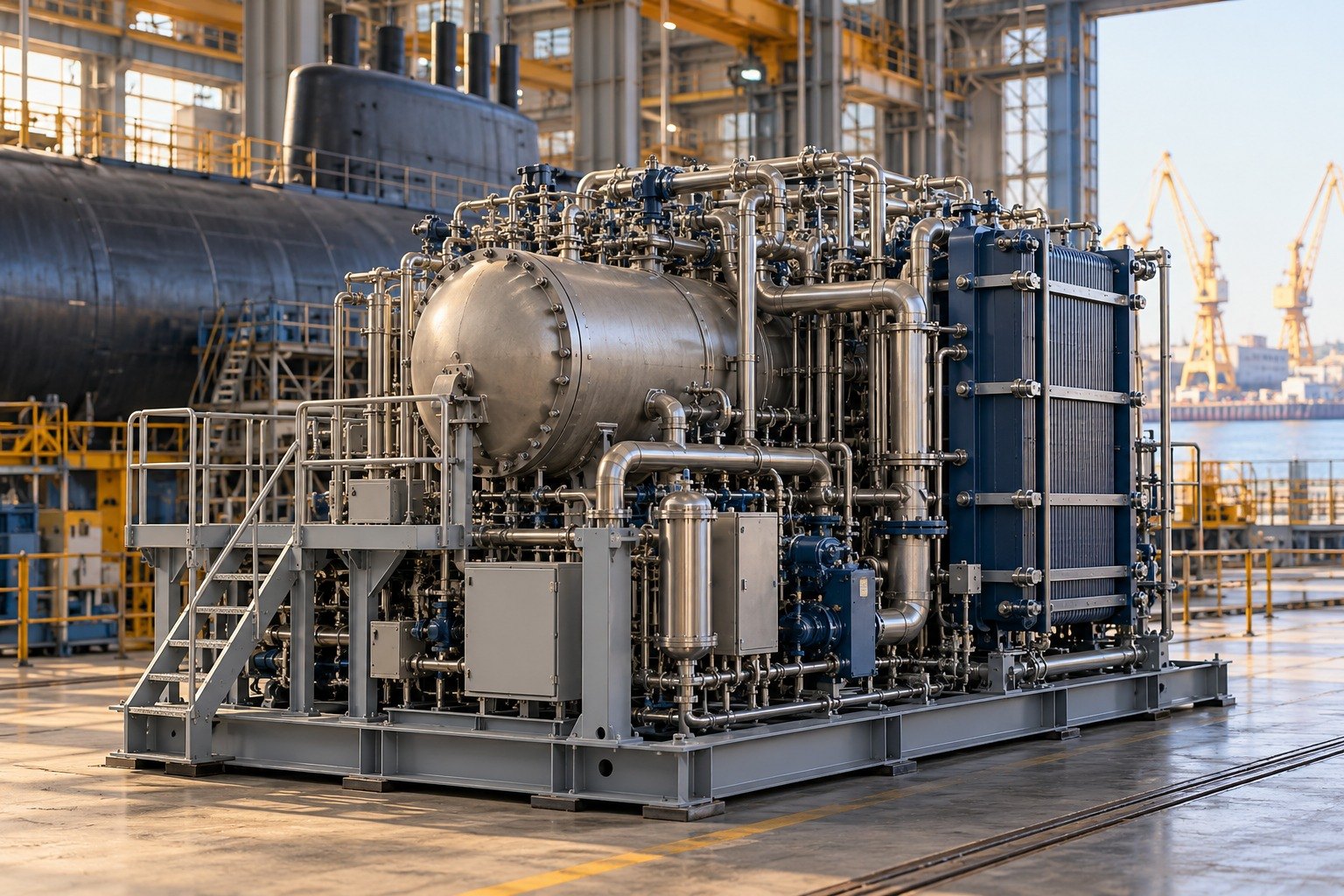
The Defence Research and Development Organisation's indigenous Air Independent Propulsion (AIP) energy module entered Setting to Work Phase-2 on 24 October 2026 at a Larsen and Toubro plant in Gujarat. AIP lets diesel-electric submarines stay underwater longer by cutting their need for atmospheric oxygen. The module is to be fitted on a Kalvari-class submarine in early 2027.
Syllabus: Prelims · Current Affairs & IR; GS3 · Science & Technology; GS3 · Indian Achievements in S&T
Why this matters for UPSC
GS3 covers indigenisation of technology and defence. Prelims can ask how Air Independent Propulsion and a fuel cell work, what Project-75 and the Kalvari class are, and which body built what; Mains, about self-reliance in submarine technology.
Why it matters
A submarine is useful only while it stays hidden. The less time a conventional boat must spend near the surface, the harder it is for enemy aircraft, ships or radar to find. Longer stays underwater mean longer patrols at sea with less exposure, which strengthens the Navy's ability to watch and deter at sea. Building the system at home also matters: a module designed in an Indian laboratory and made by Indian industry can be repaired, upgraded and repeated on later boats without waiting on a foreign supplier. The larger question is how far India can close the gap between conventional and nuclear-powered submarines through its own technology.
Prelims pointers
- NMRL is located at Ambernath, Maharashtra; its AIP land-based prototype was developed with industry partners L&T and Thermax.
- Project-75 built six Scorpene submarines at Mazagon Dock, Mumbai, with Naval Group, France: INS Kalvari was the first, INS Vaghsheer the sixth and last.
- PEM fuel cell: hydrogen is oxidised at the anode, protons cross a polymer membrane to the cathode and react with oxygen, giving electricity and water vapour.
- Types of AIP: several are pursued internationally; PIB (2021) calls NMRL's fuel-cell design unique because it generates hydrogen onboard.
- INS Arihant, India's first indigenous nuclear-powered submarine, runs on a nuclear propulsion reactor; DRDO's AIP is meant to extend the endurance of conventional submarines.
- DRDO's head is the Secretary, Department of Defence Research and Development, Ministry of Defence, who is also Chairman DRDO.
Practise a UPSC-style question
With reference to fuel cells and Air Independent Propulsion (AIP), consider the following statements:
1. A fuel cell produces electricity by burning hydrogen, giving carbon dioxide as its by-product.
2. In a proton exchange membrane fuel cell, protons pass through a polymer membrane from the anode to the cathode.
3. The fuel-cell AIP developed by DRDO's Naval Materials Research Laboratory generates its hydrogen on board.
Which of the statements given above is/are correct?
- (a) 1 and 2 only
- (b) 2 and 3 only
- (c) 1 and 3 only
- (d) 1, 2 and 3
Show the answer
Answer: (b) 2 and 3 only
Answer: (b) 2 and 3 only. A fuel cell works electrochemically, not by burning, and NMRL's cell makes its own hydrogen.
Statement 1: incorrect. A fuel cell combines hydrogen and oxygen through an electrochemical reaction, not combustion; a PEM fuel cell gives electricity and water vapour, not carbon dioxide.
Statement 2: correct. PIB (3 March 2025) says hydrogen is oxidised at the anode of a PEM fuel cell and the protons travel through a polymer membrane to the cathode.
Statement 3: correct. PIB releases of 2021 and 2023 call NMRL's fuel-cell AIP unique because the hydrogen is generated onboard.
Eliminate: Judge statement 1 first: a hydrogen fuel cell burns nothing and has no carbon to release. Out: (a), (c), (d).
Trap: Sounds right. Hydrogen is a fuel, so statement 1 borrows the picture of an engine burning it; a fuel cell works without combustion and a hydrogen cell has no carbon to release.
Remember: Fuel cell = hydrogen + oxygen to electricity + water, no combustion.
More from the 25 October 2026 edition
- Road Ministry seeks CERT-In audit of VAHAN, SARATHI over data on sale Sci-Tech
- Bundibugyo Ebola: TUMAINI vaccine trial starts in DR Congo; outbreak reaches Nigeria Sci-Tech
- MHA's Ladakh draft: proposed Article 371K body, regulations need L-G assent Polity
- DGHS bars reuse of single-use medical devices in all hospitals National
- AgriStack and the Farmer ID: how India's farmer registry works Economy