
ARIES-coordinated decade-long study tracks binary black hole blazar OJ 287
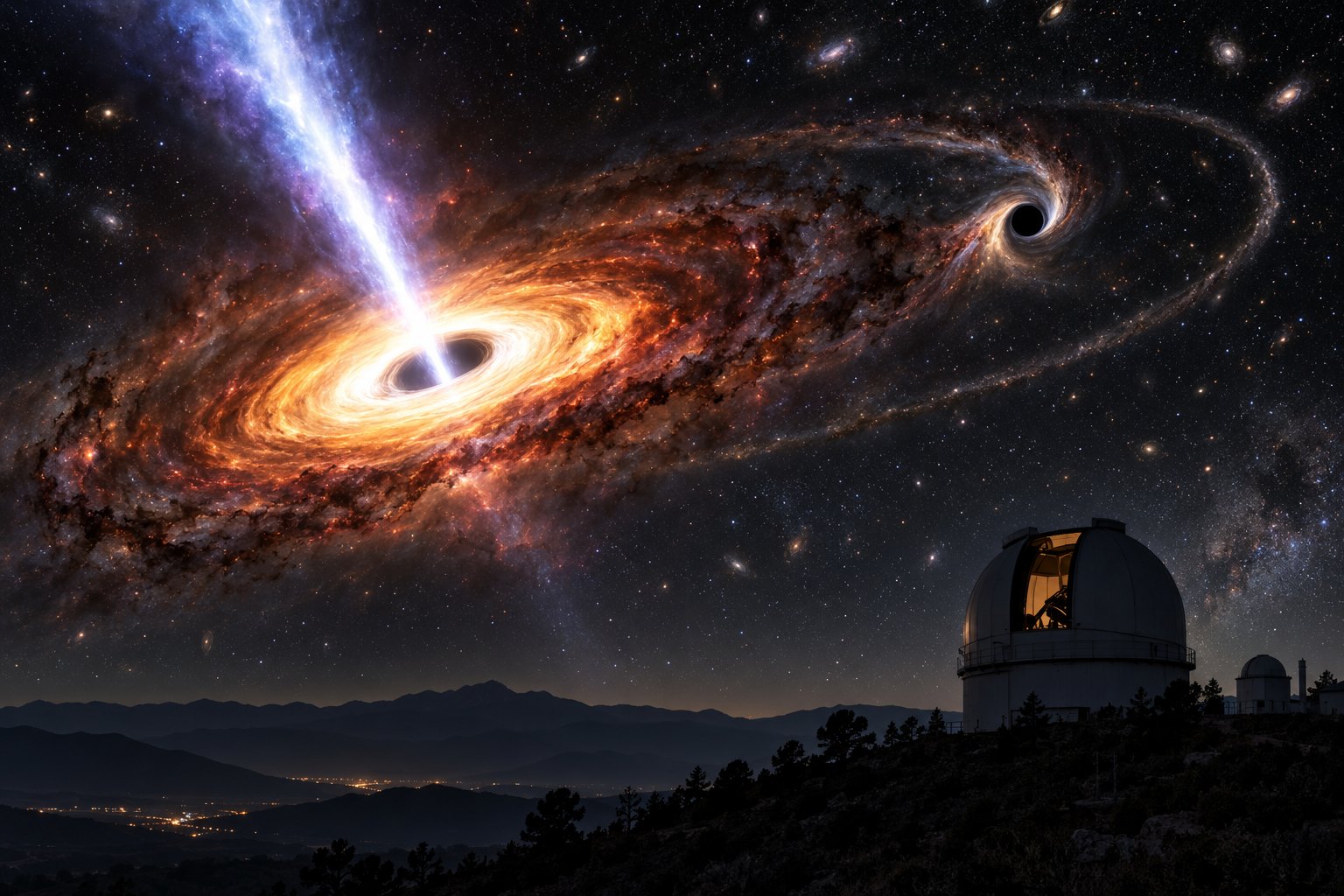
A study coordinated by the Aryabhatta Research Institute of Observational Sciences (ARIES), Nainital, has tracked the brightness and colour of the blazar OJ 287 from 2015 to 2025, the Department of Science and Technology said on October 6, 2026. OJ 287, about 4 billion light-years away, holds two supermassive black holes on a roughly 12-year orbit.
Syllabus: Prelims · Current Affairs & IR; Prelims · Science & Technology; GS3 · Indian Achievements in S&T
Why it matters
For an astronomer, OJ 287 is a rare natural laboratory: two giant black holes circle each other closely enough for the motion to show up as a repeating flicker in visible light. Ten years of dense, multi-colour data help pin down where each black hole sits in its orbit, test whether the smaller one leaves its own signal, and show how the jet's light changes over short spans and over years. Pairs like this are expected to send out low-frequency gravitational waves as they spiral together, so knowing their light helps match future gravitational-wave signals with what telescopes see. For India, the study puts an Indian institute at the head of a 48-institution campaign in time-domain astronomy.
Prelims pointers
- Blazar: an AGN whose relativistic jet points nearly at Earth; Doppler beaming makes it bright from radio waves to gamma rays; almost all extragalactic Fermi gamma-ray sources are blazars.
- Active galactic nucleus: powered by accretion onto a supermassive black hole; quasars, radio galaxies and blazars are AGN seen from different angles.
- Gravitational waves: predicted by Einstein in 1916 from his general theory of relativity; first detected by LIGO on September 14, 2015, from two merging black holes.
- Pairs of supermassive black holes give very low-frequency gravitational waves, sought by pulsar timing arrays and the planned ESA-NASA mission LISA, not by ground-based LIGO.
- Multi-messenger astronomy: the neutron-star merger of August 17, 2017 was the first event seen in both gravitational waves and light, from gamma rays to radio waves.
- ARIES: began in 1954 as the Uttar Pradesh State Observatory at Varanasi; DST autonomous institute since 2004; runs the 3.6-m Devasthal Optical Telescope and 4-m International Liquid Mirror Telescope.
- Other astronomy institutes: Indian Institute of Astrophysics, Bengaluru (DST; Hanle and Kavalur observatories); Physical Research Laboratory, Ahmedabad (Department of Space); GMRT near Pune (NCRA-TIFR).
- Event Horizon Telescope: first black-hole image, M87*, in 2019; Sagittarius A*, at the Milky Way's centre, about four million solar masses, imaged in 2022.
Practise a UPSC-style question
With reference to active galactic nuclei, consider the following statements:
1. Most large galaxies are thought to host a supermassive black hole at their centre.
2. An active galactic nucleus is powered by matter falling onto a supermassive black hole.
3. A blazar is an active galactic nucleus whose jet points nearly towards the Earth.
Which of the statements given above is/are correct?
- (a) 1 and 2 only
- (b) 2 and 3 only
- (c) 1 and 3 only
- (d) 1, 2 and 3
Show the answer
Answer: (d) 1, 2 and 3
1 is correct: astronomers think most, if not all, large galaxies, the Milky Way included, have a supermassive black hole at the centre. 2 is correct: the light of an active galactic nucleus comes from gas heated as it spirals onto the black hole through an accretion disc. 3 is correct: a blazar such as OJ 287 is an active galactic nucleus seen almost straight down its jet.
More from the 6 October 2026 edition
- eSanjeevani crosses 50 crore teleconsultations, adds AI support and ERSS-112 link National
- Defence Ministry signs ₹661.5-crore BrahMos fire-control deal under Buy (Indian-IDDM) Defence
- DRDO's Advanced High-Altitude Parachute makes maiden live jump at Nyoma, Ladakh Defence
- DRDO flies stratospheric High-Altitude Platform to 21 km Sci-Tech
- CAQM orders NCR industries to install PTZ cameras over fuel areas Environment
- Rural Development Ministry notifies 375 permissible works under VB–G RAM G Economy
- GSTN introduces Multistate Registration facility for businesses in several states Economy
- Bengal SIR tribunal judges flag gaps in Election Commission portal Polity
- India's services PMI reaches three-month high of 55.2 Economy
- HAL Koraput delivers 2,000th aero-engine; second Shakti line announced Defence