
Rural Development Ministry notifies 375 permissible works under VB–G RAM G
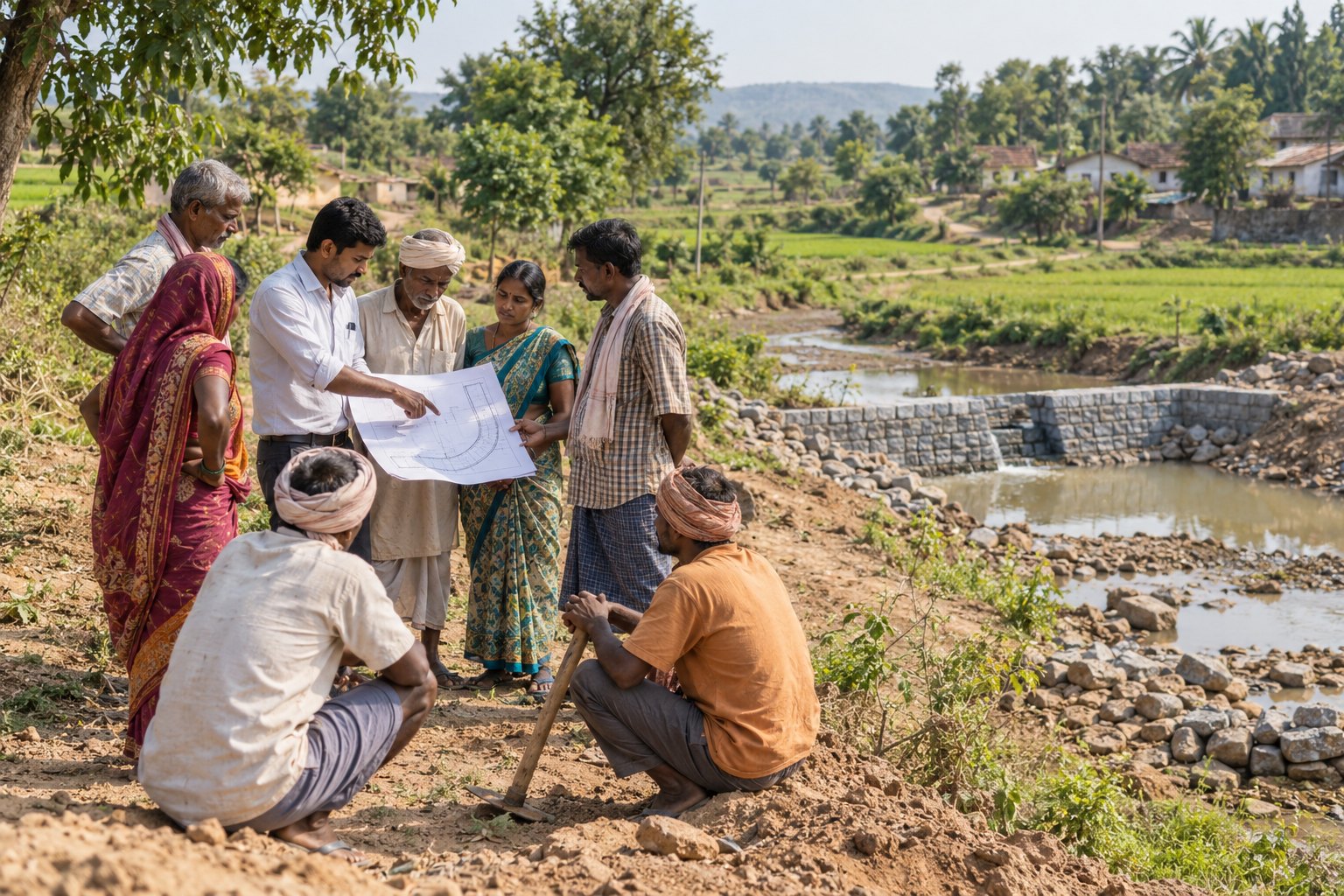
The Ministry of Rural Development announced on October 6, 2026 that it has notified 375 permissible works under the VB–G RAM G Act, 2025, the law that replaced MGNREGA. That is 41% more than the 266 works of the earlier framework. Water Security has 128 works, Core Rural Infrastructure 111, Livelihood-related Infrastructure 98, and a first-ever disaster-preparedness category 38.
Syllabus: GS3 · Indian Economy & Growth; GS2 · Federalism & Local Government; GS2 · Welfare of Vulnerable Sections
Why it matters
A landless labourer in a dry village can be paid to build a check dam, a workshed for a women's Self-Help Group or a flood relief shelter, and the village keeps the asset after the wages are spent. Livelihood works such as cold storage and grading units made up 1.1% of the old list and are 26% of the new one, so wage work can now raise farm incomes directly. The disaster pillar lets villages build embankments and fire lines before a flood or forest fire strikes. Whether a longer list becomes timely work and wages depends on Gram Sabha planning and on States paying their 40% share.
Prelims pointers
- Article 41: the State shall, within its economic capacity, secure the right to work. It is one of the Directive Principles of State Policy, not a Fundamental Right.
- Article 37: Directive Principles are not enforceable by any court but are fundamental in governance. Article 40 directs the State to organise village panchayats.
- Gram Sabha, Article 243(b): all persons on the electoral rolls of a village within a village-level Panchayat area. Article 243A: State law sets its powers.
- Article 243G: State legislatures may empower Panchayats to prepare and implement plans for economic development and social justice, including Eleventh Schedule matters.
- Eleventh Schedule: 29 subjects added by the Constitution (73rd Amendment) Act, 1992, including minor irrigation and watershed development, poverty alleviation and maintenance of community assets.
- Drip irrigation delivers water drop by drop at plant roots; with sprinklers it makes up micro-irrigation, which uses less water than flooding fields.
- Recharge shafts and injection wells carry surface water down into aquifers; both are methods of artificial recharge of groundwater.
Practise a UPSC-style question
With reference to the Gram Sabha under the Constitution of India, consider the following statements:
1. It consists of the members elected to the Panchayat at the village level.
2. It exercises such powers and functions at the village level as the Legislature of a State may provide by law.
Which of the statements given above is/are correct?
- (a) 1 only
- (b) 2 only
- (c) Both 1 and 2
- (d) Neither 1 nor 2
Show the answer
Answer: (b) 2 only
1 is incorrect: under Article 243(b), the Gram Sabha is the body of all persons registered in the electoral rolls of a village within a village-level Panchayat area, not the elected members. 2 is correct: Article 243A leaves the Gram Sabha's powers and functions to be set by State law.
More from the 6 October 2026 edition
- eSanjeevani crosses 50 crore teleconsultations, adds AI support and ERSS-112 link National
- Defence Ministry signs ₹661.5-crore BrahMos fire-control deal under Buy (Indian-IDDM) Defence
- DRDO's Advanced High-Altitude Parachute makes maiden live jump at Nyoma, Ladakh Defence
- ARIES-coordinated decade-long study tracks binary black hole blazar OJ 287 Sci-Tech
- DRDO flies stratospheric High-Altitude Platform to 21 km Sci-Tech
- CAQM orders NCR industries to install PTZ cameras over fuel areas Environment
- GSTN introduces Multistate Registration facility for businesses in several states Economy
- Bengal SIR tribunal judges flag gaps in Election Commission portal Polity
- India's services PMI reaches three-month high of 55.2 Economy
- HAL Koraput delivers 2,000th aero-engine; second Shakti line announced Defence