
Wheat MSP rises just ₹25 as Cabinet clears 2027-28 rabi prices
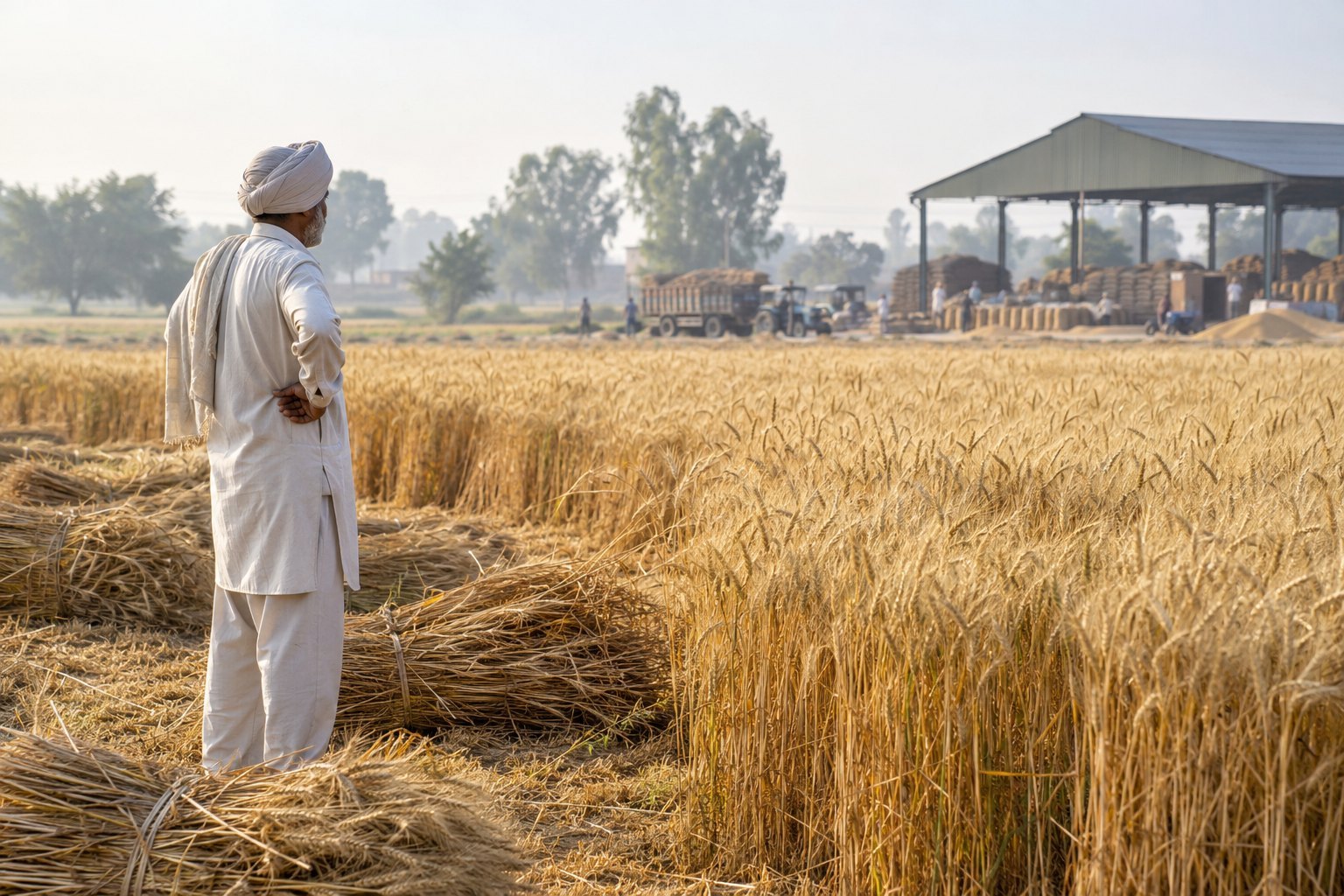
The Cabinet Committee on Economic Affairs on September 30 raised minimum support prices for all six mandated rabi crops for the 2027-28 marketing season. Wheat got only ₹25 more, to ₹2,610 per quintal, its smallest absolute hike since 2010-11. Safflower gained the most, rising ₹675 to ₹7,215, while rapeseed-mustard climbed ₹413 to ₹6,613.
Syllabus: Prelims · Current Affairs & IR; GS3 · Agriculture & Irrigation; GS3 · MSP, Subsidies & Food Security
Why it matters
A farmer deciding what to sow this October reads the signal in the price list: wheat fetches ₹25 more a quintal, while safflower, mustard and lentil fetch ₹390 to ₹675 more. The Government says it has been promoting pulses and oilseeds over cereals through higher MSPs, to incentivise crop diversification, and the Agriculture Minister said wheat stocks are many times the requirement. Yet wheat keeps the widest margin over cost, 106%, and assured buying favours it: of 3,921 lakh tonnes of the six rabi crops procured in 2014-15 to 2025-26, 3,715 lakh tonnes was wheat. The modest rise comes before Assembly elections early in 2027 in Uttar Pradesh and Punjab, both major wheat-growing States.
Prelims pointers
- Commission for Agricultural Costs and Prices (CACP): attached office of the Ministry of Agriculture and Farmers Welfare; set up in 1965 as the Agricultural Prices Commission; renamed in 1985.
- MSP covers 22 mandated crops: 14 kharif, 6 rabi and 2 commercial crops (jute and copra). Sugarcane gets a Fair and Remunerative Price instead.
- Six mandated rabi crops: wheat, barley, gram, lentil (masur), rapeseed and mustard, and safflower.
- Cost A2+FL: paid-out costs plus the imputed value of family labour. Cost C2 also adds the rental value of owned land and interest on owned fixed capital.
- 1.5-times rule: announced in Union Budget 2018-19. The margin of at least 50% is reckoned on A2+FL; the CACP uses C2 as a reference cost.
- Legal status: MSP is an administrative decision with no statutory backing; the CACP was set up by resolution, not an Act. Sugarcane's FRP rests on the Sugarcane (Control) Order, 1966.
- Procurement: FCI and State agencies buy cereals; NAFED and NCCF buy pulses, oilseeds and copra under the Price Support Scheme of PM-AASHA when market prices fall below MSP.
- One MSP applies to the whole country; it is not State-specific. The National Commission on Farmers, headed by M.S. Swaminathan, recommended MSP at least 50% above weighted average cost.
Practise a UPSC-style question
Consider the following statements about the Minimum Support Prices approved for rabi crops of Marketing Season 2027-28:
1. Safflower received the largest increase in rupees per quintal among the six mandated crops.
2. Wheat carries the highest margin over the all-India weighted average cost of production.
3. Safflower carries a higher margin over cost than rapeseed and mustard.
Which of the statements given above is/are correct?
- (a) 1 and 2 only
- (b) 2 and 3 only
- (c) 1 and 3 only
- (d) 1, 2 and 3
Show the answer
Answer: (a) 1 and 2 only
1 is correct: safflower rose by ₹675 to ₹7,215 per quintal, the largest increase; wheat rose by ₹25 to ₹2,610, the smallest. 2 is correct: wheat's margin over cost is 106%, the highest of the six. 3 is incorrect: safflower's margin is 50%, the lowest of the six and equal to the assured minimum, against 96% for rapeseed and mustard.