
Supreme Court orders penalties where Yamuna water worsens, protects its floodplain
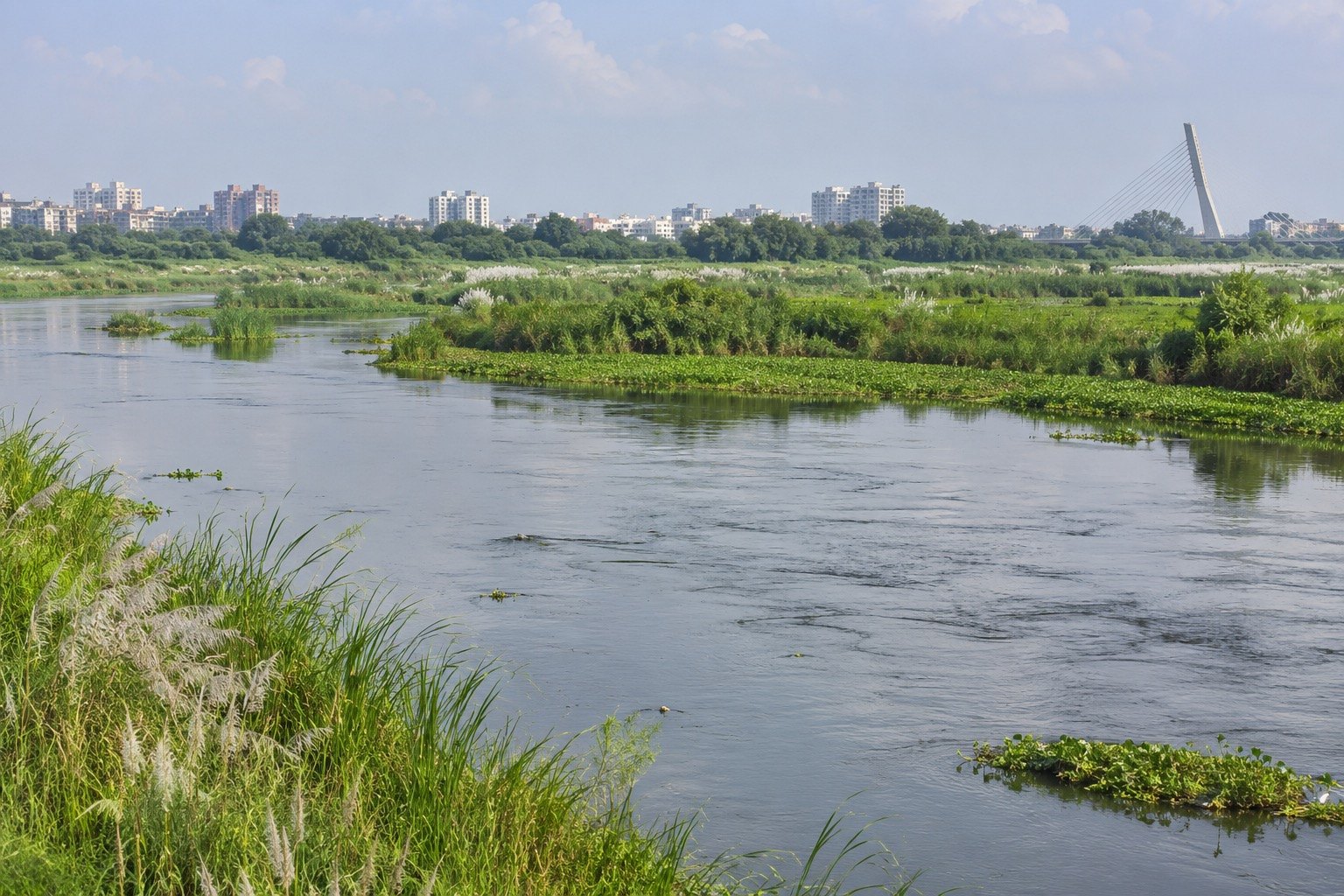
In a 4 November 2026 order, the Supreme Court directed that any State, Union territory or district where the Yamuna's water worsens be penalised. The Central Pollution Control Board (CPCB) must report the river's quality where it enters and leaves each. The court also ordered surprise sampling of sewage treatment plants and protection of the Zone 'O' floodplain.
Syllabus: Prelims · Geography; Prelims · Environment & Ecology; GS2 · Statutory & Regulatory Bodies
Why this matters for UPSC
GS3 environment: river pollution, floodplains and the Water (Prevention and Control of Pollution) Act, 1974. Prelims can ask the Yamuna's course and the CPCB's role; Mains, accountability for inter-State pollution.
Why it matters
A family in a town downstream of Delhi gets the Yamuna after the capital's drains have emptied into it. Until now, each government along the river could point to the one upstream. Measuring the water as it enters and leaves every State, Union territory and district makes that blame checkable, and would send the bill to the place that dirtied the river. Live power meters on treatment plants mean an idle plant can no longer pass for a working one. Keeping the floodplain free of new buildings leaves the river room to spread in a flood, so fewer homes stand in its way. The test is whether court supervision can achieve what large spending on cleaning the river has not.
Prelims pointers
- The Yamuna rises at the Yamunotri glacier in Uttarkashi district, Uttarakhand, and joins the Ganga at Prayagraj (Allahabad) (Central Water Commission).
- The Tons and the Giri join the Yamuna in its first 170 km in the hills; the Chambal joins it far downstream of Delhi, before the Ganga confluence.
- The Yamuna's catchment covers parts of Uttarakhand, Himachal Pradesh, Haryana, Delhi, Uttar Pradesh, Rajasthan and Madhya Pradesh, about 40% of the Ganga basin (Central Water Commission).
- Besides the Water Act, the Air (Prevention and Control of Pollution) Act, 1981 gives the CPCB powers; the board works under the Ministry of Environment, Forest and Climate Change.
- The Water (Prevention and Control of Pollution) Amendment Act, 2024 applied at first in Himachal Pradesh, Rajasthan and the Union territories; other States come under it on adopting it.
- No State board is formed for a Union territory; the CPCB may delegate its powers there, for instance to a Pollution Control Committee.
- The Yamuna Action Plan aided by the Japan International Cooperation Agency since 1993 (Phase III under the National River Conservation Plan) differs from the draft by the Home Secretary's committee.
- The CPCB treats a river location with BOD above 3 mg/l as missing the desired water-quality criteria; above 6 mg/l, dissolved oxygen falls below desired levels.
Practise a UPSC-style question
With reference to the river Yamuna, consider the following statements:
1. It rises from the Gangotri glacier in Uttarkashi district of Uttarakhand.
2. The Tons and the Giri are tributaries that join it in its upper course.
3. It merges with the Ganga at Prayagraj in Uttar Pradesh.
Which of the statements given above is/are correct?
- (a) 1 and 2 only
- (b) 2 and 3 only
- (c) 1 and 3 only
- (d) 1, 2 and 3
Show the answer
Answer: (b) 2 and 3 only
Answer: (b) 2 and 3 only. The Yamuna rises at the Yamunotri glacier, not Gangotri, and meets the Ganga at Prayagraj.
Statement 1: incorrect. The Central Water Commission records the Yamuna's source as the Yamunotri glacier near the Banderpoonch peaks in Uttarkashi district, Uttarakhand.
Statement 2: correct. Within its first 170 km in the hills, the Yamuna receives the Tons and the Giri, along with the Rishi Ganga, Kunta and Hanuman Ganga.
Statement 3: correct. After its course through the plains, the Yamuna joins the Ganga at Prayag (Allahabad), now Prayagraj.
Eliminate: Be surest of statement 1: the Yamuna's source is Yamunotri, so it is incorrect. Out: (a), (c), (d).
Trap: Look-alike names. Yamunotri and Gangotri are both Himalayan glaciers in Uttarakhand, and the statement gives the Yamuna the wrong one.
Remember: Yamuna: Yamunotri glacier (Uttarkashi) to Prayagraj; Tons and Giri join in the hills.
More from the 18 November 2026 edition
- India backs rules-based Indo-Pacific, seafarers' safety at 21st East Asia Summit World & IR
- Supreme Court: resolution plans must pay dissenting financial creditors in money Economy
- At COP31, India backs a two-tier, Party-guided Just Transition Mechanism Environment
- 23rd India-ASEAN Summit in Manila: India proposes maritime plan, free e-visa World & IR
- Indian Oil's Panipat sustainable aviation fuel plant gets approvals, makes first batch Environment